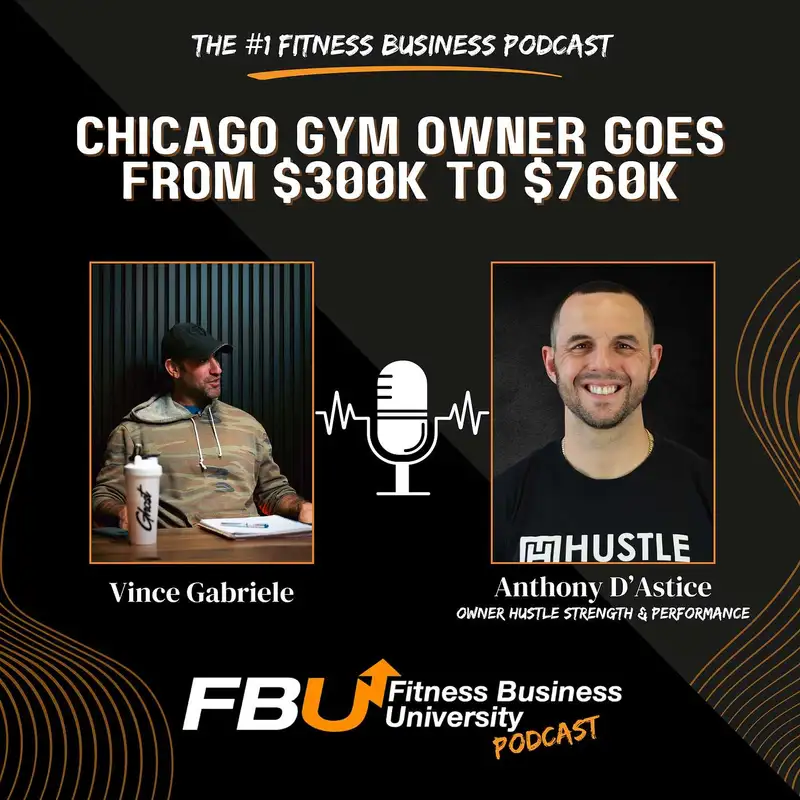
Chicago Gym Owner Goes from $300k to $760K
SPEAKER_01: What's up, guys?
Welcome to another episode of
the FBU podcast.
Many of you know that I've been
doing this podcast for almost a
decade now.
And most of the time it's me
speaking, yakking into the butt
of my phone while my kids are at
jujitsu in the parking lot.
And we've been able to uh
acquire the number one spot in
the fitness business podcast
space.
We are the number one ranked
podcast in the fitness business
space.
And that's not by my mom, and
that's not by my wife Vanessa.
That is by some very obscure
website that probably found some
algorithm and spit something
out.
And but at number one spots in
number one spot.
So we'll take it.
But one of the things I really
enjoy doing is interviews, is
sitting down and talking to
people, and not just you know
gym owners in the and you know,
um that are like my colleagues
and friends, but clients of
mine, clients uh of mine that
are in the SPF mastermind, and
that's kind of what I'm doing
today.
And I am here with Anthony, I'm
gonna get it right, Dostoce.
It's like I there's a few people
in my group that I've been
calling them the wrong name for
like five years, and finally one
time sheep asleep, they'll come
up to me be like, you know, my
name is spelled, and you were
the one that was like, I was
calling you like Diastis the
whole time, and you like, you
know, five years later you said
no, it's actually Dostoce.
Is that French or something?
SPEAKER_00: Like, how do you
it's it's actually Italian, but
I just found out I'm a little
Greek too.
SPEAKER_01: So you're a group,
yeah, yeah.
SPEAKER_00: Yeah, Greek and half
Italian.
Yeah, so it's a good mix.
SPEAKER_01: Well, we have
Anthony Dosice, he's a
phenomenal gym owner from
Chicago, he's been in our world
for a really, really long time
and has a really cool story.
We, you know, if you listen to
the podcast with Caesar
Hernandez, it was it was a big
turnaround story, and Anthony
has something similar that he's
gonna unpack today.
So, Anthony, welcome to the
show.
SPEAKER_00: What's going on,
Vince?
I'm very, very grateful to be
here, and I'm looking forward to
sharing whatever knowledge I
have for your listeners.
SPEAKER_01: Awesome, brother.
So just give us like the
background of your gym, of like,
you know, where you're located,
the type of gym you have, and
you know what things are what's
going on, what's cranking.
SPEAKER_00: Awesome, awesome.
So I run Hustle Strength to
Performance.
We're um we're a small group
personal training gym for
athletes and adults just outside
of just outside of Chicago.
We're in a town called Addison.
And we also just expanded and
opened up our second location
about 15 minutes away in Glen
Ellen.
I mean, it's serving the same
the same model over there,
working with athletes and
adults.
And you know, we're we're
grateful to be in this position
and wouldn't be here without you
know the the the guidance of
Vince and his group.
SPEAKER_01: Yeah, and we're
gonna get into like what you
have going on.
It's a lot of a lot of cool
things.
But you know, I've known you for
you know a while now, right?
I mean, it goes back to you
know, probably over a decade of
kind of been you know, been
circling around my stuff.
Yeah.
And you know, you're doing
really well now and things are
going good, but it wasn't always
that way.
SPEAKER_02: Yeah, right.
SPEAKER_01: And I think one of
the things I like to do with
these podcasts is, you know,
Anthony, I think a lot of people
they see a guy like you that's
doing well, they see, you know,
people like someone like Caesar
that you know we interviewed
before that's doing well, and
they think that like you were
always doing well, right?
They think you always know you
must have been born with two
locations, or like you were born
with and I think that these
stories are important for for
for people to hear.
So why don't you take us back?
You know, I know we were
discussing before we got on of
like where we want to start, but
why don't you just take us back
to that consulting day that you
you know had with me and let's
talk about where you were at
that point, you know.
SPEAKER_00: Absolutely.
So thinking about it just right
now, getting like I just had
flashbacks to it.
And it was, I was a I was a
nervous morning.
I flew into New Jersey and I
think it was 2022.
It was a few months before my
daughter was born.
And that was a big turning point
for me, just realizing, oh, oh
crap, I really got to start to
figure it out.
I can't be playing business, as
people like to say.
And it was it was a big turning
point in the eye opener when I
realized that hey, I was gonna
be a dad.
We were about to buy, we wanted
to buy a home.
Me and my wife sat down.
We wanted to, we had some goals
that we needed to put in place.
And I knew that something wasn't
right, not only with myself, but
also the business.
And the that consulting day, the
first one in 2022 and late 2022
was a big turning point mentally
for me.
I remember, you know, we sat
down and spent the first half of
the consulting day was spent
more on my mind than anything in
the business because, you know,
that that kind of solidified a
lot of me and you know, the
success of the business,
wherever it can be, is is based
off of me and my head and my
mind and my emotions.
So dialing in on that was a big
turning point for me.
And then, you know, we then we
got into the market.
SPEAKER_01: Let's let's stick
there for a second.
Like, what were some of the
things that you know?
I I often say I have this quote
all the time that, you know, the
number one chokehold on a
business is the psychology of
the owner.
Right.
And I can address marketing and
sales and operations all I want,
but if we don't address the
mind, you know, we're we're not
gonna get where we want to be.
And so what were the things that
you were struggling with
relative to to mindset on that
day?
SPEAKER_00: In all honesty, it
was probably my the lack of
confidence and the belief in
myself to actually go out there
and grow the business.
Because I see, I mean, in in
your group and stuff like that,
there's so many different people
with the same level or higher
levels.
I mean, it was you can get a
little discouraged easily, but
it I you kind of helped change
the mindset of, you know, this
is more, this is inspiring.
This is more of this is an
opportunity to grow.
And if things are gonna go bad
in business, you have to, you
know, and like the recently the
book you recommended at your
mastermind, the CEO sees around
the corner.
You know, I would now that is,
you know, that's something that
I really take take into
consideration to kind of see
what might be happening down the
road and to kind of expect it.
But from a mindset standpoint,
it was more of just you know,
just working on myself, number
one, and working on my my
confidence and the belief and
you know the the programs and
everything and and and all that.
SPEAKER_01: What were some of
the things that we did?
You know, this is a while now
back, but what were some of the
things that we worked on
blanking on it?
But I believe we did like a
theater of the mind, but what
were some of the tools and I
have all these kind of tools and
tactics and stuff that I use on
these days, but what were some
of the ones we used for you?
SPEAKER_00: The big thing was
you you recommended a book.
I don't remember the book.
I have it at home.
It's on my uh it's on my it's on
my bookshelf.
But we did we put a five to ten
year goal plan in place, and
then we kind of prioritized
things that it was all personal
stuff too.
And it was, you know, just we
kind of we prioritized those
things and put actions in place
to help get there.
But I honestly don't remember
the the exercises we did.
SPEAKER_01: Yeah.
So I think one of the things if
so one of the things I like to
do with people is uh to create
these uh rules for how our
business fits into our life,
right?
Deal breaker rules for how we
want business.
Because I think a lot of times
people can get like mad at their
business or angry at their
business.
And one of the things I try to
do is for you to realize that
your business is the vehicle to
give you the life that you want,
right?
And so the first thing we do is
design the life.
Like, what is the life that you
want?
What is the house you want?
What is the family you want?
What is that?
Yeah.
And then when then we reverse
engineer it.
What's the business we need to
create to do that?
SPEAKER_00: Yeah.
And that's exactly what you did.
And you, you know, look now.
I'm getting more flashbacks to
it.
And I remember that, hey, we sat
down and we said I wanted to
have one rental property in the
next three years.
And look, and looking now, I
just got the chills thinking
about it because we do have one
rental property.
We did buy a house, we we, you
know, and we did grow the
business to where we wanted it
to be at that point.
So the actions and steps, you
know, were were clear, and I
just needed to focus and
prioritize and execute on those.
SPEAKER_01: Yeah, and and for
those listening at home, I
didn't give him the book, The
Secret, which is what you sit
down and you, you know, think
about all the things that you
want, and then magically they
come into your life, right?
That that that doesn't work,
right?
What happens is you need to
decide what you want, and then
you need to go take action and
actually do the things that you
want.
So that so that that was like
the first part of our days.
Like we need to really shift
around some some limiting
beliefs that you had about
yourself and about your ability
to run a good company, right?
And I think the other thing is
too, like confidence is like uh
it it it really comes down to
you know, I always talk about my
four cornerstones of confidence,
right?
And that is one is that you have
to manage you're not gonna be
confident if you can't manage
the voice in your head.
I know we talked about that,
right?
It's a and again, it's something
that you know I've worked on
myself, but like you're not
gonna be confident if you always
have this voice in your head
telling you what a piece of crap
you are, and that you can't do
it, and it's like you never you
never so you have to learn to
manage the voice in your head,
right?
The second thing is confidence
is really all about uh skills
and abilities, right?
Skills and knowledge, right?
If you are uh don't know
anything, so I like the other
day I went to a neighbor's house
for a party.
And like all of a sudden the
conversation went to like deep,
deep, deep economics, right?
And I understand the basics of
economics, but like these guys
are this is what they do for a
living, so they're talking about
this stuff.
And it's like I didn't have any
confidence in that situation.
Of course.
I you put me on stage in front
of 500 people talking about a
gym march, I'm as confident as
they get.
But you put me in front of that
situation, I'm like, I don't
know what the other these guys
are talking about.
Right.
I wasn't confident.
So confidence is very
situational.
So really the second two things
you need one, you got to manage
a voice in your head, two, you
have to get skills and
knowledge, right?
And the third one is, and this
is a big one for you, and this
was a big one for me, is you
have to learn how to relax.
Yeah, talk about that for us.
SPEAKER_00: That's that's a
that's a work in progress.
Uh still, still to this, still,
still to this day.
But looking back in at those
times uh in 2022, I didn't know
how to react.
I mean, relax.
I was more I was more reactive
to every situation and kind of
wasn't proactive.
And it was quite simply the
first two things you mentioned
was I didn't have the reps to
and I didn't have the reps to g
to earn the confidence.
And I knew with the goals and
the the the level of business
that we wanted to grow to, I
needed to get a little bit
better, a lot better on all
those.
Because I didn't know, I didn't
know anything about marketing.
I didn't know anything about
sales.
I just wanted to train people.
I thought I was just gonna train
people all day and people were
gonna line up.
And you know, that was I thought
that was it.
So I didn't have reps to to
actually grow, and not to
mention trying to lead a team at
that point.
Like it was, you know, that it
was a whole, you know, it was a
a long, a big staircase to
climb.
SPEAKER_01: Yeah.
I think you said something
important there.
You said you were reacting a
lot, and I think that what we
really need to do is learn how
to respond versus react.
Right.
Because when we react, we
usually don't make decisions.
All of our lives are pretty much
shaped by the decisions we make.
Yeah.
Right.
And if we can learn to make
better decisions, we're gonna
have better lives, right?
And so you said something
important where you started to
you were reacting, and then we
as the work we started to do
helped you more respond, right,
versus react, which is which is
much more thoughtful and
effective.
Okay.
So I know that I know we and I
do this with everybody, right?
And I know we dug into some some
numbers.
Yes, right.
So that was kind of our next
step in the day is to talk about
that part of your business.
SPEAKER_00: I mean, coming back
in 2022, we weren't really, you
know, tracking many, we were
tracking leads, we weren't
tracking any conversions, leads,
trials, all cancels, all that
stuff.
Like I said, I was kind of
playing business at that point.
I mean, we really just dialed in
on you know, the simple tracking
of what numbers you need to get
tracked on a weekly and monthly
basis.
And when it came down to it, I I
have it, I I was I was looking
at the notes a few a few weeks
ago, and it was more about, you
know, you told me to just keep
doing what you're doing.
It wasn't as bad as I thought it
was.
And I think when you really peel
it back and look at numbers and
stuff like that, that gives you
a lot of clarity.
And I felt good on that.
And I still use that to this
day, and obviously we should,
but you know, even looking at
our new location and our current
location, if we have a down
week, is it, you know, in three
years ago I would have got
emotional about it.
But right now we're looking at,
okay, well, why is that?
What are we gonna do?
What's the plan in place to help
get some more revenue this week?
So it's more about just being
putting a plan in place to get
clarity on all the numbers.
SPEAKER_01: So you were like
almost the opposite of a lot of
people where you were actually
doing better than you thought
from a financial standpoint, but
you didn't know the numbers, so
you didn't know that you were
actually doing pretty good.
And you were telling yourself
you were doing bad, but you were
actually doing good.
SPEAKER_00: Correct.
And I remember you said it was,
you know, it's you said we the
number was three.
So it was get three a month, get
plus three a month, plus three a
month.
And that's kind of what we were
doing leading up to that.
I mean, I really didn't know
where where I was at, but it was
you kind of simplified it down
to just hey, just plus three.
You need to get this many
consults, you need to sell these
many people and go plus three on
them.
SPEAKER_01: See, this is all
coming back to me.
Uh this day same here, same
here.
Yeah, yeah, yeah.
As we talk about it more, but I
remember what happened because I
remember I looked at financials,
like, okay, things are looking
good.
Your leads were on track, your
trials were on track, your
attrition was on point.
So, what's next?
We raised price.
Yes, and so let's talk about
that, right?
Yeah, I because that was the
that was the the next thing
about that we need to do.
The numbers were on track,
right?
It wasn't a marketing problem,
it wasn't an attrition problem.
It it was simply we weren't we
we had the ability to make more
money, of course, but we were
underperforming from a price
standpoint, which is why the
business wasn't making more
money than it should have.
Yes.
So which is a very scary thing
for most business owners.
This is gonna be very helpful
for a lot of people.
Talk us through your yeah, talk
us through your Uncle Vinny
strong arming you to raise your
prices.
SPEAKER_00: Vince, Vince got
pretty you got pretty serious.
They like the the the mindset
part was serious, the all that
stuff was very serious, but he
got pretty stern and serious
during the part of just telling
me to raise my prices because he
he kind of just said, You're
gonna pay for your consulting
day by just raising this, by
just raising your prices here.
I mean, I obviously I had a lot
of reservations about it.
I would that was the most
skeptical thing because you
know, never done anything like
that in the past.
I had people who I thought were
my friends were members, and I
want to raise my prices on them.
And you know, we raised it at
that point.
I I could look more into it, but
I think we had definitely over a
hundred and hundred at that
point we were over a hundred
members, I think a hundred and
twenty, and we raised it twenty
dollars on people, and one
person canceled at the end of
the day.
SPEAKER_01: So that was you
know, that that was a big I so
so going back to when I told you
to raise your prices, I remember
the look on your face.
You were like, I can't do that.
Yeah, what was the things going
through your mind?
You know, what were the fears?
Because I think this is
important because I think a lot
of people are listening to this
and they're like, I'm I can't do
that.
I'm not gonna raise my prices,
everyone will leave.
You know, what were the
reservations that you had about
it?
SPEAKER_00: The reservations was
just the fact that everybody
would leave and nobody and and
that they didn't see the value
of what we were doing.
But the way you kind of
positioned it was very helpful
for me because we we just wanted
to, we the way we explained it
to our members was kind of like
we're gonna be providing more
value, we're gonna be able to
pay our coaches more, we're
gonna upgrade the equipment,
we're gonna be able to do a lot
more for just the cost of you
know, a dollar, a dollar
twenty-five or something a day
or whatever, whatever it may be.
So that the the value part, but
again, it was more of just me
being getting in my own way and
in my own head about them not
being, you know, them not taking
it well.
SPEAKER_01: Yeah, yeah.
And that's that's a very common
thing of like what when you
raise price, so it it it creates
possible controversy, right?
It creates you know, people
looking at you as greedy, people
you know, thinking that you're
you're all in it for the money,
which is like that's hurtful.
Like you and it's not true,
right?
Because you are you do want to,
yes, you do want to make more
money, but at the end of the
day, you're doing this to to
help people.
So I think a lot of guys
struggle with that.
And then what was the final
thing that got you to be like,
all right, I'm gonna do this?
SPEAKER_00: I think obviously
the guidance throughout the
whole process and in helping me
with with the letter that we're
gonna send, but the the biggest
thing was just that's right.
SPEAKER_01: We did draft your
letter on the day.
SPEAKER_00: Yeah, I think Joe,
you and Joe, you had Joe help a
little bit on that one too,
which was yeah, yeah, which was
awesome.
But then the the the the what
was the question?
SPEAKER_01: Uh what when what
made you finally decide like I
am gonna do this?
SPEAKER_00: Well, like the fact
that you know we the fact that
you said, you know, this is
gonna pay for your whole
consulting day if you just do
this.
So we did the math on doing the
math on the whole thing is hey,
the math, the numbers kind of
open eye-open for me because I
remember you saying, you know,
okay, you have 120 members, if
five cancel, but all those
people stay, and you make this
amount, you're gonna you don't
you're gonna make up for it in
in the long run.
So it's not even a you obviously
I think you made a more dramatic
ex example too.
SPEAKER_01: Like if yeah, so I I
think that uh for those
listening, what I did with him
was I basically try to create
worst case scenarios, yeah.
Right.
So like if you raise price on
120 members, what and I would
ask, I usually ask you, like,
what is it?
What do you think worst case is?
Like you you know that not
everyone's gonna leave.
Like you know that's not a
realistic thing, but like let's
call it worst case, like how
many people leave.
And like you picked the number,
I don't even remember what the
number was.
And I believe that with the
price raise, the number that you
said was worst case scenario, it
was a break-even, right?
It was there was no change in
the revenue they were making,
even with a loss of X people.
I don't remember what the number
was.
And so I think that that's one
of the things for those
listening.
If you're you know going to
raise price, uh, is doing the
math, right?
What is the actual numbers and
what can you afford to lose?
And and in my circumstance, I
have never, I've done this many
times.
I have never ever seen a gym
owner hit their worst case
scenario.
Never, once.
SPEAKER_00: And so what was you
said you lost one member from
it?
Yes, yes, and you know, she was
she was a college, college age,
college age student, and you
know, that was kind of you know,
it was expected at that point.
SPEAKER_01: Right.
Yeah, okay, yeah.
So there's always gonna be some,
you know, loss.
Sometimes there's none.
Sometimes there's none, but
yeah, usually there's a few, but
it's never in, you know, the the
the narrative that we tell
ourselves of of like this crazy
stuff.
Okay, cool.
So that's so so now we're
moving, right?
So we got our mind in we got our
mind in gear.
Yes.
We have clarity on our numbers.
We paid for our consulting day
at that point, and then some, I
mean, it well exceeded you know
what you paid for the consulting
day.
The a price raise over an
annual, you annualize a price
raise.
I mean, it it it well exceeded.
What were some of the other
things that we did in that day?
SPEAKER_00: That would the we
something that really
transformed the business was the
marketing discussion.
And I can't remember if it was
the one, the first one we did or
the second one we did, but the
marketing discussion, especially
on the athlete side with the
sponsorship proposals and the
sponsorships with the that was
uh I remember you that was that
was something that I just
believe it or not, I I mean I
use it to this day.
I I just spoke with a
sponsorship team this morning,
and you know, we sent out we're
we sent we're sent out our first
batch of emails today.
So that's still that still
works, and that's that's
something that you know I that I
still take from that day.
SPEAKER_01: What is it that's
brought you a bunch of new
customers?
Yes, yeah.
So I mean for those do you want
to explain?
You can explain, yeah.
I'll explain it.
So basically what a sponsorship
is, is that you know you train
athletes.
This can be done on the adult
side as well, but it's it's
easier, a little easier on the
athlete side.
But essentially you go to like
an organization that is looking
for sponsors, right?
You know, call it like you know,
your youth sports pro all youth
sports programs are looking for
sponsors, but even like you
know, nonprofits are looking for
sponsors and things like that,
even like event things are
looking for sponsors.
And what you do is many times
what the sponsor will ask you is
hey, can you put can you sponsor
us and pay$2,000 and we'll put
your name in two-point font on
the back of our t-shirt, and
we'll give you a banner and
we'll announce your name at the
thing, right?
And it's just like none of that
is ever beneficial for us.
So I created a process where it
is done literally the only thing
that you need to do is ask for
email promotions.
You basically say, I don't want
any of that stuff, I just want
you to send some emails for me
to promote my business.
And then, and a lot of times
what I'll do is is pay more
money than they're asking for.
If they ask for like a thousand
bucks, we'll ask for two, we'll
we'll give them.
I was like, I'll give you two
thousand.
Yeah, if you do this for me.
SPEAKER_00: So that's kind of
what the sponsorship is.
Yeah, I know.
And I remember you said to get
you one of the big takeaways
from that meeting was get 10
sponsors, get 10, find two, 10
youth leagues to sponsor.
I mean, I have that on my
battle, on my board, in my
office, at my house, all the 10,
the 10 teams, the 10 programs
that we're sponsoring, and
what's the next promotion that
we're running with them.
I mean, that's been a big
transform.
It's really it's transformed our
business since that day.
Because when you when we promote
these camps, we get these kids
in the door, and then we give
the parent a free month offer,
and the parents join our small.
Group program, and that's kind
of the the foundation of the the
culture that we're building
here.
SPEAKER_01: So I want to get
some numbers from you and and
you know this day, and obviously
when you started with us, you
were doing less, but where was
the business around from a
revenue standpoint around when
that you were doing this day?
SPEAKER_00: Oh, at that day
without diving without diving
into it.
I mean, that was like I say we
were at the high high threes,
three hundred uh high three
hundreds.
Give me the three monthly.
So like oh monthly?
Yeah, like 25 a month.
Yeah, I would say about 25.
SPEAKER_01: Okay, so you're 25 a
month.
Yeah.
Okay.
So and then so you you're you
you we work on all this stuff,
right?
You're and again, we're we're
not only doing stuff on this
consulting day.
You were in the mastermind,
you're getting, you know, on
calls and stuff with with
different coaches and getting
help and support, but you're at
25k around this day.
If we fast forward to today, uh,
where are we at, you know, right
now?
SPEAKER_00: Yeah, so uh 2025.
SPEAKER_01: Yeah.
SPEAKER_00: So 2025, we we
crossed about 760 in revenue,
760k in revenue, about let me
see, I would say about 65k
average per month.
And then like so, and that's
that's across athletes and
adults across one location.
SPEAKER_01: Yeah, yeah, amazing.
Yeah, so you basically went from
300k a year to 700 something K a
year since that day.
Yes, yeah, yes, amazing, yeah,
yeah.
SPEAKER_00: And no, it's been a
it's been it's been a wild ride.
I mean, even coming from the
consulting days to the CEO
mastermind to just learning at
every every event, all that kind
of stuff, sending sending people
on the team to events to kind of
grow and get better too.
So that's been it's been
transformational.
SPEAKER_01: Amazing.
And then now I know we wanted to
get to this.
You were talking about the
second, you know, location.
So tell us about what's going on
there.
SPEAKER_00: Wait, can I can I
touch on a little bit of the
core values and stuff too?
Yeah, yeah, yeah.
Okay, cool.
I did what I do.
Something because I something
just popped into my mind too
about what the biggest, the
biggest shift in all of this.
Okay.
The biggest shift in all this
was, you know, we everybody,
every gym owner says they have
core values and stuff like that.
Like, but they're are they
really written?
Are you really thinking about
them?
Do you have a do you have a
mission statement that you that
you go that you go by every
single day?
I mean, the one of the biggest
transformational things, aside
from the marketing, aside from
the the sales part of things, is
really diving in and figuring
out what your core values are as
a business.
Um, and I I thought I had them
until I really sat down and
thought about them.
And once you really dive in and
figure out what those core
values are, it's gonna make a
whole lot of your decisions that
you make when it comes to hiring
and when it comes to your
marketing and your sales a lot
easier because you just filter
it through there.
And once you, as a as a gym
owner or any business, I think
figuring out what those core
values are and living by them,
that that should have been
something I should have done a
long time ago.
But you know, it the the past
couple of years have been really
good, especially when it comes
to figuring out, you know, who
is a good fit on your team.
That that's that's been a big
one for me.
SPEAKER_01: Yeah, because I know
we've had some some challenges
with staff and things like that
over the years, and you've done
a great job of weathering that
storm.
And we all of us that are
running businesses have had
those situations as well.
You know, I always look at core
values as the the definition of
the culture, right?
And one of my mentors, Seth
Godin, told me a long time ago
that the number one job of the
business owner is to drive the
culture.
Yeah, and for many years I
didn't really know what that
meant.
And I knew the first thing was
to have a definition of it.
And what you're talking about is
core values, like that is it.
Your core values are the
definition, you know, of your
culture.
So can you take us through like
what was the the process that
you used to pick your core
values?
Did you work with on it
yourself?
Did you work on it with your
team?
SPEAKER_00: Like what was Yeah,
well, first I went through what
what what my personal core
values are.
And I went through like I looked
up, you know, I thought of
mentors in my life, I thought of
my upbringing as a student
athlete.
I thought of people like you and
how they lived and how they
lived their life.
And, you know, from Vince, from
you to Walt Disney to Michael
Jordan and going to Disney World
and that experience and kind of
putting it all together into how
I live my life, but also how,
you know, what what success
looks like to a member at
Hustle, whether you're an
athlete or an adult.
So I really I spent some time
and I wrote down a whole bunch
of words on a piece of paper.
And I in like, you know, I
thought I had I had about 10 or
12, and then we just crossed
them off and we kind of put them
together, and now there's five
that, you know, they're they're
in our they're they're not only
just words on a wall, but
there's things that we talk
about in our team meetings and
we highlight our coaches by
doing by by living out core
values and stuff like that.
So I took some time and really
dove in on you know what makes
me me and also what makes hustle
special and then came up with
those.
I believe that you gave me a
t-shirt, right?
SPEAKER_01: Yes, yeah, I think
you have it, you have a t-shirt
with we have our five, yeah, we
have a t-shirt with our no, I
remember because some of the
core values or all the core
values are on the back of the
shirt, right?
SPEAKER_00: Yes, yeah, nice.
You have that one.
Cool.
I have that one, yeah, yeah.
SPEAKER_01: So thank you for
that.
SPEAKER_00: You're welcome.
SPEAKER_01: And I always want to
the caveat is I always you know
tell this to people on the on
the podcast and and in on the
Wednesday calls is that you
know, if you ever are so bold as
to give me a t-shirt, you just
never ever should leave the
mastermind group.
Because if you do, what I do is
I donate your shirt away.
And what I'll what you'll do is
you'll be walking through the
streets of Chicago and you're
gonna see a hustle strength for
a homeless guy, and that's the
price you pay for leaving the
SPF mastermind.
No, I'm just kidding.
Yeah, I always say that mess
with mess with people.
So be careful what you give me,
be careful what you give me.
No, this is awesome.
And you know, this core value
thing is important.
I really do think it's one of
the more important things, it's
an often overlooked thing.
And me as a marketing guy, you
know, most of my conversations
are on helping gym owners make
more money.
But hey, the thing that is gonna
make your business the most
money is having a great staff.
Yeah, yep.
Like that's that's really it.
And what helps you decide who to
hire, what helps you decide who
to fire, what helps you how
you're gonna lead and manage
your people, like your values
are the guidepost for that.
SPEAKER_00: Yes.
SPEAKER_01: So how do you you
you you mentioned a couple
things.
You you use them in your team
meetings, you use like when you
bring on a new team member, how
do you incorporate like the
values in like an onboarding
process?
SPEAKER_00: Oh, good question.
So through our we do when they
apply, I send them a form to
fill out.
And one of the questions on the
form is pick one of these core
values and let me know pretty
much how do you live these out
on a day-to-day basis?
And they pick that we have our
list, all the five core values,
and then they they pick one and
then they explain how they live
it out.
And then we get on the phone a
little bit, I talk to them a
little bit more about that core
value.
And then when they come in for
their interview, we kind of get
a good feel for them and you
know, based off of that.
And when they reach that point,
we kind of we have a better
understanding on if they really
mean it.
Um but yeah, we use it as an
initial question in the in the
form.
SPEAKER_01: Okay, cool.
What are some of the other
things that you've done from um
I mean you've you've grown your
business by you know$400,000,
but you've gone from$300K to
$700K.
What were some of the other
things that you've done to from
a like a sales and marketing
standpoint that that's helped
you you grow the business?
What were some of the we talked
about the sponsorship folder,
but like what's maybe something
on the adult side that that's
been helpful?
SPEAKER_00: From the adult side,
it's honestly having a set
marketing calendar and sticking
to it.
Yeah, as simple as that.
And kind of, you know, looking
back to see what's worked last
year, like what I'm doing right
now.
Last, like around, we're
planning, we have our 21-day Fit
Mom challenge coming up, the
leading up to Mother's Day,
using using the holidays to kind
of set up your marketing
calendar for success.
Like around summertime, it's the
six, you know, we're doing uh a
memorial day meltdown, whatever
it may be.
So it's you know, getting
sticking to the calendar,
looking at the holidays that are
coming around and keeping it fun
for for the members, not only
internally, obviously, yes,
internally, to get them to do
some of the challenges and fun
things, but also on the external
side, keeping it fun, doing
giveaways, getting involved in
the community, spot doing
putting stuff at, you know, we
we have our protein powder,
shout out Jason DeRoose.
Yeah, we have our pro we have
our we have our protein powder
at a couple of restaurants in
town.
We do cross food.
Yeah, that's we we sell protein
powder out of we the out of
their shakes at a couple of
restaurants.
So it's doing that, getting in
getting in the community.
I I talked, I this is fresh on
my mind because I talked to the
team about it because we can do
all the Facebook ads that we
want, all that stuff.
But it's you know, they have to
know, like, and trust us,
especially with our new
community that we're trying to
develop over there in our second
location.
They have to know, like, and
trust us.
So from a marketing standpoint,
it's I like to pound the
pavement.
We have about 10 stuff, we have
about 10 events in the pipeline
for for for teams, for for
sponsorship stuff and you know,
and events.
We have menopause event coming
up next week at the new gym.
So no, I'm not.
We have a menopause.
I was like, oh, you ain't
teaching about menopause.
No, no, no, not me, not me.
We have a we have a menopause
specialist coming in.
Yeah, yeah.
She's um, she's great.
SPEAKER_01: You'll you'll have
like one person that comes to
that.
SPEAKER_00: Nobody, yeah, yeah.
No, so from a marketing
standpoint on the adult side,
I'd say that.
SPEAKER_01: Very good.
I that's just such a very, very
important point that you make
about the marketing calendar and
planning what you're going to do
in advance.
It's the same thing with
planning your day the night
before, right?
If you don't plan your day the
night before, you're gonna have
a shitty day because you're just
gonna be like a ship, you know,
sailing around at night,
aimlessly wandering around.
And the same thing goes for a
marketing class.
That's one of the reasons why in
SPF we and we started this this
year, but we do a 90-day
marketing plan meeting six weeks
before the quarter starts.
SPEAKER_02: Yeah.
SPEAKER_01: Right.
So before quarter two started,
right?
quarter two, January, February,
March.
We we had one a couple weeks
ago, right?
So yeah.
So so basically six weeks before
the quarter start, I guide
everyone in the mastermind
through a marketing map out
session where they're actually
sitting down.
It's like, this is what I'm
gonna do to get the customers
that I want, versus like sitting
around and be like, why don't we
have more customers?
Like, I don't want we should get
more customers.
And it's like, yeah, you should,
and you should have a plan to
get it done.
So that's great.
What what do you use to to to
document it?
Like, what do you put it down?
SPEAKER_00: My marketing
calendar, I have a simple, I
have it's I keep it simple on my
on my Google Google uh Word doc.
Perfect.
And I have a I have a document
that says on deck marketing for
what's on deck for March, and I
have my big marketing calendar
for the year, and I just you
know, I I plug and play between
those two.
SPEAKER_01: And I assume you you
mentioned FitMoms.
I know we have a playbook, and
you know, one of the things you
get in SPF is a pla is all kinds
of playbooks and stuff.
And so the cool thing about that
is like the emails are done, the
texts are done, everything's
kind of done for you, so it's
easier to implement some of the
stuff.
SPEAKER_00: Yeah, and it's yeah,
I take some of that stuff and
implement it into it there, so
it's done for you.
SPEAKER_01: Yeah, very cool.
Have you used my testimonial
email builder yet?
SPEAKER_00: That's yep.
You're it's funny you mentioned
that.
So I've used it twice already.
Oh one, yeah, one is set, one is
set to go out this afternoon at
one o'clock our time.
So I'm excited.
It made it made things a lot
better because I hear
conversations on the floor, and
I just take that a marketing tip
for you, for everybody
listening, is listen to the
conversations that are going on
in your gym and and and dive
deep on that.
So, yeah, that's I'm looking
forward to continuing to use
that.
Very cool, very cool.
SPEAKER_01: All right, so let's
let's we we kind of talked about
today where the business is at.
It's doing around 700 something
K monster year, opened a second
location, got a locked-in squad
with core values, leading from
the front, like you're doing.
What is life like for you
personally now versus what it
was back in that consulting day
when you were hemming it on
about yeah, life right now, you
know, I'm grateful for the
journey.
SPEAKER_00: I'm grateful for for
for every day.
And I kind of you know, having
this conversation with you puts
a lot of things in perspective
because when you're in the
day-to-day of things, like yeah,
you're gonna my wife, Gianna,
she's my biggest supporter.
And she without her, I we
wouldn't, you know, we wouldn't
be where we're at.
So having you know, having a
great relationship with her is
number one.
Oh, yeah.
And you know, that that is that
that without being said, could
transform a business too, having
a support of your partner.
I mean, and then you know, my
daughter, she's three years old
now.
When I went to see you in 2022,
our first consulting day, she
wasn't born yet.
So I have a different
perspective on life, on you
know, just watching her grow and
develop.
And it's more of a, you know, I
I make sure as you know, as we
continue to figure things out
with this business, that I put
some time every single day into,
you know, my family, number one,
making sure that they're good.
And then, you know, my
day-to-day is more on just
marketing, sales consults
throughout the throughout right
now, just we're kind of
fine-tuning our sales process.
So I'm, you know, doing sales,
but also leadership, making sure
that the culture is being
upheld.
So it's a three three-part day.
We're marketing in the morning.
That we actually did this on our
consulting day.
It's coming back to me.
So it's I handle my marketing in
the morning, do my sales calls
and my consults in the middle of
the day.
And then in the evening, we kind
of just you do we do our we do
our consults or leadership
stuff.
SPEAKER_01: Anthony, I want to
say that, you know, I watched
you for the last decade.
And like all business owners,
you've gone through some tough
times, some challenging times.
And you know, you always you
always come out stronger, you
always come out better, and you
always learn from them.
It's I'm I'm reading the the
Holy Bible this year.
That's my one doing right here.
I got it right here all the
time.
And one of the lines, I can't
remember what verse it is, but
it says something along the
lines of as a dog goes back to
its vomit, so does the person
that repeats their own folly.
I don't think I have it.
No, it's not here, but I don't
remember what verse it is.
But the point is we're gonna
make mistakes.
You've made mistakes, I've made
10 times more mistakes than you
have, right?
We all make them and the biggest
thing we can do is learn from
our mistakes, right?
Is is not repeat the same
mistake over and over and over
again.
That is one of the most
important success principles
that we can possibly have.
A lot of times it's like, you
know, we want to create all
these success principles and we
want to have purpose and vision
and all that stuff.
It's like, but like of the one
of the best success principles
is like, don't make the same
mistake over and over and over
again.
Of course.
Like learn from it, grow.
And I've seen you do that over
the last decade.
So you're doing great, man.
I'm very proud of you.
Thank you.
Very excited that you're you've
come on, you know, this podcast
and shared a lot of really good
stuff.
I think there's a lot of helpful
things that you shared today.
Last question for you.
I want you to picture a young
Anthony Dos Dostiche.
And, you know, maybe they're in
a spot where they're struggling
or, you know, not sure if this
gym thing was a good idea.
And, you know, they're on the
fence about getting help, right?
Yeah, getting help with the
business, right?
Kind of like where you probably
were.
I was like, oh, I gotta spend
this money to get someone to
tell me what to do.
So, what is your advice to to
that gym owner that's or
business owner that's on the
fence about getting help with
their business?
And what is your advice to them?
SPEAKER_00: I was talking to
them.
I would, number one, I'm I'm
gonna put, I'm gonna SPF
mastermind, no doubt about it.
I've seen a lot going on, I've
seen a lot of the industry,
obviously for over 10 years in
business.
But when you're looking for a
mastermind, you know, I was
thinking about this today.
You need to look for a
mastermind version.
Pretty much the SPF mastermind
is a mastermind version of how
we want all of our gyms to be.
We have, you know, we have great
leaders, you have great
leadership, you have great
marketing, there's great
retention on the SPF.
Once you're in, like you're
rarely gonna leave.
And most importantly, it's you
know, there's a great people
that run the SPF with a shared
value and a mission.
And if you go to one of your
events, one of like one of the
SPF events, you're gonna feel
family, you're gonna feel
community, you're gonna feel
relationships, you're gonna feel
accountability.
Like that's what we want our
gyms to be.
So why not be surrounded by you
know that type of feel when you
go there?
You're gonna see Vince's kids
around.
You're gonna see, you know, it's
it's a family atmosphere, but
we're gonna get down and dirty
and we're gonna get better.
And that's you know, if you're
looking to grow your gym like
like like you, like if you wanna
if you're looking to grow your
gym and have it be like that,
why not surround yourself with
people who have that type of
mindset?
That was very well done.
SPEAKER_01: Excellent.
That was very well done,
Anthony.
Very proud of you, excited for
the future, and again, I really
appreciate you doing this
podcast.
Awesome job.
Thanks for having me, Vince.