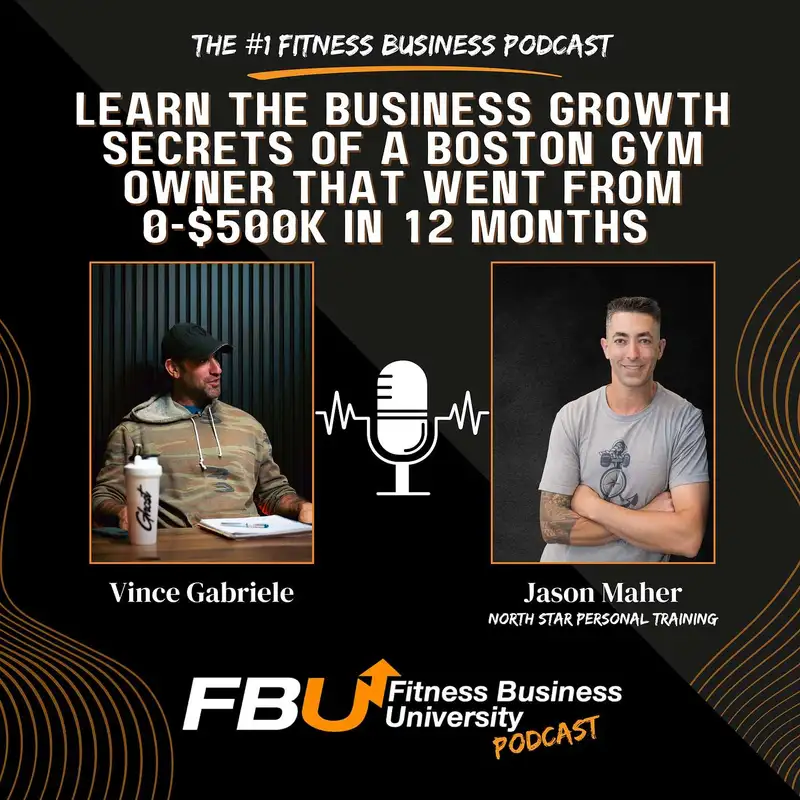
Learn the business growth secrets of a Boston Gym Owner that went from 0-$500k in 12 months
SPEAKER_00: What's up, guys?
You're about to listen to an
interview that I did with one of
the clients in my SPF
mastermind.
And this story is really, really
cool.
He had a gym in San Diego and
then he ended up closing it, got
a corporate job, and then
reopened a gym and went from
zero to five hundred thousand
bucks in less than twelve
months.
And he went through stage one
faster than any gym order that
I've seen before.
And this was my interview with
him on how he did it.
So if you're looking to scale
fast, if really grow quickly,
this is a really great interview
with Jason Maher.
Enjoy.
Welcome to another interview.
As you guys have seen, I'm doing
these series of interviews in
relation to the release of my
new books, the book the eight
profit levers.
That helps gyms that are in
stage one, anywhere from zero to
25k, get through stage one and
into stage two, 25 to 50k.
And what I'm doing is I've
selected, hand selected a small
group of gym owners that I've
worked with that have gone exact
done exactly that, that have
gone from stage one and have
exited stage one into stage two,
and life is now better over in
stage two than it was in stage
one.
And today I am with Jason Maher
from North Star Personal
Training in Boston.
Super excited to have Jason on
the show.
Jason, thanks for being here,
brother.
It's a pleasure.
Awesome.
All right, so let's kind of
start.
Now you've had a very
interesting story where you have
gone through stage one faster
than I've ever seen anyone go
through stage one before.
But it's kind of like one of
those, but it wasn't always this
way.
So I want to take it back, and I
actually met you before you
opened up your gym on the East
Coast, and I had met and worked
with you.
We did work together.
I think you did the surge
program.
SPEAKER_01: So I did surge, but
you know, and we had a nice, we
had like an hour-long
conversation when I was running
my first gym in San Diego, and
we had a good conversation, but
I couldn't I couldn't get out of
my own way and know that this
investment would have propelled
me to where I am now, like eight
years ago.
So that's how we originally
connected, and I basically told
you I can't I'm not gonna do it.
I'm not gonna sit through this
sales consultation, which you
did a great job, but I just
couldn't figure out how I was
gonna get my hands on the money
to do it, and that just kept me
stuck like right there.
And then, you know, fast forward
to to now, it's like okay, we we
could have bypassed eight years
if I just pulled the trigger.
SPEAKER_00: So let's go over
that, let's go there.
Let's so we're not gonna start
in where we'll I've started with
the the other people of like you
know, stage one and starting at
zero in your current gym.
We're going back to another gym
that you ended up selling in San
Diego.
So tell us, take us back to that
San Diego gym and give us the
whole story leading up to you
opening in in Boston.
SPEAKER_01: Yeah, so that gym in
San Diego was it was called
Resilient Strength and
Conditioning.
It we were primarily an athlete
performance gym.
High school female athletes was
kind of like our specialty, and
uh I loved it.
I loved coaching.
It was amazing for me to step
out from working for somebody to
open up my gym.
And the only reason I did that
was because I started to have a
family and I and I need to
figure out a way to support that
family.
And if I wanted to stay in
coaching, I knew that was the
next step for me.
So that's why I opened the gym.
I did everything.
It it stayed stuck because I was
the only person doing everything
for like the first three years
of it.
I did all the training, highly
burnt out.
I did all the the marketing
sales, which I didn't know
anything about.
That's probably what part me
brought me to into your your
sphere.
But I did everything and just
stayed stuck for three years and
you know, eventually ended up
selling that business.
But it was selling out of
necessity because I wanted to
get my family back to the east
coast where we're originally
from.
But it was at also at a
teetering point where I didn't
know how much longer I could
sustain that financial burden of
running a gym and being burnt
out and having like one coach to
help me and really not knowing
where to grow it.
So I sold it.
Fortunately, I was able to do
that, move my family back to the
east coast and you know,
actually left the fitness
industry for a couple of years
and ran the operations for an
oil company, oddly enough, but
figured out that I hated that,
so I wanted to get back into
fitness, so that's when I opened
up the second gym.
SPEAKER_00: Got it.
Take us, I want to take you
through a little bit more of
like what you were struggling
with and feeling during those
three years.
What were the emotions you had?
What were the challenges you
had?
What was a day like for you?
Like, kind of because I think
that's where a lot of people are
right now, and I think it's
important that they hear that
successful people like you have
struggled in that in that time
period.
So, like, paint that picture for
me a little bit deeper.
SPEAKER_01: Yeah, and massive
burnout, right?
Like, you know, get to the gym
at 5 a.m., train a couple adults
in the morning, all your
personal training clients, run
your errands from you know 9
a.m.
till three o'clock, and then
work with athletes until eight
o'clock at night and not see my
wife or my kids and wake up and
do the same thing over and over
and over.
That was that was everyday life.
It just it's just a burnout.
It's like, you know, how long
are you gonna sustain that for?
That's where I was.
I finally got out of my own way.
It took me three years to hire
my first trainer.
When I did that, that freed up
some some time, which the
trade-off was then the financial
hit because I really didn't grow
the business too much.
I just gave the trainer money
and I didn't have to train as
much, but I didn't really make
any more.
So I was stuck in that zone of
like, I remember when we hit 30
grand that first time we hit
that, I was like, Holy shit, I'm
rich.
Like, like this is amazing.
And and I don't think it ever
happened again.
So it was like it was one weird
thing, but we always kind of
like harbored around like you
know, 18,000, 20,000, somewhere
around there.
And it was just hard to make a
living, you know, it was really
hard.
Southern California is very
expensive.
And it's like, okay, great, like
maybe I'm making five grand a
month or something, but that's
not enough when you're when
you're owning a company.
That's kind of where the
struggle was.
It was just a lot of burnout, it
was a lot of work, and there
wasn't any kind of financial
reward for it.
It was missing my family.
It's you know, that's the that's
the picture.
SPEAKER_00: What made you
eventually hire that trainer?
Well, why do why do you think it
took you three years to
eventually hire a trainer?
Ego.
SPEAKER_01: Ego.
I just like couldn't get out of
my own way.
It was like no one's gonna coach
these kids as good as I'm gonna
coach them.
And that's such a like that's
such a bullshit mindset that
kept me stuck.
And it's still evolving.
Like, you know, I was actually
thinking about this earlier
today, where I'm learning
another lesson from the ego
standpoint that now that I'm
completely shifted to business
owner and I'm really not
coaching at all, there's an
identity crisis there.
And it's kind of like it's
weird.
Like I got another slap that was
like, is your ego seriously that
big that like the clients care
if you're in the gym or not?
Like they don't care that I'm
there or not.
Like they just want to get in
there and get what's best for
them, their workout.
They don't like they don't give
a shit that I'm in the gym or
not in the gym, but in my head,
I'm like, I have to be there.
Like the clients need to see me.
Like, what kind of ego trip is
that?
It's ridiculous.
SPEAKER_00: Yeah, and and and I
know when we had our consulting
day, you brought me a Joe
Dispensa book.
So I know you've done a lot of
good, deep unpacking of that.
That's I that's why I love you
know you guys.
And you know, because you know,
I love hanging around and
spending time with you guys
because you're learners and
you're growing as as human
beings, not just as business
owners, to for you to even talk
about that and recognize that
that was the problem is such
amazing growth right there.
So eventually, what broke if for
you that eventually made you
hire somebody?
Like what was there a break in
the ego, or was that I can't
take it anymore, I can't work
all these hours?
Like, what was it that broke
that got you to hire somebody?
SPEAKER_01: I I don't know if I
can't like pinpoint if there
were one particular thing.
It may have just been the kid I
hired was great.
Awesome kid named Kyle.
And he actually runs his own gym
in San Diego now.
When I sold the business, he
stuck around with them for a
couple months and then kind of
went out on his own.
And and it's too bad because
I've recommended him come to
this group like several times,
and I can see him like stuck in
that zone that I was, and I just
know he won't come.
And I'm like, come on, man, like
get get in there.
He's a great coach, he's a
phenomenal guy, but he's just
gonna be stuck as that single
trainer.
He came from Chicago, and and I
I think he just he was pretty
proactive in his in his reach
out to me and me being so
particular about how we were
training, you know, he checked
off a lot of the same boxes as
far as the people that
influenced you know my training
and who I learned from.
He had a lot of those same
influences, so I thought the
training would be a good fit.
And and he wasn't like, I was
like, hey, listen, man, I can't
I can't pay you what you're
worth.
But he was coming from Chicago
and just needed something
quickly.
So I I think it kind of lined up
that way almost by chance.
But I don't I don't know if
there was like a particular
point that broke me, but he kind
of like fell on my lap.
And after three years, it was
like, okay, I think this guy
could be like a really good fit
for for how I do things.
But but after him, it was like I
didn't really after I hired him,
we just stuck there.
It was just a different stick.
So it didn't necessarily solve
the problem.
That's why we're doing so much
better now.
SPEAKER_00: Yeah, uh, and so
let's now talk fast forward to
the sale.
Like you you you decided to sell
the gym in San Diego.
Was it mainly because you were
burnt out in the gym?
Was it that you wanted to move?
Like, what was the big driver of
all of it?
SPEAKER_01: The a couple things.
So, one, I I sold it in November
of 2020.
So deep in the heart of the
pandemic.
And in oddly enough, like we
were doing great because I just
I kind of refused to close.
I was just like, I'm I'm doing
this, and you know, I'm letting
people in and locking the front
door and shuttling them out the
back, like I don't care.
Like I'm gonna feed my family,
so we're going.
And all the big box were all the
big box gyms were obviously
closed, so like my phone
wouldn't stop ringing.
But mentally it was really hard
on me because I couldn't, it was
hard for me to conceptualize how
to operate and how to market and
how to do this without the fear
of the health department coming
in and shutting us down.
So I think it just it took a
toll.
And then in combination with
that, I got an offer to, you
know, come back and and take
over the operations for this
this small home heating oil
business, which is a family
business, but there's you know,
kind of like trying to develop a
succession plan and like, hey,
Jay might be good at running
this.
So I took that opportunity.
I thought it was gonna be great.
And it and it's another good
lesson learned that I chased the
dollars on that one, thinking
that you know, my my family was
gonna be financially secure, and
then and it was a great
opportunity.
I'm very grateful for it.
But after doing it for a couple
years, I realized how much I
hated it and how much I loved
the fitness business.
So, you know, that was a really
hard conversation to have, and
then go open up another gym.
So twofold pandemic and a job
opportunity that brought me back
to the East Coast.
SPEAKER_00: So, okay, so you
move, you get this job in the
oil industry with family
business, you realize it's not
for you.
You even though you struggled in
the gym space, you still loved
it, you still had a love for it.
And at that point, you decided
to talk about the transition
from having the job into
opening, you know, what is now
North Star, which we'll get into
the the massive success that
North Star is having right now.
But like talk about that's an
interesting transition, like
going from like a I guess
corporate is is what you would
call it, right?
SPEAKER_01: Coming up a
corporate you know, it's it was
a small, you know, family-owned
business.
Okay, so a small family
business, 20 employees, you
know, completely different
fields, trying to trying to
manage, you know, hard
blue-collar type guys, you know,
technicians, guys that work with
their hands, truck drivers, you
know, trying to take you know,
leadership from a guy that's
never done that type of work
before, and just learning a
completely new industry, lots of
lots of state regulations, lots
of federal regulations.
It was great because it taught
me a whole nother side about
business, a different way to
look at things.
But it was just it was kind of
like this isn't much fun.
You know, like I like being on
my feet, I like building
relationships with people, I
like talking to the clients.
Being in an office all day long
in a in an industry that was
completely foreign to me with
people that didn't respect me
was like hard to deal with.
That was a hard thing to run.
And I don't know that I had the
most I I couldn't number one, it
was like I didn't have the
passion for the business.
I didn't have the skill set, so
I couldn't see myself mi
continuing on that business and
making it be successful.
Like it the the the pieces just
didn't line up.
I I didn't I didn't have those
two items that I think is a
necessity for being successful
in businesses.
Like you have to have a little
bit of a passion for, at least
the type of field that you're
in.
Like I don't have a passion for
training people anymore, but I
do have a passion for like being
in the fitness business and
helping people.
And didn't have the skill set.
It was a skill set that I just
didn't take years to refine, and
I couldn't do that in two years.
SPEAKER_00: So you have this
idea to start a gym and you got
this job, you're gonna start
this gym.
What were the things that you
carried forward that you learned
from the first gym that you were
like, all right, I'm getting a
second crack at this?
What were the things that you
brought that you were like, I
ain't doing that again?
But like, what were the things
that you kind of like the
lessons learned from the first
business that you didn't fail
you because you sold it
successfully, right?
But it wasn't it was three years
of a grind, it was three years
that it wasn't didn't seem like
it was making you fulfilled.
What were the lessons carried
forward from that to the new gym
that you opened?
SPEAKER_01: Yeah, I first big
lesson we already touched on it,
like get out of my way, get get
like somebody in here to help
you.
Realize that there are people
that can do it better than you
and that they probably should.
So, you know, first business
took me three years to hire
somebody, second business took
me one month.
So I knew instantly, like going
in, like we're gonna get
somebody like right away to come
in here.
So that was lesson one.
Lesson two was the model.
The model in the first gym,
although I loved the athlete
model, it wasn't a way for me to
to make a good living and to run
a successful business.
So I knew that the model had to
change.
I did a lot of one-on-one stuff
with adults, but primarily with
the athlete model, it was like,
okay, what am I gonna do to have
a more profitable gym?
So we changed the model.
That was two.
Three, this is where you come
in.
I needed to understand marketing
better.
And I I needed to understand the
return on what you were putting
out for marketing dollars.
So in the first gym, it was
like, okay, put up a Facebook
ad, not understanding copy, not
understanding the creative, uh,
an offer, nothing, no,
understanding nothing, just
taking a picture and putting
some money out and go, oh, oh,
that didn't work, so I'm not
gonna do it again.
And and and that was the extent
of my advertising dollars going
out.
So, you know, coming into the
second one, knowing that we
needed to put some money into
marketing right away and get the
leads flowing so that we could
open up and be profitable within
a couple months.
That was like kind of like the
that was the real game changer
was understanding that you need
to put money into it.
And there's a there's a method
to it.
You know, the first gym was
like, you know, referrals only.
And we did a great job, but we
weren't we weren't accelerating
the growth because it was just
it, there wasn't even a referral
system.
It was just if somebody
mentioned something great, but I
was never searching for it.
So the marketing component and
where this group comes into
play, that's kind of one of the
tipping points.
SPEAKER_00: Yeah.
So talk me through then.
You you open the gym, you sign
the lease.
Now I'm gonna caveat this with
saying that you've had success
faster than anyone I've ever
seen through a first year in
business.
Like I've yet to see anyone do
as well as you.
Yeah.
Talk about what happened.
Like, how what did you do?
How did you open?
And I know you I believe you
joined you're one of the few
people that joined the
mastermind without a gym, right?
Is that is that true?
SPEAKER_01: Yeah, so that was
that was planned.
So I signed I signed up with SPF
two months before we opened.
Okay.
But that decision had already
been made long before that
sign-up.
So I had essentially a full year
before we opened of planning.
Once I once I had the
conversation that, hey, this
this position in the oil
business is not for me, I'm
gonna go do this.
From that point on, I stayed
working with the oil company,
but I I had a a year until that
sale of the oil company, which I
helped with and and helped to
transition there.
And I stayed on for a little
bit, but I knew I was gonna do
the gym.
So I had a full year of
planning.
I had a year to refine the
model, refine the pricing, scout
locations, do the negotiations
on lease.
And in that time, like I already
knew that as we got close to
signing a lease, I was gonna be
in the group.
And that happened because from
the time we had that first
conversation in San Diego, like
I knew of you, I did the surge,
and then from there, like every
every piece of content that you
put out, I consumed, right?
So the the emails, the podcasts,
like anything, the books,
anything that you put out, I
read and knew like, okay, this
is the group I need to be in
before launching.
So that's why I joined the
group, and we did it two months
before we actually opened the
doors, and the group helped me
with the pre-sale, which the
goal was there is I wanted to
open up and within within three
months be a profitable gym.
I think we did that in two
months, but that was why I
already knew it.
It was kind of like a domino,
like already set up.
Like I knew that this was the
group to be in to make the gym
be successful.
SPEAKER_00: So talk about the
presale then.
Can you give us some some
insights around what you did,
what was the offer, and then how
that went?
I think it sounds like it went
pretty well.
SPEAKER_01: Uh yeah, so I think
you know, when we opened up, I
think I put like I don't know, I
put like 15 grand into like
tenant improvements of the
building.
I think we did like another 30
or 40,000 in equipment.
And I will caveat that to say
like the only reason I was able
to do that is because I sold the
first gym.
So there was some benefit from
those three years of suffering.
It was like we had capital to
like get going and build it as I
wanted to build it, right?
Like the first gym was like, get
a client, get like a medicine
ball, like get another client
and get some ropes or or
whatever.
You know, like I had to piece it
together.
The second gym was like, all
right, we've got this capital.
Now I can make it happen how I
want it to happen.
So we kind of started at a
little bit of an advantage there
where I had some capital to get
going.
I wanted to get 40 clients
before the doors opened so that
we could pay off that the tenant
improvements and the equipment
from perform better before we
actually started to like have
our lease go.
I also negotiated the lease so
that I had I had a couple months
runway before I actually had to
start paying.
So we I hired an agency to do
our pre-sale or help us with the
pre-sale, help us with the copy,
help us with the creative.
And then the offer we set was I
think I had the first 40 members
at a discounted lifetime rate.
I think it was like 20% off what
we wanted to charge lifetime for
the first 40.
And I think we hit troubling
with the timeline, but I think
we hit those 40 within like the
first like six weeks or
something, six or seven weeks,
we had our 40.
And I picked that number of 40
because that's what I knew it
was gonna have us be profitable.
And and we got there very
quickly.
SPEAKER_00: Got it.
So you essentially opened open
the doors with 40 members, or do
it took about six weeks to get
there.
SPEAKER_01: We did like a um, we
had like two weeks of hey, help
me work out the kinks of the
program with like and as people
started to trickle in, we we
gave them away.
I gave away two weeks in June,
and then they started paying on
July 1st.
So I always love to see like I
always love to see like the
first of the month because
that's where all like all the
money for the month comes in,
which is great because like our
retention rate is really good.
Like out of those first 40
people, a year later, I still
have 35 of them.
Wow.
So like on the first of the
month, I see those 35 come in,
and it's like, oh, that's a nice
day, you know.
SPEAKER_00: That's incredible.
SPEAKER_01: Yeah.
SPEAKER_00: So what else?
So you said you hired an agency
to run ads for you.
What else did you do to sell
memberships in the beginning
when you were opening?
Like, what were the other ways
that you got members to sign up?
SPEAKER_01: Quite honestly, I
mean, the the digital ads and
everything that the agency
helped me with, that was the
prime driver because I didn't
have any contacts, like no, no
existing clients to work from,
no relationships.
At the town I opened the gym,
and I had never actually been to
until we opened it.
I I mean I'm from Massachusetts.
I've never been to this town
ever.
It just happened to be a good
location.
So I opened it.
Nobody, I didn't know anybody.
We we had a banner in the
window, like a coming coming
soon banner with a QR code that
was linked to the offer, and the
agency helped me with getting
the website up because I'm not
I'm not a tech guy.
I knew if you know where your
strengths and your weaknesses
are, it's like the tech part.
It's like I need help with that.
So they did a phenomenal job,
took all that off my plate and
just let me sell.
So once the leads start coming
in, I could do all the
follow-up, I can get them in the
gym.
I mean, I was selling people
with like leaks still coming
through the ceiling and
equipment half arrived, and like
trying to sell this vision of
like, look at this, look at this
nice pile of shit that I want
you to pay 500 bucks a month
for.
SPEAKER_00: Oh, very cool.
So for and again, we can
mention, you know, I know you're
using KISS Marketing, which was
the agency that I uh used to own
and now have sold to a new
company, Jim Member Machine,
which I'm super excited about
the cum combination.
But I know KISS, you know, when
you were working with that and
still are, did a phenomenal, you
know, job at the pre-sale.
So net with so that got us to
around 40 members, right?
You know, almost six weeks in,
which is like amazing, right?
Like we're already at 40
members.
Where are we at today?
Like, where is the business at
right now?
SPEAKER_01: So, right now, so we
are 15 months in to the
business.
We've got 145 adult small group
members and about 25 to 30 kids
in our sports performance
program.
Uh and what's the revenue
monthly right now?
Uh I project that we'll do about
63,000 this month.
SPEAKER_00: 63,000 this month.
And you sent me a very, very
nice email, which I
screenshotted and put in the
book, I hope you don't mind, of
the amount of money that you
made in your first year of
business.
Can you relay?
I can't wait.
I can I can pull the screenshot
if you want, but what was it?
SPEAKER_01: I'm sure you
remember.
Yeah, it's quite amazing because
I didn't think it was I didn't
know that it was possible.
So in the first 12 months of
business, we did over 500,000.
And I like couldn't believe it
because in three in four years
of running the past business, we
never got close.
I think my best year in my third
year was like just shy of like
300, you know.
So like to do to do 500 in your
first year was pretty
mind-blowing.
And, you know, in the first
actual full calendar year from
like January 2025 to you know,
the end of this year, a couple
months away, I think we're gonna
do probably close to seven.
And I just didn't I it's it's
almost hard to comprehend that
type of growth and and how quick
it went.
And a lot of lessons learned in
support of the group and and
kiss and and everything leads
into that, but yeah, it's kind
of almost uh it's it's pretty
unbelievable.
I don't believe it sometimes.
SPEAKER_00: That's awesome.
So I wanted I wanted to paint
that snapshot to show everyone
like where we're at right now,
where you're we're at, because
it's it's incredible.
And I want to start backtracking
and leading us up to all right,
we're at 145 members, adults,
you know, 15 months ago, you
were at 40 members, right?
So you literally have added 100
small group training members,
you've added, you know, 30 small
sports performance, you know,
kids and stuff like that.
Take us down the path of like
month one to today.
What were the things that you
did to grow this client base
like it has?
And I would say that the number
one thing you've probably done
really well from what you just
told me is you've had monster uh
uh uh retention, that you have
had a very, very good retention
rate, which makes it e always
easier to grow, but you still
have added a hundred new people,
more than that.
What were the things?
Can you pinpoint some of the
things that you did and used to
grow the company?
SPEAKER_01: Yeah, I that's the
number one is that I yeah,
attrition, we hover around two
percent.
Yep.
And and so your program can't
suck.
You know, the program has to be
great.
You can't hurt people, you gotta
have them feeling great.
You need a big benefit for us
was hiring the right people,
staffing the right people that
could could run this program
without me being in the gym
every day is is massive.
So the program can't be
terrible.
Your program has to be dialed
in, the attrition numbers have
to be great.
That makes the marketing and the
sales side of things much more
palatable for you to be able to
do and do well.
We originally had a goal of like
five new small group members a
month net.
And obviously it's way more than
that with with a hundred inside
the year.
Paid digital helps a ton.
I think that's probably the main
driver.
Our second source is referral.
We do a great job at that.
What do you do for referrals?
Different contests all the time.
No, I'm sorry, not not contests,
but like different like buddy
months, stuff like that.
Event event type stuff.
Yep.
Yeah, event type stuff.
I I use the uh the black card
system that that you've taught
the group where you you know you
give your members a metal black
card.
SPEAKER_00: That's it's funny
you say that.
That is one of the things in the
book that I talk about is the
black card.
How how have you used it?
I'm interested.
SPEAKER_01: Yeah, so we send we
send this nice care package to
clients when they hit like a
milestone.
So like when our clients hit 50
training sessions, we send them
a box of stuff, a really nice
box with like crinkly paper in
it, and they get like a t-shirt
and a water bottle and some
stickers, and then I I write
this card, and inside the card I
give them this black card, and I
think it's important that you
tell them what to do with the
card.
So it's like I have to tell them
like, hey, here's a month of
training on me.
I'd be really happy if you gave
it to a friend, a family member,
or a neighbor to to use.
You're hitting all the points,
my man.
Very good.
Right.
So um excellent.
That's been a big one.
And then also just I think it
has a lot to do with the town
that we're in and how many small
businesses are in the town and
how supportive everybody is.
Like the town has been
absolutely outstanding.
The town of Cohasset,
Massachusetts, small little
coastal, affluent community.
It's about 8,000 people.
A lot of small, a lot of
financial folks that travel into
the city and a lot of small
business owners that own these
little boutiques around town.
And we do like these little
holiday strolls where all the
businesses get involved and
stuff.
We're in a very awesome
location, a lot of visibility.
So there's you know, there's
some walk-in traffic as well,
and every business owner is
always open to like help share
like a lot of joint venture type
stuff.
I will share a very cool one
with you that I did, which
another piece of the retention
is my members, those those 35
founding members that are
returning, when they hit their
one-year anniversary, I wanted
to give them a card with like a
gift certificate into it to like
a local restaurant.
There's this local restaurant in
our town called Salty Days.
It's phenomenal, like seafood
place.
Everybody loves it, the owner's
awesome.
I went to him and I said, Hey,
I'd love to get my members like
a gift card.
And I'm thinking, like, hey,
I'll give my members like 40
bucks to like this.
This restaurant that everybody
loves.
And he goes, he's like, what do
you need?
And he kind of said it funny,
and I was like, where's this
where's this going?
So I I explained him what
explained to him what I'm trying
to accomplish.
And he goes, What could you do
for me?
Like, okay.
He's a little bit like heavier,
just heavier set guy and super
driven, like tape type I type A
guy.
What can you do for me?
Well, what do you need?
I'd like to start training.
Okay, great.
So he's like, Well, what would a
year be worth to you?
I tell him our pricing.
And he goes, All right, how
about this?
How about I come to your gym for
a year?
I'll give you 50 bus, I'll give
you 50 cards and I'll put a
hundred bucks on all of them.
Wow.
So I'm like, wow, like can't
believe it, right?
So number one, I've got this
amazing local business owner
that everybody loves and he
knows everybody and he talks to
everybody.
Yeah.
I have 50 gift certificates, all
worth$100 to give to my clients
for milestones.
And then I've got this amazing
relationship.
And it and it cost me, you know,
a roster spot for a year.
SPEAKER_00: Yeah.
SPEAKER_01: Incredible.
So the joint ventures were that
was another big one for like
helping grow the business.
Going back to your original
question after I rambled.
unknown: Yeah.
SPEAKER_00: Yeah.
Oh, that's a great story.
Yeah.
So you got so you you're really,
you know, pulling right from you
know the playbooks.
SPEAKER_01: I wanted four
thousand dollars worth of worth
of gift cards originally.
Oh, I'm sorry, no, I wanted
what?
I wanted 40, I wanted 40 gift
cards of 40 bucks.
So I went 60, I wanted to spend
1600 bucks, right?
SPEAKER_00: I end up getting up
spending nothing.
And you got 5,000 and you spent
nothing.
And you and you probably got a
guy that's gonna stay after.
And tell everybody in town about
me.
Oh my god.
Game changer.
Yeah, I think restaurants,
people don't do that enough.
I have a really good
relationship with a local diner
where I've had food items on the
menu for like over a decade.
And like we always get people
coming in, like, I ordered the
Gabriel Fitness thing.
Oh, the Gabriel Fitness thing.
Like, yeah, so restaurants are
cool.
Good job.
That's a good point.
SPEAKER_01: I'm gonna I'm gonna
ask he does so he does seafood,
he does like sushi rolls.
I'm gonna ask him to get give me
a role.
Yeah, give me a role.
SPEAKER_00: Get like a North
Star roll.
Yeah, yeah.
The North Star personal training
role or something like that.
Yeah, that'd be great.
Awesome.
So give us a snapshot of the
business.
How many staff do you have?
Like, what's your role?
Like, kind of how are things
playing out right now?
Yeah.
So we're we're and now that you
are legit in, I mean, you're
beyond stage two.
I didn't even realize this, but
you're really barking on stage
three for sure.
Yeah.
SPEAKER_01: Yeah, I'd love I I
mean, I'm like, I I want to be,
I know, I know I'm on the
doorstep.
I want I want to see what your
qualifications are so I could
just bypass two and go right to
three.
SPEAKER_00: Well, I'm I'm about
to I'm about to give you the
answer.
So why don't you tell me the
structure?
Because revenue-wise, you're
past it, but sometimes it's not
always just based on revenue.
Sometimes stage three is based
on like your there are some
people that get to stage three
money, but they're still very,
very connected with everything
in the business.
So your answer will will tell
me.
SPEAKER_01: Yeah, so uh so we're
in we're in about 2100 square
foot.
We run a small group training
model, we max out at six people
per group.
I basically run two coaches
concurrently on different
schedules.
So, like, for example, I have a
5 a.m.
group that starts, and then I
have a 5 30 group that starts.
Both 60-minute training
sessions, but they're running,
we kind of like overlap them.
So, you know, we'll move one
group from the turf down to the
strength equipment, we'll move
the next group in, and they'll
just convey her belt on the half
hour through the morning.
So two, I have one full-time
coach who does an amazing job.
I'm gonna make him our head
coach in the new year.
And then I have two part-time
coaches.
One does about 30 hours a week
and the other one does about 25.
And then I have myself who in
the last in the last five weeks,
I've coached one session a week
for the last five weeks.
And that is a that is a private
training client who's a very
successful business owner, that
I quite honestly get more value
out of that hour than he does.
So that's why I coach that one
session a week.
SPEAKER_00: Smart.
Smart.
SPEAKER_01: And yeah, so we uh
we'll we'll do over 60k this
month.
SPEAKER_00: That's that's a
snapshot.
So you're so you're not burned
out, you're not working six.
You're not you're not doing
sixty sessions a week.
You're spending a majority of
your time growing the company,
leading the staff, growing the
company in terms of sales,
right?
I assume you're doing still
doing some the sales.
SPEAKER_01: I'm still doing,
yeah, I'm still doing all the
sales, I'm still doing the
marketing.
My responsibilities really right
now are gonna be marketing sales
and then leadership.
I'm actually even from an
education standpoint, we have a
weekly education meeting with
our team.
And this week I gave that to
potentially the new head coach
to say, like, hey, you're gonna
you're gonna be responsible now
for teaching us, you know, about
the X's and O's of training, but
that's that's now your
responsibility.
I'm gonna attend it, but I want
him to be taking the reins of
leading our coaching team, and
I'm leading everybody as a
whole.
SPEAKER_00: Awesome.
Yeah.
No, that's amazing.
That's a really solid business.
The fact that you have given
yourself one, the amount of
money you're making, but two,
the amount of freedom that
you've given yourself.
That is where I know a lot of
people aspire to be.
So I want to end with this.
I think you've done a really,
really one, I want to
congratulate you.
I mean, you have done a
phenomenal job of you know
taking, you know, going from
your experience in San Diego and
navigating the challenges with
the family business and then
starting something from scratch
and then growing something from
scratch so quickly, you've
really taken you know a lot of
the wisdom that you've gathered
along the way from all of what
from everything and have created
something really, really
amazing, right?
And then and I do know you just
had a did you have a fourth kid?
Yeah, it's right.
Yeah, four.
You just said your fourth kid.
Like people people like you end
up having like seven kids, you
know that, right?
It's just like they don't stop
at four.
Yeah, uh and so all this while
doing this with a family, right?
And uh a fourth kid, so I mean
you're doing phenomenal, man.
Congratulations.
SPEAKER_01: Oh, wouldn't be
there without you and uh in and
kiss and and the team, the the
guys that you know you hire,
amazing, absolutely amazing.
Can't uh like like we talked
about earlier.
I'm almost like to the point
where like wondering what's
gonna break because it's just
it's uh it's running a little
too smooth for my liking.
SPEAKER_00: Well, I think you'll
be okay if it does because
you're a fast action taker and
you you get stuff done.
So I want you to envision the
gym owner listening to this, the
gym owner reading this book.
And I want you to remember back
when you were struggling and
doing all the sessions and burnt
out and not making the amount of
money you wanted to make and
tired and frustrated.
And I want you to know that
there's a lot of people
listening to this and reading
the book that are at that
moment, and I'm sure they're
inspired by your story, but we
can't make a magic wand and make
it happen.
They're still in that spot.
What do you tell them?
What is your advice to them to
get cranking in in the right
direction and make changes in
their life?
SPEAKER_01: Uh I think I'd
probably go back to some of my
biggest lessons is one, just get
out of your own way, you know,
get out of your own head, know
that there are people that can
do it better than you, certain
things, and you need to find
those people and have them help
you.
And then I think you need to
surround yourself with people
like like the SPF group, people
that have done it before you,
have more experience doing it
that you can lean on and get
their expertise, and then have
some accountability.
One more thing, too, actually I
get comfortable with with
understanding that you may not
have the money at the moment,
but you have to realize that you
do need to invest in part with
that money up front to to see a
return on it.
You have to have a little bit of
faith in it.
That's where a lot of my
struggle was too, was not having
any money.
I didn't join the group in San
Diego because I didn't have the
money.
I didn't do any ad digital ads
because I didn't have the money.
But if I had done that, we would
have leapfrogged eight years.
So those those are some big
things to kind of take a leap of
faith, a little bit of a leap of
faith, and have some have some
trust that you're gonna put some
stuff out there with the right
group around you and you'll
you'll get something back from
it.
SPEAKER_00: Awesome.
So I I heard an investment
mindset, right?
You know, from both standpoints,
because you have to be able to
have the investment mindset to
hire somebody, right?
Because that costs money to do
it.
And then the same thing with
your marketing, you're investing
in acquiring customers and then
surrounding yourself with the
right people, like finding you
know people that you are doing
what you want to do or have done
what you want to do, and then
getting their advice.
That's really, really well,
really well said.
Any final words of wisdom from
the great Jason Marr, who is
like very quickly elevated
himself into legend status in
the SPF mastermind, you know,
for probably the biggest first
year ever.
SPEAKER_01: So yeah, give us a I
think you've I think you've
blown my head up way too much as
it is.
I don't need to say any more.
Just a just a thanks.
Thanks for you know, thanks for
running the group as well as it
is, and you know, just a little
extra push for me that got me to
do it.
You know, the group is
responsible for a lot of this.
Kiss is responsible for a lot of
this, and I appreciate it.
It's an honor to be here.
Honor to help you in any way I
can.
SPEAKER_00: Awesome, man.
Well, congratulations.
Appreciate you and looking
forward to seeing what you do
this year.
SPEAKER_01: Thanks, Vince.
SPEAKER_00: All right, brother.