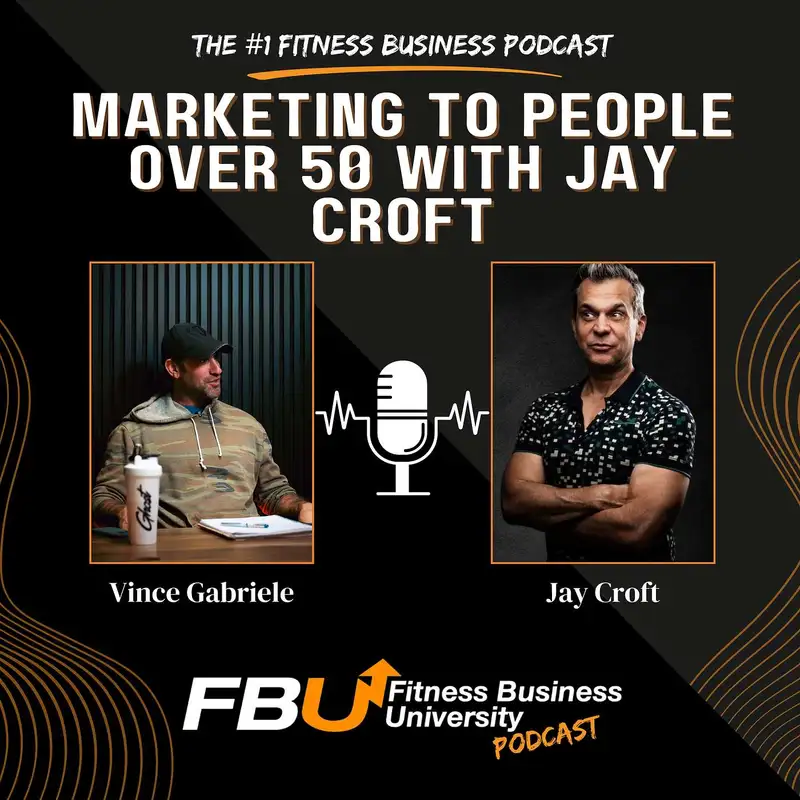
Marketing to People Over 50 with Jay Croft
Speaker 1: What's up guys?
Welcome to another special
episode of the FU Podcast.
You guys know that majority of
this existence of the podcast
has been some Greek-Italian guy
yakking into the bottom of his
phone.
About last year I started to
bring on some guests.
I really enjoyed talking to
people.
I really enjoyed getting some
different voices onto this
podcast and I started doing it
last year and I'm continuing
doing roughly once a month Don't
hold me to that, but roughly
once a month of having a guest
on to talk about some great
things that they're doing.
As with Joint Ventures pretty
particular on who I bring onto
the podcast, I want you to
introduce you guys to people
that are doing really good work.
I've had Ari Weinsbeck on the
podcast.
I've had Mark O'Donnell from
EOS on the podcast.
I've had some really awesome
guests and today is going to be
another doozy.
We have Jay Croft on the line,
the author new author of a book
called Selling Longevity, which
we'll talk about today.
But where I discovered him was
on his podcast called the
Optimal Aging Podcast.
And if you are training people,
majority of you guys that
follow me are doing stuff with
the 40 plus market.
I think that we've all realized
that college kids don't have a
lot of money, so let's not train
college kids.
And you're realizing that the
guy that's 50 years old, that's
making a couple million a year,
he can afford training all day
long, so let's figure out a way
to get him into the gym.
But I first heard Jay on his
podcast I think it was when I
heard you do an episode with my
friend, rick Mayo, who we have a
common friend in, and it was a
great episode.
I listened to it and then I
started listening to other
episodes.
So quick plug for Jay's podcast,
the Optimal Aging Podcast, if
you're looking for marketing
ideas, and one of the things I
love about Jay is he's a
marketing guy and a writer too
marketing mind and a writer, and
he'll get into his background
on journalism in a little bit.
But, yeah, doing some really
good.
So check out the Optimal Aging
podcast.
In addition to, we'll give you
the info and insight on his new
book Selling Longevity, which
hit one of the bestseller lists,
which I'm very proud of for you
, jay.
Good work.
But, jay, thanks for coming on.
Speaker 2: Vince, thanks for
having me and thanks for that
kind introduction.
I really appreciate it.
And Thanks for having me and
thanks for that kind
introduction.
I really appreciate it.
And I had you on Optimal Aging
about a year ago when your most
recent book came out, and it was
fantastic because we are
talking to a lot of the same
audience and pursuing a lot of
the same goals.
I appreciate the chance to come
on and talk about all of this
stuff.
Don't wind me up too much
because you might have a tough
time getting me off to stop
talking.
Speaker 1: Very good.
Let's give the audience a
little background on you.
You don't have the typical, you
don't have the typical entry
into the fitness field as a gym
owner, but tell us what you've
been doing and what led you to
the point of what you're doing
to write this book and have that
podcast.
Speaker 2: Absolutely so I so.
My background was in
communications, professional
communications.
I was primarily a newspaper
journalist for many years.
That's what I trained to do and
wanted to do and did for about
20 years, rising through the
ranks of daily mainstream
newspapers in various cities
across the country.
And I concluded my career with
10 or 11 years here in Atlanta
at the Journal of Constitution.
I was a hard news beat reporter
and then I was a features
editor, had a good mix of all of
that.
And then smartphones and the
internet came along and pretty
much destroyed the newspaper
industry.
So I stumbled out of that
disaster in my 40s and fell into
corporate communications at
some giant multi-billion dollar
corporations here in Atlanta and
did not like it, did not
succeed in it.
Kind of cubicle farms, nine to
five, office politics, all that
stuff.
It just didn't suit me.
And so right around the time I
turned 50, I thought thought I
got to find a new way to make a
living.
What am I going to do?
And, long story short, that was
around the same time that I
noticed that the fitness
industry was no longer
interested in me, and it's
difficult to say exactly what
happened that opened my eyes to
this.
I don't remember what it was.
I remember I was at the gym.
Speaker 1: I was on a piece of
Well, all you say was no longer
interested in you as a customer.
Correct, yeah, yeah, Okay.
Speaker 2: Yes, I had just
turned 50.
I was at the gym that I've been
going to for years and I was
looking at something a trade
publication or a mainstream
magazine, I don't remember what
and all the marketing was just
all about boys and girls too,
and I don't mean younger men
than me, all about boys and
girls too, and I don't mean
younger men than me, 22-year-old
boys who want huge biceps and
six-pack abs.
And that was it.
And I thought, damn, you're
missing out on something,
because I've been going to a gym
my whole life.
I'm very comfortable in a gym.
If I go out of town, I find one
, I spend money at gyms, I use a
trainer, I buy supplements, all
these things and suddenly I'm
invisible.
And the thing that it reminded
me of is when, if you're ever
driving in a car with teenagers
and they're singing along to the
songs on the radio and you have
no idea what that song is or
who the singer is, right, that's
because you aged out of pop
music.
And I felt the same thing, that
I had aged out of the marketing
target for fitness, and so I
thought let me check this.
I'm a reporter.
I had aged out of the marketing
target for fitness and so I
thought let me check this.
I'm a reporter, I can find out
if this is true or just my
emotional reaction to something.
And it's true.
The industry is primarily
historically focused on
specifically people in their
twenties who have no money and
want no service.
And we'll find a new gym and a
heartbeat and go across town to
the new gym, new club, whatever.
And I thought this just doesn't
make sense.
So I looked into it, did my due
diligence and found out that
there was this opportunity for
content marketing.
And content marketing had
really grabbed my attention
during my corporate years, in my
time between being a journalist
and getting into fitness this
idea of using my skills as a
journalist to gather information
and tell stories and
communicate to masses of people,
but for a different purpose.
And that purpose with content
marketing is to get consumers to
buy a product or buy a service
or engage in something.
So I saw this as an opportunity
to start a content marketing
firm, company interest, whatever
you want to call it.
That would help gyms reach more
people like me, more people
over 50 who have the time and
the money and the desire to
become good, long-term,
high-paying customers.
And since then it's just grown.
I'm servicing a lot of gyms all
across the country.
I've got some in Canada, some
in some other countries even
where they speak English at
least because I don't speak any
other languages and I create
marketing content for email,
newsletters and Facebook and
Instagram and blog posts, things
like that people then use in
their gyms and studios, then use
in their marketing to tell
their communities that they want
to help people who are a little
bit older.
I'm not talking about geriatric
care, I'm talking about 50-ish
and over.
Some people are saying 40 and
over.
It's roughly the same thing and
it's the idea is that you
distinguish yourself in your
community from all these other
gyms by saying, hey, I can help
you, I want to help you and I
want your money because you've
got more of it than those kids
do.
So that's my background, how I
got into this, and then I wrote
the book because it was an
outgrowth of all of this great
information and fantastic
stories that I've accumulated
over the years.
Speaker 1: It's very funny that
this very concept that you kind
of created of what market to go
into is very similar to when I
was working in San Diego.
I was a trainer in San Diego
and I was working with a lot of
NFL players and it was really
cool to work with NFL players
and I was also working with
high-level college athletes and
even the highest-level high
school athletes and I found
myself getting really excited
about working with those people
and not as excited about working
with the mom and pop and I
realized after a while that one
there's not nearly as many
professional athletes in high
level college and high level
high school athletes as there
are these normal people.
Yeah, and while it is more
exciting and cool to be like
working with Luis Castillo and
Donnie Edwards and Quentin
Jammer who actually anyone
listening to this probably has
no idea who those people are I'm
dating I'm definitely dating
myself, with name dropping.
Apologies to the pro athletes
that I just mentioned, but at
one point in time these were
household names in the.
NFL.
But at the end of the day,
that's what shaped my start in
business.
When I moved back to New Jersey
, I said, hey, you know what?
I'm not going to focus on those
guys.
I had my fill.
It was fun, it was cool, but I
want to make some money in this
career.
Speaker 2: Yeah.
Speaker 1: And I realized that
the middle school athlete was
the most unchartered territory
in all of sports performance no
one's even talking about these
kids and I built my entire
business around that middle
school athlete it's the exact
same thing and then eventually
came around to working with
adults over 40, as your market
is.
But I think it comes from
people wanting the cool and
exciting client right.
They want to be like, excited
by the client.
They want to get someone that's
10% body fat to 5% body fat and
that's more exciting and they
can use more of their knowledge
to get to this next level.
But a lot of times that's like
the last 5% of people.
So I think you're right on the
money with creating a marketing
niche for this market and I
think people, I think you're in
the.
You're in a perfect spot right
now because people are starting
to see they didn't see it when
you first started doing it, when
I first started doing it, none
of us saw it, but I think people
are seeing the writing on the
wall in this space.
They're starting to see that
more people are going after this
market for you.
So I have a question.
So I read through your book and
it's a great.
You did a great job.
It's a great book.
It's simple, it's clear.
My first question is about the
psychographics part of it,
because I learned from the great
Dan Kennedy there's three parts
of marketing, right.
There's the geographics, it's
where they live.
It's the demographics, it's the
facts about them, and then it's
the psychographics, about the
people age 50 plus.
Can you go into that, because I
know that was a whole section
of your book.
The title of this chapter was
why Psychographics Matter.
Why do psychographics matter in
marketing for people age 50
plus?
Speaker 2: Yeah, again, I come
at this from a slightly
different angle.
I come at it from the question
of this is interesting.
What's going on here and what
are the cliches and the
stereotypes and the common
misconceptions that are out
there?
And then how can I find out if
they're real or not?
And then that's what I set out
to do.
So maybe a more classically
trained marketer would come at
it.
From what are the psychographics
behind this demographic?
It's not how I came at it, but
I just think it's fascinating to
hear a young trainer or not
even a young one, I'm sorry this
happens a lot with veteran
trainers and gym owners talk
about how they want a D1 athlete
.
D1 athletes don't need you, do
they?
Good luck with that right.
People who need you are the
ones you should be going after.
So you need to find out who
needs me and you were genius to
realize that middle school
athletes were there and needing
your services, and it's the same
thing.
So you find out who's most
likely to be a good customer for
me.
And then, who are they?
What makes them tick?
What do they want?
What are they afraid of?
How can I find out?
And people who are a little bit
older and I'm just going to say
over 50, if anybody out there
listening has decided to focus
on people over 40 or people over
60, or women after menopause or
men after retirement or
whatever, it's the same If
you're home listening to this
and you're doing 40 plus, which
a lot of people do.
Speaker 1: This is more than
relevant to you, because I
guarantee you you're having
people that are 50 and over for
sure?
Speaker 2: Yeah, exactly.
First of all, you got to think
about what are your
misconceptions about them?
A lot of younger people in
their 20s and 30s and maybe even
their 40s, think of over 50 as
being ancient and being
grandparent level and being
previous generations of old.
And I'm 61 years old and I
guess I'd look at I don't really
care.
I've got gray hair and wrinkles
and that's fine.
But I know that when I walk
into a gym that I've never been
in before, the kid behind the
counter doesn't see me.
He sees right through me
because he just sees an old guy
and thinks that guy is not
someone I'm interested in.
He doesn't know how much money
I have in my pocket or how much
I want to spend at his gym.
He doesn't know what drives me
to come into a gym people who
are a little bit older to get in
shape or stay in shape.
I discovered that there are some
really common motivators they
want to play with their
grandkids and feel safe and
confident doing that, and they
want to be able to get up off
the floor and climb up the slide
with them and all those things.
They want to be able to travel
and traveling just getting on an
airplane can be exhausting.
You got to schlep your bags
through the airport and put the
bag in the overhead compartment
and stand in line and do all
these things, let alone
something more challenging like
hiking or skiing.
They want to stay in good
health.
We have a lot of chronic
ailments that are commonly
associated with being a little
bit older.
They want to keep their weight
in check, all these things.
And yeah, maybe they want to
look better, but it's not the
same thing of I want to look hot
at the gym, hot at the beach.
Speaker 1: I do think, though,
they want to look better.
Speaker 2: Absolutely.
Speaker 1: I think that there's
a misconception here, jay, with
this market and people saying
the 50 plus here don't care
about losing weight.
They don't care about how they
look.
I think that's total bullshit.
I think, whether that's your 50
, your 60, you still a hundred
percent care about it.
It's not the only thing you
care about.
Which is what.
The only thing you care about
when you're 22 is how you look.
That's it.
Speaker 2: That's what I mean.
Yeah, that's it.
So yeah, of course you're going
to have fewer people come in
and say, hey, dude, give me some
guns.
The guy's still going to be
really happy when his biceps
start coming through.
Absolutely, it's just not the
main, primary or even solo
motivator.
But of course everybody wants
to look better, we want to feel
better and move better and all
these basic motivators.
We want to continue to play
sports, play hockey, play golf,
play tennis, work in the yard,
garden, whatever.
All these things that we like
to do that you don't need the
gym to do those things when
you're 25 or 35.
You do when you're 55 or 65 or
older.
You really need guys like you
to help stay strong and have the
agility and the stamina to do
the things that you like to do
with confidence and some degree
of proficiency.
Speaker 1: So I just climbed
Pike's Peak with my buddy with
my buddy, joe, and there was
another guy that went with us
named Mark and Mark, so I'm 46.
And it's it's hard for me to
fathom that, like I'm four years
away from the people that we're
talking about here.
Speaker 2: Yeah.
Speaker 1: We'll say this.
One of the caveats is like the
best compliment I've ever gotten
was one from my daughter that
said to me dad, I'm so glad
you're in really good shape,
because if you weren't in good
shape I probably wouldn't be in
good shape either.
Speaker 2: Man that's right, it
was like the best thing ever.
Speaker 1: And again I'm not
like I'm fine, I'm doing okay
and I still work really hard and
everything like that but like
to be recognized as setting the
good example in your family,
like for me that was like a
marketing line right, like your
kid complimenting you for
staying fit.
But what I was saying was we
went on this Pikes Peak climb
and it's a 24 mile total climb.
It's 12 miles up, 12 miles down
and it's like 13,000 feet of
elevation at the top.
It's pretty total climb.
It's 12 miles up, 12 miles down
and it's like 13,000 feet of
elevation at the top.
It's pretty, pretty tough climb
.
But the guy that did it with us,
mark, was 57.
And he hung the entire time and
he was fine.
He's a marathon runner, ironman
and stuff like that.
But I remember saying to him I
was like my goal is to do this
at 57, just like you, and that
was like a big thing.
And I think that these I know a
driver for me is, as I get
older, to be able to try to do
things that I used to be able to
do when I was younger.
And again, I'm never going to
be able to bench as much as like
I was when I was in college or
anything like that.
That's fine, but these types of
challenges like hiking and
other things like that as you
get older, there's these like
types of whether it's an
obstacle, whether it's a race or
something like that you can
very well stay fit for a really
long time while doing that and
that was a big motivator for me
was seeing Mark at 57 do that.
Speaker 2: That's great, yeah,
and I've got people in my life
who are even older than that,
because I'm older than your
friend and I can do that.
I can climb Pikes Peak tomorrow
, at least I think I could.
It's been a few years since
I've been there, but I think I
could.
And I've got an older sister
who runs Ironman triathlons, as
does her friend, who's in her
70s.
They live in Alaska, they play
on a hockey team.
These are just ordinary people
out there living their lives,
and there's a lot of them out
there who are very comfortable
doing all of these things.
There's even more who are not
comfortable.
We've talked about some, about
the folks who know their way
around a gym, but the vast
majority of people in this
demographic are, like the vast
majority of all Americans,
totally deconditioned,
overweight, out of shape and
scared to death to walk into a
gym.
So those are some other
motivators.
But you look at, the reasons
why this demographic is so
appealing to people listening to
this show, in addition to all
the things that I've just said,
is they've got the money,
they've got the drive, they've
got the ambition, the idea that
some 25-year-old woman comes
into your gym and says help me
lose 20 pounds so I can go to my
sorority reunion.
You can do that.
Any trainer in the world can do
that Big deal.
And then she's never going to
come back after her reunion and
she's out the door.
You help a 55-year-old,
70-year-old retired accountant
who's 40 pounds overweight and
gets winded to check the mail.
You help her go skiing with her
grandkids.
You help her take her toddler
granddaughter to the park and go
up the slide with her and come
down the slide with her.
Speaker 1: You're going to
change her life and she will be
with you forever.
She will never leave you
because you have given her life
back.
The biggest joy of my week is
walking through the gym and
seeing my 86 year old high
school football coach training
at my gym yeah it is like one of
the it's, he's like a family
member and it's like walking
through and seeing him working
out is just it's incredible.
So I love this market.
I have a question for you on
the mind of the 50 year old or
let's just go 60, since that is
you and that's what I love about
you is I've had to really study
the market through talking to
customers and clients and
getting in their mind and
hearing the things they say and
using the things they say in
marketing.
You're a little different in
that you are the person Like you
are walking around as the buyer
.
What are the things that are
going through a 60 or 50 to 60
year olds mind when they get to
the point where they're like I
need to do something about my
health?
What are the things?
What's the?
What's the negative thoughts?
What's the thoughts, what's the
?
What's the head trash going on
in their mind that gets them to
make that decision?
Speaker 2: The thing that gets
them to make the decision is
almost always and we're talking
about the people who have been,
who are not doing it.
Speaker 1: We're not talking
about yeah, let's just you think
prospects, think what.
They're not customers of gyms.
Yeah, because there's a
substantial they get to a point
where they realize I got to do
something.
Speaker 2: Yeah, I think there's
a catalyst in almost all the
stories that I tell.
It's the classic hero's journey
structure.
It really applies to this.
People who are, let's say, 55,
65 years old.
Right around retirement, women
have gone through menopause, men
are getting that tire around
the middle, back aches, joint
pain, whatever right, and they
just think, oh, I'm getting old,
I'm getting old.
They know in the back of my
mind that they're not just
getting old.
They know that something's not
quite right but they keep
putting it off because change is
hard and it's intimidating to
go into a gym.
They haven't been to a gym
since college, 40 years ago, and
they're afraid that they're
going to walk in and be ignored
or be treated with disrespect,
or they're going to hurt
themselves, or they're going to
feel for men, they're going to
feel less in control and maybe
women are going to feel judged
because they're overweight.
What have you All these things,
man?
It's really intimidating.
I want everybody listening to
this who's used to a gym to
think about how scary it is for
a deconditioned person of any
age, but especially a
deconditioned person who's as
old as your parent, to walk into
a gym.
It's terrifying.
So, yeah, think about all that
and then what it takes to get
them to do something is a moment
, a catalyst, and that catalyst
can be the doctor saying Tom,
you're going to have type 2
diabetes in about six months if
you don't get off your ass and
start doing something.
Well, hopefully nobody wants
type 2 diabetes.
They can start reversing their
life that diagnosis with some
lifestyle choices.
Maybe it's seriously the
grandchild who won't play with
Nana because Nana can't get off
the floor, or because Nana
smokes, smells like cigarettes,
or because Nana gets tired and
cranky whenever they want to
play.
That'll break your heart to
have your grandchild say I don't
want to play with you, or just
any kind of thing where they are
invited to do something and
they can't do it.
It could be a rafting trip, a
hiking trip with the extended
family on a reunion.
I know one man who his catalyst
was when he's still working.
He's a very high-powered
executive still in the game,
trying to climb the ladder, and
his boss said hey, every year I
take a group of people on an
adventure.
I'm taking you.
This year we're going to climb
Kilimanjaro.
And he said we're going to do
what now?
Climb Kilimanjaro, are you
kidding me?
So he went to a gym and said
hey, this has come up.
I've got to go because it's the
boss and I'm not backing down
from this challenge.
But I can't climb the stairs,
let alone Kilimanjaro.
He got in shape for that.
So there has to be some moment,
a catalyst, that makes you go.
I got to make a change.
It's not going to be your wife
telling you need to lose weight.
It's not going to be looking in
the mirror and thinking, oh
hell, I'm getting fat again.
It's going to be something that
moves you in a way that all
those previous warnings didn't,
because you know you're
overweight, you're deconditioned
, you shouldn't be feeling this
bad, but it takes something
that's really emotional and
powerful, like that.
Speaker 1: Yeah, and I love that
.
I have a series of copy that I
use based on that exact concept,
because I think what they're
after is this they don't want to
look embarrassed and they won't
feel stupid.
And a lot of times those events
tend to make that happen and no
one wants to stay that way.
And it's funny because I have a
whole bullet point that I used
in my big book of marketing that
people have ripped off many
times and taking these exact
bullets and a recent scolding
from your doctor reunioning up
and all of these things and all
of it is to be used as this
catalyst to avoid further
humiliation and embarrassment.
And it's honestly it's like
weird to think like that, but
that's it's what do they want?
No one wants to feel that.
No one wants to feel that, and
so a lot of times in marketing
you tend to and can call some of
these things out to help people
avoid that somewhat
catastrophic thing that is.
Speaker 2: Yeah, I try to do
that with an emotional story.
It's way worse than your pants
not fitting.
Speaker 1: It's way worse than
your pants not fitting.
Speaker 2: Yeah, because you can
just shrug that off and say, oh
hell, I look all right, move on
.
But when your doctor says
you're type two, you better get
on that, or you're the same age
as when your mother fell and
broke her hip and died a year
later, and all these things that
when you're 30, they sound like
they're never going to happen
and, trust me, at 61, I can see
them all happening right now.
So it's those stories, it's the
emotional story that people
connect to, and I guess that's
what you and I try to help gym
owners do is get to those
emotional stories that the
audience connects with and says,
hey, I'm like that guy.
I'm not Chris Hemsworth, I'm
not an athlete, I'm not some
fitness model, I'm just a normal
dude.
And I'm happy being a normal
dude, but I need to lose some
weight.
Speaker 1: Yeah, that dovetails
nicely into the next thing I
wanted to ask you about, because
you have a whole chapter on it
on storytelling and I think that
obviously your background in
journalism has probably made you
a great storyteller to be able
to that's what your whole life
was doing that.
But I think, in the midst of
what's going on with AI and all
these things of how easy it is
to create content, no one has an
excuse anymore not to put out
five ways to burn fat and
there's a place for that kind of
stuff.
But the more people are getting
numb to this AI, like this
whole thing, like oh, that's AI,
oh that's AI, oh that's AI.
Speaker 2: You can spot it.
Speaker 1: But it's really hard
to pull out a, to pull it to say
an AI was generated, a genuine
story.
And so I think, and especially
to like on video, if you can
tell stories on video and in
presentations, like I've made a
living on showing up every
Wednesday for two hours and
talking to my group, I ain't
throwing information at them for
two hours and getting them to
stay on the call Like we have a
pretty high stick rate too they
stay for the whole call.
It is just a series of stories,
one after the other, and
answering questions, and using
stories to answer the questions
and everything like that.
And so if you were to in the
short amount of time that we
have, yeah teach a gym owner how
to be a better storyteller yeah
what would give us the pitch of
what you would do?
Speaker 2: yeah, sure, happy.
That's a great question and I
address that in the book.
I give some tips on how to tell
stories better, and not just in
an airy-fairy I went to college
kind of way, but in real,
simple terms.
So let's think of perhaps the
most common story that a gym
owner is likely to use, and
that's a member profile, like a
member of the month or something
like that, which I hope
everybody's doing.
If you're not, you should be
doing that.
Of course, I often see them
done really badly, as I'm sure
you do too, and they will be all
about how great the gym is, all
about how nice the trainer is,
all about how pleasant the
facility is.
Not a word about the client.
Or they might have some
questions, but you can tell that
these questions were answered
via email because there's never
a follow-up and there's never
any sense of a conversation.
You can see the email went out
saying what's your favorite part
about Vince's gym I love the
trainers period.
What's your favorite movie Star
Wars.
What's your cheat meal Pizza.
It's like who cares?
Don't do it via email.
Have a conversation with the
person.
Don't just throw out a bunch of
questions.
The best stuff comes in the
follow-up.
It's like when you tell your
kid she can't have ice cream and
she says why?
And you say because we're going
to have dinner.
And she says why?
And you say because mommy made
dinner.
Why Be that kid?
Keep saying why.
And you do this in your sales
calls already.
When people come in and say they
want to lose weight and you say
tell me more about that.
That's what you have to do in
the profiles is to get past the
really boring, flat, generic
answers and get to something
that's real.
So do them in person, ask
follow-up questions and really
listen and try to follow the
format of before, during and
after.
So before, what was your life
like?
Before I was working 70 hours a
week and raising three kids and
I got fat.
And then the kids went to
college and I finally retired.
And now I want to live a better
life.
Okay, what got you into the gym
?
The doctor said I was on the
verge of type two.
Okay, what's your life been in
the six months since you've been
working out at Vince's gym?
How's your life got better?
Then you list those things.
What do you want to do next?
I want to go on vacation and
climb Pike's Peak.
That's a story.
To go on vacation and climb
Pikes Peak.
That's a story, and Vince's gym
is a secondary role in that
story.
It's not about how nice Vince
is or how helpful the trainers
are or how well lighted it is or
any of that nonsense.
It's about this person who life
got out of control and you
helped them get their life back.
So keep the focus on person,
not on you.
I really don't care about you
too much as the gym owner.
I care about the person.
What was their life before,
what got them into your gym and
what's their life like now, and
then have a real conversation
and listen to them.
Speaker 1: Yeah, no, that's
great.
I think that it boggles my mind
how people don't look around at
all the.
They're swimming in a sea of
content every day in their gym,
like all they have to do is walk
out on the floor, and I found
the conversations that you're
talking about having those
create the best headlines right.
If you're a marketer like you
should be listening to the
things that you say and
listening for the one thing that
kind of pops out.
That's all.
That's the start of the whole
thing, and I remember I was
talking to one client or he was
telling me a story, and he came
up to me and he's like oh, it's
my 60th birthday.
And he's like I was like great
and he goes, I feel better at 60
than I did at 50.
And I like stopped and I was
just like holy shit, what had
just happened there?
And I looked to just stop right
there and I stopped them from
talking and went over and got a
piece of paper and I wrote that
down.
Speaker 2: Yeah.
Speaker 1: And I think it's
important from a storytelling
standpoint that we're paying
attention to, because one of my
biggest pet peeves on
testimonial is I see this big
lump paragraph that nobody reads
, yeah, I see this big lump
paragraph that nobody reads,
yeah.
And what we need to do as gym
owners that are telling good
stories, is pull out what is the
best part of the story.
Speaker 2: Yeah.
Speaker 1: And then make that a
headline and that's what people
will read in a testimonial story
.
They're going to read the
headline and if the headline
gets them excited, they'll read
the whole story.
But I see a huge mistake of
people putting these big lump
paragraphs together and thinking
someone's going to just read
through that whole testimonial.
You have to pull out the thing
and I think what they need to
pull out is exactly what you
just said.
Is you pull out the part that
says before I was this, now I'm
this and that's the
transformation story.
Speaker 2: Yeah, Give me a story
.
Story.
Don't just tell me how great
your gym is.
You know that.
First of all, it's not a story.
Secondly, it's not about the
client.
And third, all I don't care.
I care about the woman who can
finally play with her grandbaby.
I don't care about how many
certifications you have can you
talk about some?
Speaker 1: you, as a journalism
guy, one of the things that you
probably had to do was create
content, even when you didn't
want to create content, right,
yeah?
You bet because you had the
hardest thing in the world,
which is called the deadline
yeah with content and I think a
lot of us.
We don't have deadlines, right.
There's no publisher being like
, hey, you gotta get your
article in, I send a daily email
and I'm my own publisher, right
, I'm the one that decides if I
send an email or not.
And I think that takes a lot of
discipline and it took me a lot
of time to get to that point
and I think obviously with AI
it's become a lot easier to do.
But what are your helpful hints
, tips for people that, hey, I
just can't get consistent with
content creation?
I do it once in a while, I do a
little bit here and I do
flurries of it, and then I go on
a drought and don't do anything
for two weeks.
And then I, what are your as a
journalism guy?
What are your helpful hints to
us that don't have someone
holding us over our head to
create content, meaning nothing
happens if we don't do it, but
we know we should.
Speaker 2: I think it's
something that you have to treat
like any other component of
your business.
I think too many gym owners and
probably small business owners
in all industries, think it's a
nice to have, or I'll do that
when I feel like it or when I
have time, or when my niece is
back from summer, over summer
break from college.
She likes to do that.
I feel like it, or when I have
time, or when my niece is back
from summer over summer break
from college, she likes to do
that.
No, it's a part of your
business.
Bake it into your business plan
, assign it to someone, make it
a part of their job, or book an
hour a week on your calendar so
that everyone knows that from 10
to 11 on Tuesdays, vince, vince
is doing his content, just like
if Vince were having a team
meeting or if Vince were doing
sales calls or any other part of
your job.
If you don't take it seriously,
then you're not going to do it.
I get it, but there are things I
don't like to do.
I'm really bad at numbers and
accounting and all that stuff.
I have to do it.
I do what I have to and then I
hire out for it, and not to plug
myself here, or any of us who
do what I do.
But hire someone.
If you really can't make the
time or develop the discipline
to treat this like making sure
that there's toilet paper in the
stalls and that the showers are
clean.
If you can't do that, then pay
someone to do it.
I pay someone to do my taxes
every year because, like I said,
I can't add, let alone keep up
with changes to all my
deductions.
So I pay someone to do that.
So you can outsource it, sure,
but mainly you've got to get
your head around that.
It's not just cute, it's not
just nice and it's not just
people who have time.
Or I don't like Facebook.
I don't like Facebook either.
Vince, believe me, I would love
life without Facebook.
But it's the life we live, it's
the world we're in.
So accept it and deal with it
and just treat it like another
responsibility, because it
really is.
Speaker 1: You're a big email
guy.
How often should gym owners be
emailing their list?
Speaker 2: I say at least twice
a week.
That's what I do for my clients
who subscribe to Prime Fit
Content or some other clients
that I have that I do specific
work for their business.
I do twice a week.
Others in my line of work will
tell you three times, or every
day.
I have a little bit of trouble
selling that much, not selling
it to get the money, selling the
idea, promoting the idea,
because people freak out at
twice a week.
But it's got to be at least
twice a week because even once a
week isn't enough.
I think that we all get so much
email and so much content and so
many marketing messages all the
time that once a week they
might not see it.
Everyone's busy, everyone's not
sitting there waiting for you
to send them an email.
They might not see it, they
might not read it, they might
forget it, they might be on
vacation, what have you?
So you need to be in front of
them at least a couple of times
a week and you need to be giving
them good, relevant, engaging
information that's going to make
them want to hear from you.
Relevant, engaging information.
That's going to make them want
to hear from you.
The biggest objection I hear,
aside from.
I don't have time to send email
, which is don't get me started
on that one but is I don't want
to be a spammer and the only
answer to that is that don't
send spam.
Simple Spam does not have to do
with how much you email them.
It has to do with what you
email them, and if you email
them crap every day, three times
a day, then you're a spammer.
If you email them useful, good
information that's relevant to
their lives, that they're going
to enjoy, then that's just good
business.
They asked to be on your email
list, they wanted to hear from
you, and if they change their
mind, they can unsubscribe.
So I think a lot of people just
need to get over this
assumption that I don't like to
read email, so I'm not going to
send email.
Do you know what I mean?
You're laughing.
Speaker 1: Oh yeah, it's funny.
If there's one thing I've done
well in my group, it is help
people understand that they're
haters.
And the people that respond
with all this screw you, take me
off your list, you suck those
types of things that you get,
that you will get if you go
frequently enough.
We have now shifted because it
used to be, people would freak
out when they got those emails
and they would post the emails
in the Facebook group and they
would be like what do I do here?
I think I'm doing something
wrong.
I think I'm emailing my list
too many times.
The posts have shifted to them,
posting the emails in the group
, screenshots of the emails and
them with this badge of honor
saying I'm finally doing email
because I'm getting someone to
hate me.
That's right and I think it's a
total mindset shift, but it's
like crazy what a few years has
done.
Speaker 2: Yeah.
Speaker 1: Just me parping into
their head.
It's just like Kennedy has a
line.
It's like you haven't pissed
anyone off by noon.
You're not marketing hard
enough.
Speaker 2: Yeah, I'm glad you
said that.
Do you have time for a quick
story?
I sent out an email for this
gym just within the last couple
of weeks and had a bunch of good
stuff and at the bottom it had.
I often will include an
inspirational quote or something
like that.
That's just type on a plain
background, and this time
instead I copied something I saw
on social media about the
Coldplay concert where the guy
was caught with his mistress.
Speaker 1: No, I didn't hear
about that.
Speaker 2: Yeah, it's Coldplay.
Is this band?
It's a rock and roll band.
Speaker 1: No, I never heard
about the mistress thing.
Speaker 2: Oh seriously.
Speaker 1: I'm totally joking.
Okay, you had me there.
Speaker 2: I thought you were
joking, and then I thought oh my
gosh, is it possible he didn't
hear?
Speaker 1: about this I've never
seen that was bigger than when
Trump got shot.
Speaker 2: It shot it was, and
so after two or three weeks
later I put this at the bottom
of my email for this gym just
text on a plain background that
said if a CEO has time to run a
company, raise three kids and
run around with a girlfriend and
still get tickets to the
Coldplay concert, then you have
time to work out.
Okay, I thought it was funny.
I heard back from the gym owner
because one person on his email
list wrote him and said I was
just about to share your email
with some friends because I
think they would enjoy it and
want to join your gym.
But then I got to the bottom
and I read that joke about cold
play and that was just cruel to
his wife and children.
You should do better.
Speaker 1: What was he saying?
What was his response?
Speaker 2: He said that we would
try to be more sensitive in the
future and I wanted to say it's
just a joke and it's not sexist
, it's not demeaning, it's not
hurtful.
You can't please everyone.
One person didn't like it.
I don't know what else can I
say about that.
But the thing that was lost in
all of this was Did Jim O'Reilly
ask you to tone it back?
No, I just said I'm sorry I
caused you some friction, is how
I put it, and that's legit.
I am sorry that someone didn't
like it, but it's not like I'm
out here telling jokes, sexist
jokes or something, it's just
Anyway.
So what he missed and the point
I want to make here, what you
were saying, the woman said I
love this email and I was just
about to share it with my
friends because it's so good.
Hello, that's the message.
Message yeah, marketing is
working.
She's gonna send it to her
friends because she likes it so
much.
Cold play aside, was doing
something right.
Speaker 1: I love it.
I love it.
Yeah, no, it's really.
It builds up.
I did a whole lesson on this at
one of my most recent
mastermind meetings, called
Immunity to Criticism, which is
a concept I learned from the
great Dan Kennedy, who basically
says if you're going to achieve
any type of success in your
life, you have to start I don't
know becoming totally immune.
I think that's really hard to
be 100%, completely immune, Like
Trump is the guy that's
completely, 100% immune to
criticism.
I have gotten myself to that
point not even close, but way
better than I used to be, Like
way better.
If I get an email with someone
responding and says Vince,
you're an effing moron, Don't
ever email me again, You're a
piece of crap, I laugh at it and
I'll screenshot it and I'll use
it in my next email.
So that's it's so.
Come a long way, but I think
that's one of the things about
and we've gone on a little bit
of a rabbit hole.
Speaker 2: Our original question
was how many days a week should
you email?
Oh, at least twice.
Speaker 1: And it's led to a way
more important topic than that,
because the frequency topic,
while, yeah, two, three, four,
whatever it is my, one of my
favorite lines is what are the
best days to email your list,
and the answer being on the days
that you want to get paid.
Speaker 2: Yeah, I like that.
Speaker 1: I subscribe Not my
Jim's a three-day week Jim email
list, but my newsletter for
this business is every day and
never miss a day.
But I think it led us to down a
way more important point of
when you're going to create
consistent content you do open
yourself up.
Speaker 2: Yeah.
Speaker 1: There's the fear of
people not liking it when you do
it more.
There's the fear of people
saying why are you emailing me
so much and all of that?
And I think that's an important
growth lesson for people to get
through that.
Speaker 2: Yeah, it is, and I
don't want to give the idea that
you shouldn't be sensitive to
your audience's concerns.
Obviously, I'm not going to
send something that is blatantly
offensive or off point.
This one just surprised me
because the Coldplay thing had
been beat to death for two weeks
.
How am I hurting anyone?
Anyway, whatever, but there are
things I'm not going to do.
I deliberately intentionally
always avoid controversy.
I never talk about politics or
a political figure or a
political issue.
No one cares what I think about
, or which TV network I watch,
or if I like Trump or don't like
Trump.
No one cares.
And the most important thing
about not going down those paths
and not just about politics,
but about anything controversial
going down those paths and not
just about politics, but about
anything controversial is
because you then lose the.
You lose control of the
conversation and instead of
talking about fitness or your
gym or your specials or how
great your trainers are whatever
you is, it is that you wanted
to talk about You're now talking
about these other things that
have nothing to do with your
intention.
So it is important to keep to
your keep in your lane.
Speaker 1: Yeah, let's talk
about becoming an authority.
I know that is a chapter in the
book and it's interesting.
One of the most downloaded
podcasts that I've created is
the title of the podcast was how
to get famous in your community
, and I'm like really surprised
by that.
I've had a lot of podcasts.
I've been podcasting since 2018
.
And of all the once a week
since 2018 and many times
multiple podcasts in a week and
seven years later, like that
still is the number one download
podcast.
Yes, oh, that's great.
How to get famous in your
community.
Yeah, and so you talk about
becoming an authority in the
book, can you?
And obviously, storytelling is
a big thing of doing it.
Consistent content is another
way to do it, but what did you
describe in the book as the way
that gym owners can become
authorities?
And let's link it to our
specific population, right?
How do we become an authority
for the 50-year-old market, as
you've done for yourself?
Speaker 2: First of all, I'm
going to listen to that podcast,
seriously, today.
I'm going to listen to that
episode because that's really
relevant to what we're talking
about.
Everybody wants to be, if not
popular, then at least
well-known.
I think with any specific
audience, you have to learn
about them.
I've had gym owners tell me I
don't know anything about
training old people.
How am I supposed to know
anything about that?
And I said can you learn?
Can you take a certification
through one of the training
organizations I think a lot of
them have them now and there's
organizations like Functional
Aging Institute that have them
and you can learn how to train
specifically for older people.
You can express curiosity, you
can open your eyes and your ears
and your heart a little bit.
You need to connect the
messaging and the content with
community involvement in real
life and with the customer
experience so that everything is
aligned to crank out clients
who are your biggest ambassadors
, people who maybe saw your
Facebook ad and then got your
email newsletter and then came
in or met you at a 5k because
you were smart enough to have a
table at the community fun run
and then came in and had a great
experience initially and
repeatedly and got the results
that they wanted.
I think another thing is to
engage with your community in a
way that a lot of people don't
want to do these days.
They want to stay online and
just do it all on Facebook.
Engage traditional media If
that's a small town newspaper,
if that's a free weekly, if
that's a good morning Austin
kind of TV show, whatever it is,
get yourself out there, be a
part of your community.
Sponsor a little league team,
whatever it is.
But I think the main thing is
to learn what the heck you're
doing and then align a positive
user experience with all your
messaging so that people come
away thinking, yeah, this guy
really delivered and I'm going
to tell people about it.
Speaker 1: Yeah, I think it's
also knowing the market too.
I think about what you're doing
with becoming the guru for the
50 plus gym that wants to market
to that business.
You've really done a good job
of knowing the market and I know
.
For me that was like I started
at GFP and we started with
middle school kids.
We transferred to adults.
We just knew the market really
well and we said things that
they wanted to hear.
Same thing I've now become an
authority in the gym space.
I knew the market right, I
spoke to the market.
So I think that's one of the
biggest things and that's like
marketing 101 is know your
market yeah but I guess, picking
a specific niche right to
become an authority, it narrows
down the things you need to do
and the things you need to know,
and so I think that's a really
powerful piece of it is.
A lot of times, people that
that go mainstream have a tough
time becoming an authority
because their their is so
widespread.
It takes them forever to become
the authority, so niching down,
which is exactly what you're
talking about in the book.
Speaker 2: Yeah, If you say to a
new gym owner who's your gym
for and he says, oh, it's for
everybody, I said no, it's not.
First of all, it can't be.
Secondly, it's not so.
Thirdly, let's narrow that down
a bit.
Is it for everybody?
Then you can name three or four
groups right off the top of
your head who it's probably not
for.
It's probably not for people
with severe handicaps, it's
probably not for the very, very
old and infirm, it's probably
not for D1 athletes.
You can name a lot of people
it's not for.
So stop saying that and then
think about who is it for and
how you choose your target
audience can be any number of.
You can come to it any number
of ways If you want to do it.
For who's got the most economic
potential today and for the
coming years?
It's this demographic period.
Speaker 1: Yeah, I'm going to
end with this this.
This has been an awesome
conversation, jay, so I you're a
new.
I was reading through your bio
and talked about all your years
in journalism and you're writing
newspaper and I want people to
think about the old days of
marketing, where even think
pre-internet where you had to
put an article in a magazine or
a newspaper and they had to read
that piece of content.
They had to go to a website or
a phone number and download
something, or even before that
to I.
It boggles my mind that this
actually happened, that they
used to put these things in
magazines called order forms yes
, and people would take a pen
and they would fill out their
credit card information on the
order form, put a stamp on it
and send it in the mail and then
wait for the thing to come.
Yeah, it absolutely boggles my
mind.
That was a real thing.
But I think about how good and
how much better the internet has
ruined it for us.
We don't have to be that great.
You have to be able to stand
out more.
There's so much more
competition and everything like
that for sure, so you have to be
able to stand out.
But at the end of the day, it's
so much easier to get someone
to reply to an email, to this.
And a lot of that started with
print and I never considered
myself a good marketer until I
started really getting
successful with newspaper ads.
And in 2001, sorry, 2021, we
relaunched Grit Sports
Performance, our sports
performance program.
2021, we relaunched GRIT sports
performance, our sports
performance program Solely went
from zero to $25,000 a month in
legitimately just newspaper ads.
Really, yes, because and this
question I'm going to get to and
it is very self-serving but
because there was this local.
I just moved into my new house
and there was this local.
I just moved into my new house
and there was this local
newspaper that was for like
eight pages but it was like a
black and white old school
newspaper.
And I'm looking through I was
like do people actually read
this thing?
And I'm looking through I was
like there are ads in here.
And I was like I tried it and I
tried marketing.
I did a full page ad, big one,
very direct response style, put
a lot of time into it and it
exploded.
And then I did it again, and
then I did it again, and then I
did it for four years straight
until we pretty much were
selling the program out without
them.
Your market is 50 plus
Imagining 50 plus.
People still read publications
that are print.
Speaker 2: Yeah.
Speaker 1: What is your best
advice to someone that wants to
possibly dabble in that game?
Speaker 2: Yeah, the first bit
of advice is maybe not over 50,
but probably over 60 or 65.
Because over 50 is too big to
be a niche.
So if you say Is it true,
though?
Speaker 1: I heard that over 50
gets the yellow pages.
Is that true?
Speaker 2: Do they even make the
yellow pages anymore?
Speaker 1: Yes, they still make
the yellow pages, but it only
gets sent to a certain age group
.
I don't know if it was 50 or 60
.
I could be wrong, but I believe
if you're over 50 that you get
the yellow pages, or something
like that.
Speaker 2: I'm not familiar with
that one.
I don't know about that.
I just think that-.
Speaker 1: You should look into
that, because that's a good one
for your market.
Speaker 2: Yeah, it is.
I think people in my
demographic whether it's 50 or
60 or whatever generally read.
If I were doing this for
20-somethings, I'd be on TikTok.
I wouldn't be writing blog
posts and email newsletters.
So people want to read emails
and they want to read what you
put on social media and they
want to read what you have on
your website, absolutely.
So that's important.
And as far as reading the
newspaper, I would say this
those small newspapers that
you're talking about are super
important.
I live in Atlanta.
I don't know that the Atlanta
Journal-Constitution would be
helpful for a neighborhood gym,
because the city is so big and
the paper goes to people over
many miles, and is it going to
be effective for something that
serves a neighborhood?
I don't know.
It was way back in the day.
It was much more complicated
than now.
But the community newspapers
that you might just see tossed
on lawns or front porches and
throw away, because who's going
to read this?
People in this demographic do
read them, and if you can
advertise in them like you did,
that's great.
And if you can write a weekly
column in them about how to feel
great after 50, how to kick ass
in your retirement, whatever it
is editors of those kind of
publications are going to be
really open to that.
And then you've got that byline
and mugshot and tagline at the
end of the column every week
saying Vince Gabriel runs
Vince's gym down on Main Street.
Come in for 50% off tomorrow,
whatever.
That's spectacular exposure for
you.
I know 20-year-olds don't read
it, but yeah, 60-year-olds do,
absolutely.
Speaker 1: Awesome, awesome,
very good.
Yeah, I love the print stuff
just because I think it really
tests you as a marketer and I'm
not saying for everyone to run
out and just start doing print.
It does take time, even like
direct mail, which I've had much
less success with direct mail
than I have with print
newspapers and magazines.
But I think if you do find a
local magazine in your area like
I'm not the only one that's
done it.
We've had many of our clients
in us that have succeeded with
local print stuff.
But I think you're right, it's
got to be a local rag, something
that is like almost town
specific.
That's going to be really much.
Get much more local eyeballs on
it.
Jay, where can people go to get
your book?
Where are you at?
Are you selling the book?
Are you giving it away?
Where are we at right now with
the book launch?
Speaker 2: You can get it for
free on my website, which is
primefitcontentcom.
I think right now it's just a
free PDF.
I'm going to eventually change
that to get a copy, but if you
want to shoot me an email and
give me your mailing address,
I'll be happy to put one in the
mail to you.
My email is jayj at
primefitcontentcom and it's for
sale on amazoncom as well.
It's called Selling Longevity
Over 50.
Fitness can transform lives and
your business.
Speaker 1: And then plug your
podcast too, because I really
like your podcast.
It's the Optimal Aging Podcast,
right.
Speaker 2: That's right.
So the business Prime Fit
Content is primarily about just
how to get people into your gym.
Optimal Aging is a little
broader than that, and I talk
about things that are not so
specifically about the gym or
even specifically about growing
your business, but more like the
things that you and I have been
talking about for the last few
minutes, vince the ideas of
marketing and communications and
how do you reach them regarding
all sorts of things related to
fitness and health and
well-being.
So that's Optimal Aging Once a
week.
You can get it wherever you get
your podcasts and you can watch
it on YouTube.
I just started doing video
version about six months ago.
People told me to do it for
years and I finally did.
Speaker 1: Excellent, excellent
Jay.
Keep up the good work.
Thank you for coming on.
I appreciate the insights and
how genuine of a guy you are and
how much you put into all the
work and the content that you're
putting out there.
So definitely go get Jay's book
Selling Longevity.
I have a copy here right here
that I have read through and
really loved it.
Excellent job with the book and
keep up the great work.
Speaker 2: Thank you, vince,
thanks for having me.
I appreciate it.
Creators and Guests