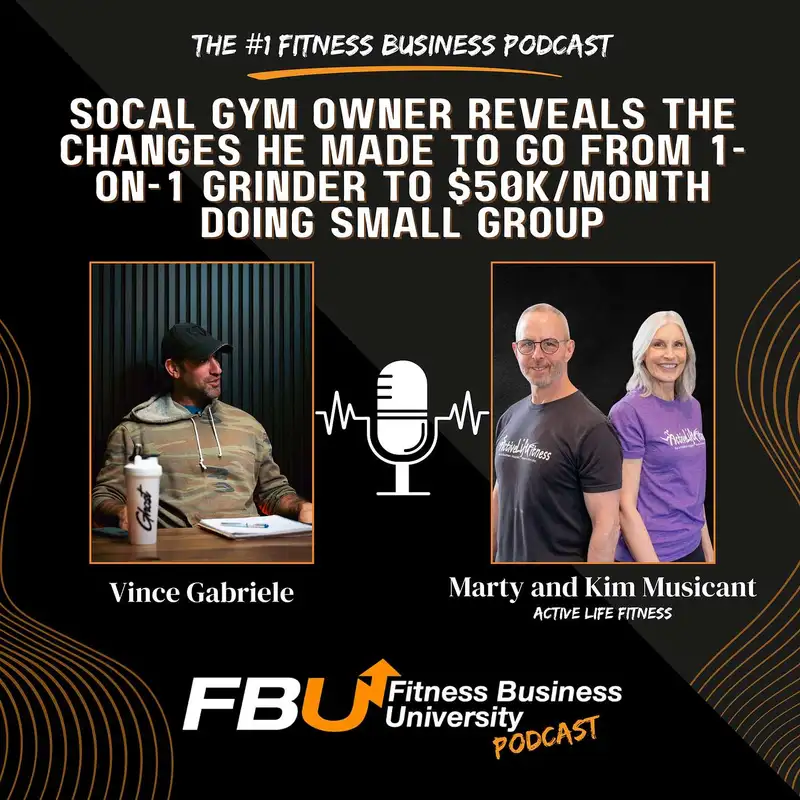
New Jersey Gym Owner Goes from Burnt Out and 18K per Month to 60K and Thriving
SPEAKER_00: All right, guys,
welcome to a very special
episode.
I'm doing these series of
interviews with members that
have had success with myself and
my team in the SPF mastermind.
And what we're doing is we're
doing this twofold.
Obviously, this interview will
be as a podcast, but it will
also be going into a new book
we're creating.
And that new book is called our
SPF Member Success Guide, where
it tells the stories of gyms
that have gone from struggling
from single-digit revenue to big
money.
And uh so I've been taking the
time to sit down with a bunch of
different gym owners over the
last several months and to pull
out these very inspiring
stories.
And I have a very guy that's
special to me today.
His name is I just figured out
what his last name was after
about 11 years of knowing him.
But this is Marty Musicant.
And your wife Kim did a
wonderful job of teaching me how
to say it.
I just think of music, musicant,
and I put an ant next to it.
Marty, thank you very much for
being here today.
I really appreciate it.
Okay.
So what we're gonna do is I want
to start at the very beginning
and tell us when you joined SPF
back in, I believe, 2018.
I want you to tell me where you
were in your business, where you
were personally, what life was
like.
Take us back to that kind of
moment, your pre-SPF mastermind
life.
SPEAKER_01: We learned ST worked
in November of 2018.
Yeah, we had been open for two
years.
He had about 75 memories, and I
would work like our trainer he
saw it in the weekend.
And the first couple of years of
our business from actually we
had a fire in 2015, but we only
opened three and a half months.
We didn't reopen in our current
location until September of
2016.
We kept the struggle the first
couple of years of that
business.
SPEAKER_00: Marty and Kim run
the business together, their
husband and wife team, who
joined the gym not that long
ago, about a year ago.
Hannah's done a great job with
it.
So, Marty, go ahead and continue
with your story.
SPEAKER_01: So 2016, we reopened
in our current location.
And it was a struggle for the
first couple of years, on mainly
because we didn't know we were
down.
And uh by the time we joined the
mastermind in 2018, we're only
at 75 members.
And we were sh we were
struggling to get above$18,000 a
month.
We did have one part-time train,
but it was mostly mere care.
Doing the training.
Yeah, one part-timer.
And then I was getting up at 6
a.m.
every morning.
Actually opening the gym at 6
a.m.
So I was getting up more at
4:30.
Five days a week, and then came
in to open at seven on
Saturdays.
I was doing most of the
training, coming back at nine,
foot shifts.
It just left me very little time
to work on the business.
I was so involved in the
business.
Despite that, we kept growing
albeit forward, and by the time
October 2018 rolled around, you
I don't remember how I found out
about you.
I don't know if I saw you on
Facebook or whatever.
But somehow I I ended up on your
email list.
And he decided to do your
two-day membership up at GFP.
SPEAKER_00: Yep.
Yeah, I remember that.
SPEAKER_01: And that's when I
decided to join the Masterline.
Of course, I needed that Kim
meet with you first to make sure
that you know you were on the up
in that song.
SPEAKER_00: Yeah, I want to tell
that story.
I want to tell the story.
But before we do that, tell me
when you saw the event, what was
the pain that you were
experiencing that made you be
like, I gotta do this event, I
need help.
What were the things was it were
you feeling burnout?
Were you feeling stressed
financially?
What was the challenges that
made you be like, I gotta call
this guy and this event looks
good?
Let me try this out.
What was it?
SPEAKER_01: I think all of the
above.
I mean, Kim and I have been in
another mastermind prior to
meeting here.
SPEAKER_00: Okay.
SPEAKER_01: The mastermind was a
really dead one, but we still
struggled, and it had nothing to
do with the people that ran the
mastermind.
It was really awesome where we
were at in our evolution.
And you're always talking about
the psychology of the business
owner.
And back in those days, our
psychology wasn't the greatest.
We had a fire in 2015.
Um then in 2017, you know,
things were so bad that uh we
were still paying off a loan for
one of our members.
We were still paying for our
original equipment lease for
about a thousand dollars a
month.
And I had to take out a personal
law with a company called Cavage
just to keep things going.
Late in 2017, we ended up having
to sell our house because we
just we were paying our bills of
a business.
We were having a hard time
paying our personal bills.
So we stone our house that we
rented for the next few years,
and that really helped a lot.
So that was a like a true
decision we made prior to
meeting her.
And uh it paid off as we things
started getting better in 2018.
But by the time October rolled
around, we realized that we
wanted a lot more.
And we just weren't getting it.
We wanted more freedom, we
wanted more money, and we
decided no doubt we were gonna
reach out for help.
And that's when I found out
about your mentorship when I
decided to grow.
SPEAKER_00: And yeah, and so you
joined the mastermind, but it
was contingent upon something.
It was contingent upon Kim
Meeting Me, which was a first
for me.
And this was funny because this
is back when I had just started
this mastermind.
So I had never run a mastermind
before, and most of the guys
that were coming in, they were
like younger gym owners that
were coming in.
And here comes Marty, and then
he brings his wife, Kim, into
the office at my gym with me,
and she's before he signs up for
this mastermind, I want to make
sure that you're not some crazy
charlatan.
And so we had a really fun
conversation, you, me, and Kim.
And I don't know what was said
in that meeting to make Kim give
you the green light to join the
mastermind, but uh maybe I don't
know.
SPEAKER_01: I think it was just
the report straight or telephone
that was established pretty
quickly.
SPEAKER_00: Yes, she is a big
ball of fun.
I really enjoy her.
Awesome.
Okay, so that that is the time
you started to join and
obviously came into our world.
When were the things what were
the things that you started to
do?
This was a really helpful thing
for some other people that heard
some of the other interviews.
What were some of the things
that you started to do to give
you the sign and the feeling
that all right things are
starting to get a little better?
SPEAKER_01: It was really
learning to become a better
marketer.
SPEAKER_02: Okay.
SPEAKER_01: And some of the
tools that you had given us
right from the start with the
concept of the marketing book.
So make sure that you're
everywhere basically.
Five or more fingers on that
bar.
And also the uh the idea of a
marketing calendar by our
Chibote, because prior to that,
we were just we were scattering
all over the place.
And despite the fact that we
were in another mastermind, we
had learned some of the stuff
for whatever reason where we
were at mentally, and it just
didn't secate at the time.
So I think the way you presented
it just really simplified it and
uh really helped a lot.
SPEAKER_00: Okay, and then so
what were so you got your head
around the marketing stuff, and
again, for those listening, the
marketing glove is basically
this symbolic thing that I
invented to have multiple ways
that you're gonna get new
customers.
A lot of people were relying on
just one way to get new
customers, and really what you
need to de-risk your business is
to have multiple ways to
generate new business.
So, what were some of those
things that you did?
What were some of the fingers on
your glove?
What were some of the things
that went into your calendar
that got you to start having
some success?
SPEAKER_01: Yeah, as far as the
glum goes up, we had our we get
our quite a few things in the
glove, but we weren't doing any
of that well.
So what we did, we stepped up
our email then.
Okay.
SPEAKER_02: Okay.
SPEAKER_01: Prior to that it was
very sporadic.
The images that we were using
were much better, and the copy
that we would put in there, as
well as these organic posts
always have a poll to action.
They always have our web address
on to drop people to our
website.
SPEAKER_00: So I'm hearing two
things that you did well.
One is consistency.
Right.
I think a lot of people don't do
consistency really well.
Right?
They they do what I call
squirrel marketing, where they
do one thing here, and then they
try things over there, and it
sounds like you were consistent
with email, you were consistent
with social posting.
And then the second piece I
heard is that you applied the
principles that I learned, I
didn't make this up.
You applied the principles that
I learned from the great Dan
Kennedy of what's called direct
response marketing, right?
Where you always put something
out there with an intent to get
a response.
And I think that's like a big
piece of where people screw up
marketing, is they just they do
branding, right?
They just throw stuff against
the wall, they put their logo
out, and they spread the logo
out.
And instead of that, you go with
the intent to generate a lead.
And then there's a system behind
that we can get into, but at the
end of the day, it sounds like
you did consistency and direct
response.
What else?
What were the other things that
happened?
SPEAKER_01: So if you email, it
was organic Facebook publishing.
We started wrote Facebook ads
around that pun.
SPEAKER_02: Okay.
SPEAKER_01: That might have been
prior, it was probably prior to
KISS when we were using somebody
else that you have recommended.
But that went very well for a
while.
We had some decent success with
some local street fairs.
SPEAKER_02: Okay.
SPEAKER_01: And our website was
upgraded.
Just just marketing took over
our website, and they upgraded
our marketing, and that's that
kind of ties in when we were
more about uh SEO, search engine
optimization, and try to rank
higher on Google.
So I think all those things came
together to help us get more and
better ways.
SPEAKER_00: Well, there's
something different about your
website that typically I see
this a lot where people they
have a website and they never
look at their website as a
client-generating tool.
It's like just something they
have that exists.
But since we started building
websites for people, the website
has become what I call like a
client-producing asset, meaning
you can depend on your website
to give you generate leads that
deliver good quality clients
that are interested in personal
training.
What were some of the di changes
that they made for your website
that made it all of a sudden
start to work?
Like I imagine you went from
getting zero clients from your
website to getting clients from
your website.
SPEAKER_01: Well, we first
opened, we hired a local web
designer, someone from town,
really nice guy, and he did our
website for a couple years.
He did not specialize in the
fitness business.
He was a general website
designer.
And when we looked up with KISS,
the website was more geared
toward towards fitness and they
knew how to do it better than
this guy.
And I think we learned how
better to tell stories because
we gave them a lot of the
content for a website.
So we had more stories on there,
we had more testimonials on
there, social proof, obviously,
and a way to contact us.
I think we we had a lead magnet
on there where we could capture
their email address.
And we also had another have
another form on there where they
could contact us directly to get
more of the information on the
setup of a consultation.
But the combination of all that
stuff made it take offer.
And plus, like I said, it was
learning how to get people to
our Ratson through search engine
was a was a very big boost to
us.
SPEAKER_00: Awesome.
Let's so like we've gotten into
the marketing, and then what
we're working through right now
is the starting point of Marty
being being in$18,000 a month
business that is fully dependent
on him, that's fully dependent
on him doing everything and
doing the majority of the
sessions with a part-time
trainer, till fast forward to
today, where we'll tell you
where he's at in a second, which
is super impressive.
But Marty, tell us now the
second level of starting to
build a team, right?
You went from a one part-time
trainer with you doing
everything to now you have a
full team.
Talk us talk tell us about that
process of you going from almost
no employees to having a full
team that what you've got now.
SPEAKER_01: I think the terrible
part for us, the breakthrough
moment, if you will, was when we
hired our first full-time coach.
It was 2021.
He's still with us, by the way.
And right about the same time,
he hired our first part-time
admiral with the those two
things really helped help us to
work more on the business.
He went to another level of
working on the business.
I saw what else to do now.
So that really fueled our
growth.
And by December of 2022, we had
grown 41% year over year.
SPEAKER_00: So you're starting
to see, if those listening to
this, you're starting to see a
progression.
Like the first progression was
marketing skills, was learning
how to acquire new customers and
learning how to make some money.
And then the second progression
is people.
If you don't have any money, at
$18,000 a month, you guys
weren't making enough money to
be able to afford to hire a
full-time trainer.
Right?
And so we ring the register
first, we teach marketing, we
ring the register first, then
all of a sudden we start to
build as a form of stability and
a freedom of some money to be
able to hire these people.
And then there's all new
challenges, right?
Learning how to lead those
people.
What were some of the maybe
challenges you faced with
leadership and having a team and
payroll and all that stuff?
SPEAKER_01: Yeah, I'll address
payroll first.
So the first payroll was a
little out of whack.
So it was an it was an
investment like during the
onboarding of the trainers.
And it's not just we were
full-time training, but we had
since added four of the part
panels.
So the onboarding is a per time
and so we're no well worth it.
So I had to get better at that.
Just reading on my humanity-year
experience of the coach myself,
I didn't always have to teach it
to somebody.
So I had to get it out of my
brain.
It's a documentation.
And if it was the first time I
didn't have how to do that, this
basically was just watch what I
do and talk religion.
SPEAKER_00: Yeah, my favorite
form of teaching delegation.
My favorite form of teaching
delegation is you do, they what
is it?
You do, you probably know this
better than I do.
You do, you do, they watch, they
do, you watch, and then they do.
Right.
That's the form I learned that
many years ago.
It's a real simplified way to
teach delegations.
So the next phase was building a
team and getting some full-time
team members, not just from
trainers, but some admin help,
and that continued to grow the
business and you continued to
work on the marketing.
Now, I would imagine when you
first hired those few people,
you were still doing a lot of
sessions, right?
SPEAKER_01: I definitely was
doing a lot of sessions.
I was doing all the most of the
one-on-one sessions, but we did
percentage on small groups.
We were growers seller, we
started off with a four-to-one
ratio.
One bunch of rebuilding six to a
lot of money.
As we kept growing, we decided
that we would we have space to
take more people.
But we need another coach in the
group.
So any group over search will
start to have two people.
So for a while, I wasn't
coaching almost, but then I got
pulled back here as a good shop,
baby, until I started hiring
some other quartiles.
I age just now our max in a root
there is tiny weather people.
One that will sold a lot of
roots, so that was quite the
evolution we have.
Besides me and Kira, we have
some thick employees.
You're helping us.
unknown: Yeah.
SPEAKER_00: That's amazing.
And so basically it's you get
you find the skills to get new
customers, you hire the squad,
but you're still doing a lot of
the work in the very beginning
when you hire those first few
people, and now you're at a
point where you have six team
members, and you're not doing
nearly as many training
sessions.
You're in that classic stage
three, where you got a squad,
you got a team, your business
isn't dependent on you doing all
the sessions, and you are able
to spend time working on the
business, doing the marketing,
doing the sales, growing and
leading the team.
And so you've evolved, and now
you're starting to do cool
stuff.
It just had a big price
increase, right?
You started to think
strategically, so why don't you
tell us about that?
SPEAKER_01: We are checked out
prices for for the original
manage.
Well, there's about 40 people.
We had kept those prices also
walkers found when you were we
want you to raise prices on they
were ordering a price increase
that we had back in April.
And to my surprise, all the
short people left because of it.
We did raise prices on all of
the other memories at the planet
that he probably had about 150
members toll, although we had
what amounted to a 10% increase
the cost of order or three
thousand dollars on my BFT.
We were nervous about doing it,
and we had a weed on you and
some other members as a
mastermind to get the courage to
do it.
We realized that in retrospect
we much worry about nothing.
Because it was the right
decision, and now we're up to
170 miles.
Anyone anyone who's unsure about
raising our quality with my
advice, don't wait.
Do it as soon as you said you
sure don't look back.
SPEAKER_00: Yeah, you handled it
masterfully, and there's been a
few people that have been
hesitant to do it after I've
been coaching with them, and I
just call Marty and you just
tell the story about what you
did.
But it was and we talk about
this in in increasing profit.
It's the it's the fastest way to
do it.
And the reality is that every
business is doing it, every
business is raising prices, and
I don't see why a gym is
different than any other
business.
We still have things we need to
invest in.
We have staff members that need
and here's the thing too like
staff members that have been
this for a long time, they need
more.
You know, that when we hired
someone at 23 years old, and now
they're 30 years old, their
lives are different.
And if we want to keep those
people around, they need to be
paid and they need benefits and
they need all these different
things, and the clients have an
invested interest in that.
They right they and again, they
don't want to pay more, but I
think in most cases people
understand and people get it.
All right, so let's talk about
today.
I think you we've led people
through the stages, right?
You're almost like a classic
stage one going to stage three
gym, right?
Struggling at 18k, doing
everything yourself, hiring a
couple team members, still doing
almost everything yourself, and
now you have a team of six, your
business is running
independently of you doing the
sessions.
Tell us where the business is
today, and I can verify all of
this because you are now a
member of the CEO Mastermind
that comes to my domain
quarterly with your profit and
loss statement in hand.
I've seen your revenue, I've
seen your margins, I know how
well things are going, but I
want to hear it from you.
Give us the data and the numbers
of where the business is now.
SPEAKER_01: We're sitting at
about 170 members.
Five percent of that business is
from the one-on-one training,
the rest is small group, staff
of six.
We hit our highest revenue month
in September at 60,000.
We're probably gonna get pretty
close to 700,000 should be a
year on December 31st.
Things are growing well.
We're gonna grow about 21% this
year, and we're hoping that it
continues next year.
We've decided to stay where we
are and maximize our space
rather than look at other
locations.
Our finish room for growth at
this location.
Personally, it's allowed us a
lot more financial freedom and
success.
And uh Kid and I are taking our
first trip to New York together
next week.
We haven't we have not been
together.
We hardly went anywhere during
the first few years of our
business, and now we're
international travelers.
We bought our house, we became
homeowners again three years
ago.
Yeah, to have it sold our house
in 2017.
So business has grown and it's
gonna get even better.
We have bigger things planned
for ourselves.
SPEAKER_00: That's amazing.
I want to dig into a little bit
more.
So obviously the business
started below$20,000, it's doing
$60,000 at very you didn't
mention the margins, you don't
have to, but the it's a very
solid financial sound business.
There's a lot of business that's
earned sixty thousand dollars a
month and they got fifty-eight
thousand dollars of expenses.
Like that is not you.
You have a very healthy business
from a profit standpoint, so
from a financial standpoint, I
know things are going.
We obviously had the funds to
buy a home and travel to Europe
and things like that.
What about you, Marty, as a
person?
Right, you mentioned your shifts
and changes from a mindset
perspective.
There's a couple stories that
you know really hold true for me
that I can get into, but I I
think from your perspective, but
what are the things that have
you've been impacted by from
this education that you've been
on with us for the last several
years?
How's it impacted you from a
personal level?
SPEAKER_01: Think I'd certainly
come a long way as a novice
business owner to where I am
now.
One of the one of the things
that has helped is or the
lessons that we learned in the
SPF mastermind with that mindset
and the psychology of
reonerance.
So it's not just about the X's
and the O's of marketing, sales,
and fact it and things like
that.
So just in order to be a bad
person, where to think better,
where to live more through
gratitude.
And trust me, I struggle with
this every day.
It's not like I'm perfect, but
I'm definitely so much better at
handling the day-to-day stress
of running a business.
And I wouldn't have it any other
way.
I think could vouch for the fact
that I'm not as negative as I
used to be, and I'm much happier
than I was, and I I'm a better
leader than I used to be.
And all of those things just
make a better life because
coming home and being stressed
and being miserable and just
having all the negative feelings
associated with a struggle in
business.
That's all all behind me now.
And you know, although we're
doing better, as there's the
bigger the business, the bigger
the problems.
When I work to handle those
problems much better, and I try
not to let things get out of the
way, and I try to stay as
grounded as possible and try to
avoid those highs and lows that
you see a lot when you don't
have that the experience and you
don't have the guidance from you
know from people like you or the
people I entertain, and the
other people in the mastermind
and the other guys and rising
gas and CEO, all of those people
like in my life, just has made
me a better person.
And as my relationship grows
with the SPF people, my
relationship gets better with my
team, and my relationship gets
better with my partner and my
wife care.
So I just think there's way too
many lessons for me to mention
that I've learned in the SPF and
the personal development side of
being a business owner can't be
discounted.
In fact, it's essential.
If you're uh if you're a coach
and you're still digging into
all the X's and O's of training,
the sets and the reps and all
that stuff, that's all well and
good, but until you really dig
deep into your own psychology,
that's what really is gonna have
to visit all.
And that's what did it for us.
And when I say these days, I'm
not just talking about the
impact it's had on me, but I can
see the changes and the impact
that it's had on Kim as well.
All those all those lessons have
really helped the two of us to
become better designers and
better people.
SPEAKER_00: Yeah, one of the
things that comes to mind when I
think of you is more of an
abundance mindset.
I you mentioned this and I
didn't think you were a negative
person when I first met you.
But you were not nearly as
upbeat and optimistic and
positive, and not in a blind
type of way.
You definitely tread carefully
like you should, right?
As I do.
But there's one story that it I
look at it almost like as the
crossroads of your success.
And that story was there was a
guy that was local to you that
had a gym that was nearby.
And there was I'm guessing some
like we had do, we don't want
competitors and stuff like that.
And it was during COVID where
you came to me, you had come to
me before and basically said, I
don't want that guy in the
mastermind, he's too close.
And then you came to me in COVID
and you said, Hey, I want you to
work with that guy and let him
into the mastermind.
And since that moment, that was
like a moment for me that showed
me that you had a massive
abundance mindset over a
scarcity mindset.
And so it was a big growth
moment.
And the cool thing is like I I
think from that moment that's
like when your business started
to explode.
It was like right when you
started really hitting some
bigger numbers, is right when
you made that call.
Do you remember that?
SPEAKER_01: Or was they
competing?
So get in on Dr.
Greg that I had already found
for us.
And I actually reached out to
him when we went out to lunch
and we were talking and got to
know each other.
And uh that just made my mind a
whole lot to stay.
And then someone else said,
well, when they're a guy just
like meeting the family and just
how to do better.
Yeah, I felt like a real like a
real shithead.
He might have dated that out,
I'm not sure, but I felt like a
real shithead for doubt.
One in the sky in the same room.
And it really bothered me for a
part.
So that's when I reached out and
decided to change it.
SPEAKER_00: Yeah, and it told me
a lot about the man that you
were, but also the man that you
had become.
And it was a cool It was a cool
thing because they also think it
came out of the spirit of
generosity, which our friend Ari
Weinswick talks about a lot,
right?
Of it being during COVID, it
being during a tough time where
everyone needed help.
And it was a period of time
where you were like, all right,
everybody needs help right now.
And you didn't want to take that
away from him, which I really
respected and appreciated.
And the cool thing is you're
both doing great.
And you're both where you're in
different, you're in different
towns now, but I think you're in
the same town at this at this at
that moment, you're in different
towns now, and I think it's
farther away, so it's better,
it's even better now.
But it's I've seen both of you
in such a short distance apart
have massive success at the same
time.
So it the abundance mindset is a
real thing, and you have it.
Marty, if someone was on the
fence about joining SPF, what
would you tell them?
SPEAKER_01: I would I don't know
what I tell them, but I would
certainly ask them what's
holding you back.
Or things so good for you that
you know we'd help.
Because honestly, even things
are going very well for us right
now, but I would never think
about going it alone no matter
what stage of my business I'm
in.
We've learned that challenges
these surpass are just a natural
part of business.
But if you have someone in your
corner, someone who's been
through lows and highs before,
and someone who's made mistakes
before, and someone who's
weathered a storm of the fire
and COVID and all the other
things, I would say there's no
reason to go it alone.
The investment that you make in
yourself and in your business,
you'll get that back
exponential.
And that's how I've known some
people who people have been in
business for years and never got
the help and they continue to
struggle.
And there's no reason for help.
Like there's help.
And someone who's been in
another mastermind, you fought.
I could tell that person that
I've only been in two, and this
one is far superior to the one I
was in before.
I'll end it for the lower ball.
SPEAKER_00: Marty, what you're
one of our biggest successes,
and there's a lot of people that
have joined SPF.
I can't say a lot, but there are
people that have joined SPF that
didn't have success.
What are the things that you did
as a member of the group?
Because it's it's not you
weren't successful only because
of us.
You were successful because of
you.
What were the things that you
did that made this investment
where you got a return on the
investment?
SPEAKER_01: Number one, I try to
make sure that my mind is right.
That's number one.
Number two is to take action on
things.
Because for many years I was
sold, I would just idle the word
everything.
I would read stuff, I would
listen to podcasts and watch
videos.
Well, I was real sort of take
action.
So I think sometimes the
information comes out at us like
a fire, like the water out of a
fire host.
And there's just so much.
So I've learned to take the
things that are applicable to
where I'm at in the business at
the time and solely work those
things in.
And develop systems over the
years where the steps are easily
repeated.
Particular, we've talked about
the marketing calendar before,
it's just knowing that every
year we're doing X amount of
challenges.
Every year we're doing a Black
Friday special, or every year
we're doing the same once every
month.
So consistency, which we talked
about before, that's real or so
being consistent with the action
sets that we take.
And something else I learned
from you is to try to spend most
of my time working on getting
clients who keeping clients.
That's really the big takeaway
from this.
SPEAKER_00: Yeah, I think that's
a big point right there.
I think a lot of people spend
time on stuff that doesn't
matter.
I call it this thing called fake
work.
Right.
And if you just looked at your
time that you're spending and
asked yourself, is this thing
that I'm doing right now helping
me get a new customer or keep a
customer that I've got?
You're probably in the right
place.
That's a really well said.
Marty, I want to thank you for
getting on here with me.
This was a great interview.
I'm so proud of how far that
you've come.
And with Kim and the rest of
your squad, I got the
opportunity to see your business
in action not that long ago.
Or walked into a bustling
session with Marty not training
the session, but back in the
office, do you know I don't know
what you're working on, you're
working on something, and had a
cut uh he can only meet with me
for a few minutes because he had
a client coming in to do a
consultation and get a new
customer.
And so there was things
happening and things bustling.
So this is real people with real
success.
And man, really uh really happy
that you did this, and thank you
for sharing your story.
SPEAKER_01: A lot of fun, Rats
and Shaq on your team for
helping us get to where we are.
SPEAKER_00: Awesome, brother.