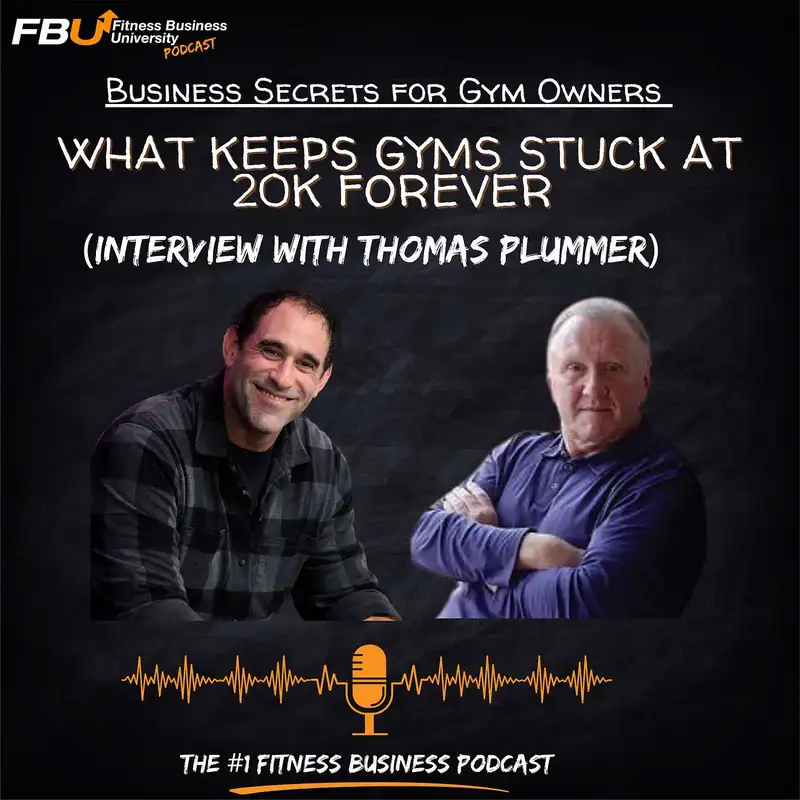
What Keeps Gyms Stuck at 20K FOREVER (interview with Thomas Plummer)
SPEAKER_00: What's up,
everybody?
Welcome to another episode of
the FBU podcast.
I have a very, very special
guest today on the show.
It's on it's rare that I have
guests.
Uh usually just me yakking into
the microphone talking about
whatever's on my mind.
But once in a while, I bring on
some of the best of the best
guests.
And today is the legend.
I I call him the term goat is
thrown around a lot lately.
And I think Tom Plummer is the
goat of fitness business
coaches.
Many of us are where we are
today because of all the years
of coaching and advice and
guidance and punches in the
mouth that we got from Uncle Tom
over the years.
Many of us are not where we are
today without his his advice and
help and love at the same time.
And so I I 100% can tell you
that I am not where I'm at today
without Tom, both in my gym and
my consulting business.
And you know, he's retired, but
he's now still out there, still
doing stuff.
And I'm honored that he's going
to be speaking at our event
coming up in Orlando, the Jim
Pranos event.
So if you haven't gotten your
ticket yet, make sure you get
down there and get and grab a
ticket.
There's a link in the show notes
for that.
But Tom is going to be the
keynote, he's the last time he
spoke in Orlando was March 8th,
2020.
And about you know, five five
hours later, after you got you
walked off the stage, Tom, and
the whole world turned upside
down.
And the funny thing is that this
is actually an interesting
thing.
We didn't even talk about it.
SPEAKER_01: No, it was already
handled.
It wasn't brought up in the
lobby.
They were already worried.
That was my last.
I had 22 more gigs that year,
and that year was the last one I
did.
Everything after yours was
canceled for the rest of the
year.
And it's just, yeah, three
countries.
I was supposed to be in Brazil
that year, back to Australia,
back to London, and then all the
domestic gigs, every single one
disappeared after that workshop.
So what a way to end with Vince.
SPEAKER_00: Well, six years, six
years later, we're back, same
hotel, same everything.
And it'll be it'll be amazing.
So I'm honored and and grateful
that you're going to be down
there speaking live.
You're slepping down to Orlando.
You'll be there in person, and
we'll have a great I know if
it's uh you're there, we'll have
a great time.
That's one thing for sure.
But I wanted to bring you on
today just for a quick podcast,
quick discussion.
The cool thing is, you know, we
were just talking before we
recorded.
You and I got on the phone to
kind of set up this podcast,
right?
To have a five the plan was a
five, a three to five minute
conversation to talk about this
podcast.
And that turned into a 97-minute
discussion, the future of the
world, and everything like that.
And it was absolutely amazing.
So you still have so much wisdom
and insights, and I'm always
grateful to talk to you.
So I know you're gonna drop some
some great stuff for us today.
So, Tom, thanks so much for
being here.
Appreciate it.
SPEAKER_01: My pleasure, man.
Always my pleasure with you.
So thank you for inviting me.
SPEAKER_00: Yes, sir.
So let's start.
You have been doing this.
How many years have you actually
been coaching gym owners?
SPEAKER_01: Uh I trained my
first client in 77.
Okay, so before our sports.
Yeah, uh, yeah, before most of
the guys were, yeah, it's uh and
um so coming up to 50 years and
uh sitting on 50 out on the
road, taught my first workshop
in 79, and I've surpassed way
past 1100 workshops now, and
every place you could possibly
do a workshop.
So yeah, I've been around for a
minute or two.
Yeah, it's been out there.
SPEAKER_00: So you've seen a lot
50-something years, 1,100
workshops, thousands and
thousands of gym owners that
you've had conversations with,
both in a coaching you know,
format, but also just at on the
breaks in the bar at the
workshops, too.
And you've heard some of the
cries and the oohs and the ahs
of struggling gym owners.
And that's the big question I
have for you.
And it's there's a Charlie
Mogram quote that I heard the uh
recently, and it was the key to
success in life is doing these
three things.
Don't do cocaine, don't race
trains to the tracks, and avoid
all aid situations.
SPEAKER_01: And so by sharing
I'm sad, I'm sad that it was
history and that person, that's
all they got.
That's all you got.
That's pathetic.
SPEAKER_00: But the point is
knowing what not to do is very,
very insightful.
And so I ask you, what are the
things of all the ones that
struggled that you know spent
their whole gym life struggling
and you know, really tired and
burnt out all the time?
What are the commonalities
between those gym owners?
SPEAKER_01: When you asked me
that question to set up the
podcast, I've never framed it
that way.
So you really triggered some
good stuff.
Actually, it's making me crazy
sitting up at 11 o'clock,
pounding on my laptop, trying to
figure out, okay, so what the
hell did it mean?
Where did this come from?
What is if you got to put it
down, and and there's a picture
that kind of appears from that
question where you you kind of
look back and you can get it
down.
Kind of that's the essence of
what I'm gonna attempt to do for
your workshop is to bring it
down into what is the problem,
what is the solution, so to
speak.
And I'm looking at this, maybe
the number one, these are no
particular orders, but the big
one is people don't know what
they want.
I'd like, you know, you open a
gym, what is that business going
to do for you?
You open a consulting business,
you open anything, and just and
they they open it, but nobody
often they're not sure why.
And I tell people over and over
again, never get in until you
know how you're gonna get out.
That business has to be
something in your life.
And many guys just end up
opening and they buy themselves
jobs.
They they don't know that this
understand, think about that.
This business sets you up for
the rest of your life.
And so they and so when I ask
people what they want and they
open a business and then they
screw the business up, they
never master the parts of the
business.
That fascinates me.
It's just you you own a gym and
you don't know how to market.
Take a marketing course.
You own a gym and you can't read
your own financial statements.
My God, get some help.
Have somebody sit down and
explain it to you and learn.
You staffing, we don't go to
workshops on staffing, therefore
we get frustrated and uh we yell
at people, but we have no clue
on what we're doing.
So we own a business, we don't
even know the parts of the
business, and it's incredible.
And so that we and we we look at
those things, and it's just the
business is simple.
Uh, maybe the ultimate thing,
and you do it's um, I'm worn you
vintage, you got me warned up
just wound up with this
question, is possibly the
biggest thing is every day you
have to sell somebody something.
And I see gym owners talk to
them, they go, Well, I don't
really like to sell.
Well, then close the gym, you're
gonna fail.
You know, every day you sell
memberships, then but they're so
busy being busy that they're too
busy to make money.
And there's a their thing I use,
I take a barbell and turn it
sideways.
And I this is how most people
run their gym, the horizontal
management method.
And they they they train a
client, then they go sit in
their office for 10 minutes and
then do a text, and then they
solve a problem for a pissed-off
member, and then they fire a
staff, then they hire a staff,
they train a staff, then they go
try to do marketing.
So they 60, 70 hours a week.
I'm so busy, but they're they
get stuck at$25,000,$30,000 a
month, which is pathetic in this
industry.
And because everything is equal
weight.
Instead of understanding if I
just got more leads, I could
convert those leads into
memberships, and I could get an
average in a training gym world
of 350, and I do eight to ten of
those months, it's a
million-dollar business in 18
months.
But then we're so busy with all
the other stuff that we just we
can't we're too busy to make
money.
So again, I I'll go back to that
the way I started that is you
when you own a gym, why?
What's it supposed to do in your
life?
It's a vehicle to get you
somewhere, but we don't drive
the vehicle, we don't understand
what we bought, and we failed to
run it, and then seven, eight,
nine years later, we're pissed
off because we're still making
twenty-five thousand dollars a
month and we close it.
SPEAKER_00: I it's interesting
as someone that has struggled
with not knowing what they
wanted, right?
And that's the one of the first
things you kicked me in the
teeth with I don't know how many
years ago that was.
Yeah, it was it was a while, but
it's interesting because I've
thought a lot of that about that
question.
And why did I struggle with
that?
Why do other gym owners struggle
with that?
And I think it is I was just
writing down notes as you're
talking, and I think this can be
very helpful and insightful, and
I want to get your opinion on
this too.
I think people have struggle
deciding what they want because
when you have to decide what you
want, in order to make a
decision, you have to say no to
certain things.
And so, like in order to choose
this, if you go to a restaurant,
you if you choose chicken,
you're saying no to steak.
The same thing goes for target
market.
If you choose adults over 40,
you're saying no to adults that
are 25.
And I think that's scary.
I think that that's scary for
people to say no to certain
things because it shuts off
possible possibilities.
And when you take off
possibilities off the table,
that can be a scary place to be.
And I so I've thought about that
a lot of like it is not knowing
what you want is all about the
failure to say no, which is hard
and which is scary.
I wanted to get your thoughts
around that.
Is that on the right track?
Do you feel like that's one of
the reasons why?
SPEAKER_01: I I think there's a
layer under it, and that so I
was wrestling with a client,
he's got a nice space, he's
topped out at about 45,000 a
month, which is decent and 2,500
feet.
But he's been wrestling with the
year is should I expand this
space?
Should I move across the parking
lot into landlord's other space?
Should I build my own building,
or should I just move the whole
location?
And this has gone on for a year,
and I finally just like make a
decision.
And it's to go with the no, to
take your point just a step
further.
When I say no, it also forces me
to make a commitment, and that's
the commitment where I have to
admit what I really want.
And I don't think a lot of
people know that.
So the saying no, but the subtle
thing under it is the
commitment.
I have to declare.
And finally, this guy declared.
He said, I'm gonna do this.
I'm like, okay.
Now the next hour I spent with
him was the probably the most
productive we've had in a couple
of years because we had a plan.
It's just if you know where
you're going, then we can build
a bridge backwards to today.
But if you have no idea where
you're going, you with your
20-some years of experience, my
50 years out here, guys like us
can't help anybody if they don't
know where they're going.
Yeah.
So they they just sit there, and
a lot of people, because of the
fear of commitment, and one more
layer under that, which I think
is people they get caught up in
the should, not the I want.
I think a lot of people do know
what they want.
I think they're terrified to
admit it sometimes.
It's just I had a guy in a
speaker school and he broke the
second day.
He was in the hall and he was
crying, and he was leaning up
against the wall and he had
tears in his eyes, and he was
not coming, you know, he was
hesitant to come back with the
breakups.
I said, Matt, what's going on?
He says, I I've always wanted to
be a speaker standing in front
of a room because I think I have
stuff to teach.
And I would never admit that to
myself.
And I probably have wasted 10
years of denying that to myself.
And he says, This is the first
time I felt confident enough to
admit that's what I want.
I've never even admitted it to
my spouse.
And here's, and so I think when
we admit what we want, we have
to commit to what we want.
But we on your side of no, I
also have to say, well, it's
like your parents.
Oh, Vince, oh, well, you know,
if you do this, you're going to
make your mother and I very
happy.
This is what we think you should
do in college and with the rest
of your life.
And so there's a guilt trip,
there's a should, or the spouse
whispers, well, if you work
less, we could spend more time
with the kids.
So that gym you're wasting all
that time in, you know, why
don't you just get a real job,
honey, you know, or something
like that.
So we get caught up in the
shoulds, we get caught up in the
guilt, we get caught up in that.
But I think it's just admit what
you want and commit.
And that commitment scares the
hell out of everybody.
Because once you declare it, now
you got to do it.
And a lot of people are that's
where the hesitation I think
comes in.
SPEAKER_00: Yeah, no, for sure.
I I guess it always comes back
to fear, right?
And you know, why people don't
show up to your I mean, a lot of
people do, but why more people
don't show up to your public
speaking masterclasses.
It's scary as hell.
SPEAKER_01: Terrified.
Yeah, yeah, it's terrifying.
SPEAKER_00: It really is.
It's like, and even me, like I,
you know, it's funny, I you
know, not nearly as many as you
have, but I went back to speaker
school last year, and I've
spoken for a decade, you know,
and spoken on many big stages,
spoken in front of 500 people
before getting back to speaker
school and being evaluated for
me was it was nerve-wracking.
Like I was like, possibly also
because we were in the SPF
mastermind was there, and I'm
supposed to be their guy, and it
was a little bit like, all
right, I'd better show up and
not let any of these guys do
better than me.
But uh, and I think one of them
actually did.
John's already killed it, he did
amazing.
But yeah, those does so it all
comes back to fear.
Okay, so they don't know what
they want, they don't sell, and
we could add marketing into that
same frame as well.
SPEAKER_01: Any other course uh
there's a terrible fee.
When you look at the gym, we
know the parts, so they fail to
master the parts, which is
senseless because if they had
any other job, they usually have
to learn all the components of
the job.
In the gym business, I just go
in because I think I'm a good
trainer and I want to train.
And so I really it's like I
again signing up for a marketing
course.
There's somebody online that
would help you, and specialties
and and the Facebook algorithms,
how to use Instagram better, how
to create YouTube.
There's stuff out, nobody takes
courses.
So then I I you look at another
layer under that, and one of the
things I you know I'm trying to
work into what I'm I'm gonna do
for you is people are resistant
to change, and why?
And if you think about it, it's
there's that person that doesn't
know how to fix it, but they
won't let anybody else fix it.
I've got a a friend I've known
for 35 years in this business.
His business every year is
mediocre.
His wife runs the business and
she's terrible, absolutely
horrible.
And he just wants to train.
But she's so bad at it, but she
won't let anybody else fix it.
So she can't do it, but won't
let anybody else do it.
And I think there's a lot of gym
owners like that that they just
have that ego, that sense of
ego.
That's when I'm picking up on
what you said while it goes
there's that sense of ego where
they've got to do it themselves.
They can't ask for help.
And then the second guy in
there, maybe a level above that
one, is they ask for help and
then take you give them an idea,
they take it home.
And I always talk about the big
dog.
You got a truck, you go to the
park, you let your gold
retriever out.
He runs all over the park just
peeing all over everything.
You know, he's marking his
territory.
So a guy like you gives somebody
an idea, they take it home, jack
it up so badly because they got
to pee all over it, so to speak,
and then they blame you because
it didn't work.
Dude, that's not the idea I gave
you.
So, ego, again, they can't admit
that maybe you have that.
So you work through, I've got
five or six stages of that.
I work with clients, but to get
up in that level where you're
willing to be coached and you're
willing to admit that what
you're doing isn't working, and
you're willing to submit to
somebody else to help you,
that's what makes consulting so
difficult for so many people is
that there's very few people
willing.
How many, you know, you've got
guys, I'm sure, sit in your
workshops for two, three, five
years and still do$25,000,
$30,000 a month.
They don't change.
But the the text out there, the
information's out there, the
marketing advice is out there,
they don't change.
Why?
Because of resistance to change,
they can't change, they just
can't admit that they can't do
it, but they're not going to let
anybody else help them.
And so they'd rather ride that
pig into the dirt than change
it.
Makes me insane sometimes with
that, with those guys.
And you just can't help them.
SPEAKER_00: I have a question on
that.
And again, every time we talk,
it's like I the the hardest
thing to do today is limiting to
this to 30 minutes.
But how do you balance I I I
we're gonna flip to what are the
successful gyms doing, right, in
a second.
I'm going to guess that there's
some ego in that in that group.
And my question is like, how do
you balance the part of the ego
that is driven and wants to
succeed and wants to win and the
ego that is just destroys a
business that doesn't, it keeps
them where they're at?
Where's the balance between the
the two of those things where
you use your ego in a healthy
way to grow, but it doesn't get
too crazy that you know you
don't even recognize who you are
anymore?
SPEAKER_01: If I looked, I just
taught a light planning workshop
last week, just a whole day of
where are you gonna be in 10
years, what do you want?
I had four guys in this room
that would probably be, if we
looked at the top ten training
gyms in in the in probably the
world, they are probably four of
the top ten by revenue per
square foot.
And it's weird, but the guys
that are most successful have
the least amount of ego.
And they're because they come
into it looking at the business
as a tool, not as a child, not
as something.
They come in and look at it as
they just they're they see it
differently.
One of my guys is doing 1.8
million in 1900 square feet.
And he's he there's not a shred
of ego to this guy, unless you
play golf with him.
Then you're gonna see a little
bit of macho stuff because it's
just some dude playing golf.
But he's one of the most
coachable people I've ever met
because he'll just sit, ask
ideas, and then he adapts them,
but he he just he's willing to
do that.
And I've got another guy pushing
two million and nine thousand
feet this year, and that's a lot
of revenue.
And the difference between him
and the guys that resist and
don't want to change is ego.
He has none.
The the better you get, the more
willing you are to let go of
your ego and just kind of you
learn, you you you set it aside,
you become a self-actualized
human being where it's okay to
you develop relationships
because they do help you, not
because you're trying to outdo
them, outmatch them.
You're willing to ask for help.
It's like my my clients, and I
always laugh at stage four
clients in consulting.
Stage one, they're failure.
Stage two, you help them, they
start making money for the first
time in their life.
Stage three clients, they're
like telling everybody.
Stage four, they never talk to
you again because now they tell
everybody, oh, it was always my
idea in the first place, and I'm
really the one that taught
Plumber everything.
And you get a stage four client
where they don't, they simply
don't remember who they used to
be, how they started.
Why?
Because their ego says, I have
to be that guy now, I have to be
the person.
When you did speaker school last
time, your body has changed,
your voice has changed, your
experience has made you a new
person.
Coming back to take who you are
and let yourself evolve into the
next version version, Vince,
that's no ego.
That was something just you you
know, you you evolve every three
to five years.
You sit up there and say, Look,
I'm different now, and I want to
be a better speaker, even though
you're very good.
You just said, take me to the
next level.
You know what?
That requires zero ego to do
that.
That's just I want to find out
how good I can be.
It's not about ego, it's about
potential.
And that's and how good can you
be?
And most guys never reach the
potential because they're so
just they're just trying to out
macho every other guy.
And it's it's just suck.
It's just it's what a waste of
your life.
SPEAKER_00: One of the have you
read any of Robert Ringer's
books?
unknown: No.
SPEAKER_00: So Robert Ringer is
one of my favorite unknown
authors, but he has a concept
that he talks about called the
ice ball theory.
And the ice ball theory is
essentially in however many
millions, billions of years, the
sun is going to burn out.
It's no longer going to exist.
And then the world would
literally freeze over and turn
into a big block of ball of ice.
And there'll be no record of
anything in anyone that ever
existed.
So the point is don't take
yourself too seriously.
We're all going to be frozen
balls.
I like that one.
Okay, that that was great.
SPEAKER_01: I heard that same
theory from one of the old
motivational guys.
I had some, I've got some
ancient books on my shelf.
I mean, my books are probably
older than most of the guys you
work with.
But one of the guys was the he
said, just anytime you drive by
a seminary, peek over the fence
because that cemetery is filled
with people that thought they
were totally irreplaceable.
And so somewhere out there they
are.
And the gym business, we look at
these things, it's just I'm
fascinated by how many gym
owners in their 20s up to their
40s just they fight everything
because they again they don't
know how to do it, but they
refuse to learn how to do it,
and they refuse to let anybody
help them because the ego has to
admit that I don't I don't know
how to do this.
But it's like driving it for our
first time.
You have to have you ask for
help somewhere, dude.
It's something I don't know.
Teach me.
I just it makes me crazy.
SPEAKER_00: One of my favorite
stories of you that you actually
don't even might not even know
about, and this shows you're no
ego, but I have a buddy named
Brent Gallagher, he's one of my
one of my really, really good
friends, and he's got a gym in
Houston that absolutely crushes
it.
And he hired you for a
consulting day.
And in the first hour, you told
him all the things he needs to
change about his business.
And then he says, Oh, yeah, by
the way, I'm doing three million
dollars in about 6,000 square
feet, and our margins are off
the charts.
And you paused and you said to
him, Forget everything I just
said and don't fuck it up.
It's like it's my favorite
story.
Like, I don't even know if you
know that.
I don't even know if you know
Brett, but he's a really good
friend of mine, and he tells me
that story, and it just shows
that like no, you weren't you
were trying to give him the best
advice you could, but then you
realize that business was about
a unicorn, and don't mess it up.
SPEAKER_01: Sometimes that's
hard to do.
See that sometimes it's hard not
to screw it up, and especially
when it is an outlier.
SPEAKER_00: Yeah.
SPEAKER_01: Yeah, there's yeah,
there's a there's a guy in LA
that's he showed up two
workshops and he sat in one of
my three-day, the old business
schools, and we used to get 20
people locked up for three to
five days, depending on the time
of year.
And he had 6,000 feet doing
about seven and a half million
in LA.
And he was telling me his
numbers, and I'm just like, I'm
I'm not sure, dude, I got
anything that you need.
I said, What are you here?
He says, You're always going to
find new ideas.
And then I'm like, Oh, okay.
But it it was very flattering
that he was there, and I'm not
sure I ever could help him
because he was such a freak.
But the funny thing is, he he
took a he had to take a call
right in the middle of the
workshop.
And you know how I like you
know, people doing calls and
workshops.
And so he grabs his phone, runs
out, and he comes back in.
He says, That was my brother
calling.
He was in the space station,
he's an astronaut, he was flying
overhead and just wanted to make
sure he could talk to me for a
few minutes.
Like you're a freak, dude.
You're just everything about you
is a freak.
The whole family's a freaks, you
know.
It's just but he was very kind,
he was very gracious.
But there's sometimes where when
guys get to that level of they
still seek help.
I'm not so sure they need help.
But it's amazing that both of
those guys, you know, your
friend and my client, the other
client, look at that, they ask
for help, even though they're
crazy successful.
That says more about them than
it ever would about the stupid
ass consultant.
You know, that they how how good
you have to be where you're
you're doing three million and
you're still looking for opinion
just to make sure you didn't
miss anything.
In today's world, that guy'd
write 12 books, he'd be teaching
35 workshops, and he'd be
selling you the hacks and all
this.
Here's a guy that's an outlier
making three million dollars in
a gym, and he's he asked for
somebody to look at his
business.
That says, man, what does that
say about that person?
Their ability to let go, there's
not a drop of ego anywhere in
there.
That just that's pure.
That's why the guy's successful,
that's why that guy's brilliant,
the guy in California's
brilliant, that's why the guys
that make the most money,
because I think they're all like
that.
They're humble enough to say,
what am I missing?
SPEAKER_00: Well, my friend uh
that we're talking about Brent,
he's a very, very loyal follower
of the show and listens to every
episode.
So, Brent, there you go, man.
We're talking about you on the
call.
All right, so let's let's switch
gears.
We talked about what screws it
up.
That we're starting to get into
what are the things that make it
work.
50 years you've coached all the
big dogs, my friend Frank Nash,
Greg Girab, who's actually an
SPF mastermind member, uh, my
friend Colin McGarty, who's I'm
trying to get his butt down to
Jim Pranos.
He's uh he said he doesn't like
to leave the state of New
Hampshire.
That's what he said.
So what are the big dogs doing
well?
SPEAKER_01: I think there's not
a there's not many traits.
You can get them down to four or
five key points with all of
those guys.
Uh you'll probably get Colin
down because he's a Disney
freak.
He goes, so you're you're
probably gonna you could get
Colin down just if you guarantee
he could go to Disney one day.
SPEAKER_00: He's a he's a he's a
big wrestling, he's a big
wrestling fan, and he didn't
come to Jim Business Raw last
year.
So I'm I'm starting to think
he's he's just not gonna make
it.
SPEAKER_01: So I I look across
the board at the people that
make money, they're one, they
understand how the business
really works.
These are sales machines, they
have to be.
You have to create a vehicle
where somebody buys a
membership.
So a lot of gyms flail because
they try to be everything to
everybody, and their marketing's
horrible.
So if you look at all the gyms
that are very successful, and
I'd say all of them, they are
all target specific.
They have a very good grasp of
who their member is, what their
client needs.
Like that most of the gyms now,
when you training gyms, you're
90-95% of your people who are
over 40, probably 70 to 75
percent are female.
They're the top 25 to 30 percent
by affluence in any given
market.
They're they're very target
specific.
And the guys you mentioned all
have very target-specific gyms.
You know, Colin's got probably
in that, we we think New
Hampshire, Dover, you know, how
many clients can he have?
The original Planet Fitness is
there.
He's probably got eight, nine,
ten clients within that county.
And he just, but he's different.
He's separated himself.
So the guys that are good have a
sense of differentiation.
They don't they're they don't
try to be better, they try to
show how they're different than
everybody else.
And you see stuff, my last
workshop I taught last fall, I
pulled up websites from like 15
gyms in Florida, Boston area
places, and they were crap.
They were just absolutely
totally crap.
It's like you know, we have
professional trainers, certified
trainers, and we're gonna design
a program specifically for you,
and we're that gym where
everybody's gonna love us, and
it's just and here's all our
trainers, and it this it's
worthless.
But the other guys market toward
finally a gym where you belong,
or here's a gym designed just
for you, or here's a gym for
affluent people.
You can see by the other people
in the ads, testimonial driven,
and they all do the same thing.
They master their target market.
But most importantly, on all
this, that barbell I just
described earlier, Vince, they
turn it upright.
They stand it on its end.
And somewhere in there, every
single one of them has come to
that point where all they do is
work on lead acquisition, lead
conversion into visits, visits
into either trials in my world,
six-week trials for most
training gyms, and then
conversion into memberships at
an average of 350 or higher.
They do that.
Everything else they farm out.
And I can one of the thumbnail
things is if you ask me if a gym
is successful, tell me how many
hours a week the trainer, the
owner trains.
The trainer's training over 10
hours a week in his own gym.
I'm gonna tell you right now,
without looking, it's a$25,000
to$30,000 a month gym, and it
will be forever.
You can't train over 10 hours
and you just broke it.
SPEAKER_00: You just broke some
hearts right there, Tom.
SPEAKER_01: Well, but look at
your you know, if you're happy
making 30,000 bucks, I'll give
you the same thing that Brent,
you know, just don't screw it
up.
If that's what makes you happy,
do it.
But if you're not making the
money you want, it's you.
SPEAKER_00: And the funny thing
is, I think Brent does train
more than 10 hours a week.
SPEAKER_01: So does so does Greg
Grab.
But Greg Grab, one of the best
things Greg told me is he went
in one day and started training
because he still loves it, not
because he has to.
Right, right.
And that's the and that's one of
one of the things I try to teach
everybody to get a 10-year plan,
seven-year plan, get that plan,
next one with a bit zero on your
birthday.
The day you go to work because
you want to, not because you
ever have to work again, is the
best day of your life in your
gym business.
You don't want to be going to
work when you're 57, your back's
torn up, and you're you've got
$5,000 in the bank.
And if you don't make money this
week, you can't pay your rent.
That you don't want to get to
that spot.
But yet I've got clients that
come up to that because they
just they've been real happy
training 30, 40 hours.
I love what I'm doing.
They make$50,000 a year, and
then they get old, meaning 57
and damaged, and they're they
can't go to work.
They're just they they don't
love it anymore.
They've lost the passion.
It's been 25 years of sweaty
people.
You know, they just they're
done, but they can't be done
because they've never learned
how to do the business.
So the guys that do it all well,
they they they only do a few
things.
They focus on sales, they don't
train in their own gyms very,
very little, or unless they have
great managers like Greg Drab,
that people that can run the gym
and sets him free.
But you and you look at that and
then you look at the focus, the
ability to farm everything else
out.
You get a good lead trainer that
can manage them, manipulate the
process.
And one thing I would say, one
common thing we don't talk
enough about, you know, even you
and I should have that
conversation sometime, is they
they're willing to evolve every
three to five years.
Now, how many guys left over
from 2005, first generation
CrossFit guys just keep clinging
to the technology?
You know, Greg Glassman was a
genius.
CrossFit was absolute genius.
I I that's one of the few things
in my 50 years I've looked at
this and go, man, that was
magic.
He was so right.
He committed, he invented
community, he brought that into
the gym world.
The guy, he his certifications,
everything he did was just a
stroke of genius.
The guy never gets enough
credit, I don't think, for what
he created.
But the world has kind of moved
on.
And can you evolve?
If you're an old team guy from
2010, can you evolve?
And how many of these guys don't
evolve anymore?
So you see these team natural
franchises, and they're mostly
all not doing very well.
How many of them are those guys
that own them say, I need to
evolve, I need to reinvent my
business and move on?
So, one of the things is we
cling to the past too long.
We cling to old methodology, old
technology, and then you see the
guys that are good, man, they're
willing to just break their gym
every three to five years.
They're willing to, you know, a
couple of my guys are just
completely gut their gym and put
the pod system in because that's
what you need now to be
effective.
Then other guys fight it because
they still want to train like
they used to.
One big gym, and I just take my
clients all over the gym, and
oh, that's the way we always
did.
Good, you're gonna be$30,000
forever.
So, are you willing to evolve
and re and reinvent yourself?
That's why it margin you going
to the speaker school, is
there's another level of vents.
You were willing to evolve and
get shoved to that next level.
And you know how many speakers
out there, Chris Poyer sees a
performer and he goes, Oh my
God, they're teaching the same
stuff for five years.
They don't even change the damn
slides.
And yet here you are with all
your experience saying there's
another level of play, shove me.
And so that willingness to
evolve, we don't see that much
in the gym business.
The best guys evolve.
They're willing to look every
three to five years and let go
of old technology, let go of old
methodology, and take what it
is.
Nobody cares if you use a
kettlebell, a barbell, a
dubbell, a medicine ball, or a
band.
They care if they get results.
So, what's it going to take this
year with this client to get the
results?
Don't cling to methodology.
Just who's your client and how
do I sell them and everything
else?
Get the hell out of your pod,
give it to somebody else, let
somebody else manage those
parts.
You, owner, bring in new sales
and you sign them up.
SPEAKER_00: Amazing, Tom, for
those on the fence for coming to
Jim Pranos, which I don't know
how they would miss dressing up
as a as a mobster for the
weekend.
Can you give us a little trailer
on what you're going to talk
about?
You know, what you're preparing
for us.
And I know you're everything you
do is always you you always put
so much time and energy and
effort into whatever you do.
You you're always asking
questions about how it relates
to the market.
Make sure you you that's one
thing is you as a speaker really
understand is like who's in the
seats and who you're speaking
to.
And you've asked me a lot of
those questions about my guys,
but give us a little bit of a
the commercial before you wrap
of what you're going to be
talking about in Orlando.
SPEAKER_01: As I hit the 50-year
mark and start to kind of fade
out and leave this industry to
young gurus like you, there's
still lessons, I think, left
that need to be said.
And what does make a gym owner
successful?
And how is that gym owner
different than the ones that
struggle and are frustrated with
their business?
There is there's things that we
should think about in our own
behavior, why we are doing what
we're doing and why we don't
change.
And maybe if we understand that
process, we will change it
someday and be able to accept
help and advice and grow this
business.
And maybe if we understand what
this business means, it's a
vehicle to create wealth.
And you know, I I don't care
about the million-dollar this,
the million dollar that, the
million dollar this.
What I care about is money.
If you've got enough money, live
life on your own terms.
Money is freedom.
That gym is just nothing but a
vehicle to create freedom in
your own life.
But we don't understand that.
We don't understand what these
gyms are about.
So what I'm going to try to do
in 90 minutes is for you, it's
just like, okay, man, here's
what I've learned from 50 years
working with guys all around the
world, and here's what works.
And I will tell you the a funny
thing, at one point, the top
seven gyms in Poland were guys
that went to my workshops.
The number one gym in London for
over a decade, 3,500 square feet
to about 1.2, was the guy that
we've done, I've done workshops.
There's a consistency with the
guys that play, and I've been
very blessed to be able to see
these guys in motion.
But all these guys, the guys in
South Africa that were scoring,
my guys in New Zealand, my guys
all over the world, they all
have commonalities.
They all do the same thing.
It's amazing when you get down.
If you get the top 20, 30 guys
down, they're like a
brotherhood.
There's no egos, they exchange
ideas freely, they reinvent
their gems every few years.
They're not resistant to change,
they know what they're trying to
get done, they've mastered the
sales process, all these things.
And you know, just as I kind of
head toward the door these days,
I'm that's when we're gonna try
to share with people.
And we do it there, and we'll
probably do over a few glasses
of wine in the bar later.
And that's uh that's just the
way it works.
But there's just there's got
there's what whatever time I
have left out here to teach,
man, I'm gonna try to share what
I've learned with these guys and
what I've seen with the
successful gems, and just you
know, as I hand the world off to
you, and you know, that whole
generation of guys are trying to
change the world next.
It's just there's some still
some lessons out there that
would be worth sharing.
SPEAKER_00: Yes, sir.
I'm excited for it.
I know everyone coming down to
Florida, super excited for it.
If you're listening to this and
you want to come down to Florida
or get a virtual ticket, which
you can just click the link in
the show notes and all the info
is there, or you can go to
jimprados.com.
SPEAKER_01: Can I throw one more
that like now?
SPEAKER_00: Yeah.
SPEAKER_01: Go live, come to the
event.
Oh, yeah.
There's something about the
brotherhood, and I call it the
brotherhood of the table, where
you get people together like for
dinner, you people sit at lunch,
you sit on breaks and talk to
people.
Live workshops, we've almost
given that up, the human touch.
You may you sit there on a break
and have a cup of coffee with
somebody, and he's got a
successful gym and he shares a
couple things, that's worth the
whole trip.
You know, you you walk to dinner
with somebody, you have lunch at
a table, guys are throwing ideas
back and forth.
The information in your workshop
is always good, but it's the
brotherhood.
It's everybody exchanging ideas
for three days on breaks at
dinners, having a drink
afterwards.
There, we that live touch,
that's what drives it, man.
You guys do that so well.
They I the virtual, you do a
good thing with that, but man,
get your butt.
It's a land though.
Just come down and hang out.
It's worth every penny to come
and see the speakers and
exchange ideas with people that
know how to make money.
SPEAKER_00: Well, it's funny you
say that.
We built out a conference room
in the back of the gym.
And so we now do regular meetups
in person.
So we have our regular big
meetings like this.
But now as a mastermind group
like yesterday, I had about 12
gym owners come in for like a
half a day, and we just sat
around, you know, had lunch,
talked ideas, and it was great.
It was such a good time.
Lost art.
Yeah.
SPEAKER_01: Lost art, yeah.
So yeah, I mean, they could sign
up online, but they need to get
their butts for Orlando.
It's going to be worth it.
SPEAKER_00: Awesome.
Guys, thank you so much, Tom.
Always appreciate it.
Always learn.
I've got a couple pages in notes
here, as always.
And thanks so much for doing
this.
And I will see you in Florida.
SPEAKER_01: Thanks, my friend.
It's always an honor to be
working with you.
Thank you so much, Vince.