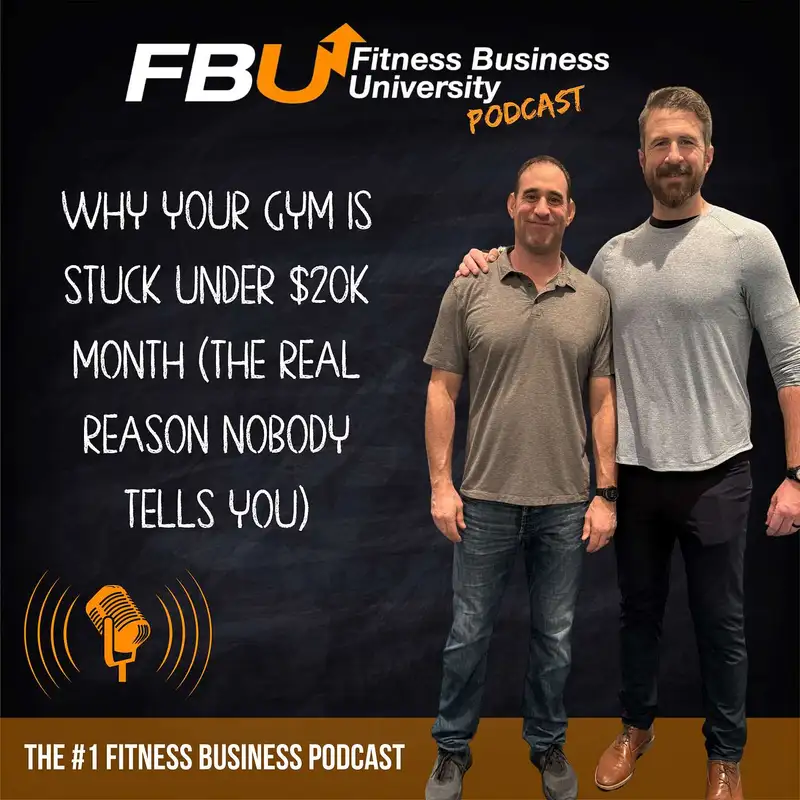
Why Your Gym Is Stuck Under $20K Month (The Real Reason Nobody Tells You)
SPEAKER_00: Welcome to the
Fitness Business University
Podcast.
This is episode 535.
You sure?
Episode 535.
Today we're going to be talking
about why your gym is stuck
under 20K a month and what to do
about it.
All right.
So we say episode 535.
By the way, I'm Tom Langton.
Who?
I'm here with I'm here with
Vince Gabriel.
All right.
So this is episode 535.
But it's really episode one of
like the relaunch of the
podcast.
SPEAKER_02: There definitely
should be an asterisk next to
that 535.
Wow.
The way we got that number is
very choppy.
It's close though.
It was close.
It was close.
SPEAKER_00: It was over 500
episodes.
For sure.
Okay.
Yeah.
And they've been all different
for I was on the first one ever.
I can I know that for sure.
I was on episode one.
Now I'm back.
And now I'm back about 400
episodes later.
I don't know how many we did
together, but I'm back.
Why did we stop?
COVID.
Right.
COVID, so we were doing them for
about three years.
Right.
And then COVID hit.
And then when COVID hit, we
stopped doing it and you started
doing them by yourself.
Right.
And that's when the ratings
plummeted.
Plummeted ratings.
So now we're back.
And now we're back.
SPEAKER_02: Broad in Leo for a
little bit.
SPEAKER_00: That was when it got
really bad at one point.
It got dark for a little bit
there.
But we're back.
So why why are what are we doing
here?
SPEAKER_02: Well, I it's funny.
I told the we had a CEO mash
amount a couple weeks ago, and I
spilled the beans on you're
back, right?
That we're doing this podcast
together.
And for those of you that don't
know, I just looked at the
camera.
For those of you that don't know
who Tom is, Tom worked for
Gabriel Fitness for 13 years,
was the very first employee of
Marlene Gabriel.
SPEAKER_00: Your mom was the
first.
Well, she was she never had a
W-2.
Okay.
I was the first that was
official.
SPEAKER_02: Okay.
You're the very first official
team member and you know worked
together for 13 years.
Yep.
And you know, the cool thing was
I told the CEO guys that, and
they were like, wow, that's
really, really cool that after
now 18 years, that you know,
we're still doing stuff together
and friends, and you you came
down and did an amazing job as
the MC for the Gym Pranos.
Absolutely.
Mastermind was super fun.
And you know, we got to go out
to dinner that night.
We had an O Lyman style.
That's right.
O-Lyman style.
We did a little bit.
We did a little bit.
We waited a little bit.
It was just you and me too.
Everyone else had left.
That's right.
It was just you and me, and we
had a great time, and then we
just basically started talking
about hey, let's you know, do
the podcast again.
And you know, we'll and you had
something big happen in your
life.
Well, you worked for us for 13
years.
Yep.
You moved on to some different
stuff, but then you found your
way into becoming a gym owner
yourself.
Yes, sir.
SPEAKER_00: Tell how was that?
It was great.
It was great.
I was a gym owner for about
three and a half, four years,
and got a great opportunity to
sell my stake in the gym and
kind of kind of step away from
that.
So I got the opportunity to be a
gym owner for a for a period of
time.
How'd you like it?
There were some really good
things and really just like
anybody else, really good
things, really bad things.
Yeah.
So it was great.
It was a good experience,
though.
Yeah.
Yeah.
SPEAKER_02: And now you're
retired, or you sold the gym and
you're retired to retired life
now.
You came in at you know, rolled
in at 10 o'clock with your chock
full of nuts coffee.
Right.
You know, life is good.
SPEAKER_00: If I'm retired now,
you've you've been retired,
you've been retired for about 15
years, if this is considered if
this is considered retirement.
SPEAKER_02: Oh man.
Well, anyway, it's awesome
you're back.
It's great to be.
I honestly do.
I and I say this all the time,
and and people like bust my
chops all the time when whenever
we would have like an
anniversary party, and I had to
like introduce all the different
staff members, and like, and I
always get to you, and I never
could hold it together.
I would always like cry and do
uh and uh it's just really very,
very grateful to be doing this
with you.
I consider you a very good
friend, but also you know your
shit.
You've been around for a long
time.
You've been doing this.
And the cool thing is like, you
know, for the listeners, like
you've been in leadership
positions here at this company.
Yep, you've owned a gym, you've
been a head coach for forever,
you are a vast knowledge of
training clients.
So it's like you've kind of
walked the path in multiple
ways.
So I think you're gonna, I'm
excited of your perspective.
Because I think the podcast, you
know, it's been me yakking into
the butt of my phone for the
last, you know, five years,
right?
And so I think what you're gonna
bring to these shows is one,
you're really good at asking
questions, right?
Two, you're somewhat funny.
A little bit.
I can be funny.
But two, you have like you kind
of come from different angles.
Like I, you know, you come from
an angle of a team member, you
come from an angle of a leader,
an owner.
So there's multiple things that
you you're gonna bring.
So I'm super excited to do this
with you, man.
Beautiful.
SPEAKER_00: Well, we're not
gonna talk about many more.
We're gonna that we're kind of
stuck here.
You were weird, you're weirded
out of it.
I I don't love to talk about it.
I would love to talk about it.
I don't love it.
You did not like it.
But let's let's get into why why
we're here.
All right.
So today's the title of today's
podcast is Why Your Gym is Stuck
Under 20K a month.
Now, there's I we talked about
this before we went live, before
we started recording, and I
said, Why is that why is that
the number?
Why is 20K the threshold?
SPEAKER_02: Yeah, and I'm gonna
lead in with the book I'm
writing right now, like to kind
of set the stage for this.
So I I wrote a really, really
small pamphlet of uh of a book
probably you know eight years
ago, right?
I think it was when I was with
R.
Yeah, yeah.
And it was called The Four
Stages of Fitness Business
Success.
And basically, certain, you
know, revenue levels cater to
businesses being in a certain
stage.
And there's four stages that I
kind of have mapped out, right?
And what we're talking about
today is stage one.
And stage one is anywhere when a
gym over is between zero and
twenty K.
And the problem with stage one,
the beauty and the problem at
the same time, is that it's you
know, you spend a lot of time,
you know, working for someone
else or kind of being a trainer
at a gym or stuff like that, and
now you've taken the first step
into owning something for
yourself.
And there's a lot of things you
don't know, and a lot of stress,
and a lot of pressure, and a
rent that you never had before,
and insurance that you had to
buy, and there's a lot of
uncertainties, you know,
throughout this whole stage.
And I think that I see a lot of
gym owners that stay in this
stage too long.
Everyone's got to go through it,
right?
Right?
I went through it, you went
through it.
Any business owner that started
a business has gone through this
stage.
So never, there's nothing wrong
with being in this stage.
The thing I want to talk about
today is staying there too long,
right?
And if you are stuck below 20K
and you're doing all the
sessions yourself, and you're
responsible for every new
customer, and you're responsible
for talking to the landlord when
he comes in, and you're
responsible for setting
everything up on mind body, and
you're responsible for watering
the plants, it's like everything
lives and dies with you.
And in the beginning, it's cool,
after a while, it's just too
much.
And I think that's the biggest
reason why I see a lot of people
fail is they just get burned
out.
SPEAKER_00: And they get burned
out in this stage.
SPEAKER_02: Yeah.
SPEAKER_00: Now, one thing to
hear I want to say though is
like for people listening to
this, if you are in stage one,
like you said, it's not a bad
thing.
Like, if when we we uh we're
like story, we love to tell
stories back in the day, and
everyone that's been around,
like most of the great stories
that we tell are from stage one,
pretty much the nostalgia of
like looking back, like even
though that was a hard time, but
that was also maybe like the
most we learned, we were
learning the most.
It was like the so like I don't
think it's a terrible thing to
be in stage one because it's
like a lot that's that's when
you're getting better when
you're that's like the rapid
growth, right?
SPEAKER_02: Right, yeah, and
again, the whole purpose of this
podcast is how do we not stay
there too long?
So I have this I have this
theory, and you know, poke holes
in it if you want.
Yeah, but I I I presented this
theory and I've totally made
this up myself.
No one has taught me this.
I'd never learned this anywhere,
but uh it's called the 1.33.
Okay.
And I believe that training a
session is takes 1.3 human
energy hours, okay?
Not one.
And so the example is if I'm
training 30 sessions a week,
it's not 30 hours of work.
Right.
It's 30 times 1.3, which ends up
being 39.
Okay.
Right?
Yeah.
So that's almost like now,
technically, in time, it's not,
it's still 30 hours, is 30
hours.
Right.
But even if you added, you do a
session, and after the session,
client hangs around and talks to
you for 20 minutes, right?
But you know this better than
anybody, there's a lot of energy
that goes into training a client
from a physical energy, from
emotional energy.
And I believe that when we
compound an owner being in stage
one, doing every session, and
say they're only doing 30
sessions, but that's 40
sessions.
Right.
And now I have to do all the
other stuff.
I'm working, you know.
I I had a guy in the other day,
and I'm gonna talk about him in
a second.
A guy in the other day, he's
like, I'm working 60 hours a
week.
He wasn't working 60, he was
really working 80 from a human
energy standpoint, and so that's
why I think like we we were you
and I both have done the grind
of being an employee and working
40 to 50 hours a week.
But that's all we were doing,
right?
We didn't have the stress and
the pressure of paying the
bills, of managing employees, of
doing all the other stuff.
And I think that that's where
this stage gets so hard on
people.
It gets so hard on people with
the compounding of the training,
because we're still doing all of
it, and then the compounding of
all the other business stuff
that one, we have to do.
If we don't do it, it bad things
are gonna happen.
But but two, we have no idea
what the hell we're doing.
SPEAKER_01: Right.
SPEAKER_02: Right?
And the right, like I had no
idea what the hell I was doing
in the very beginning.
And that adds a whole nother,
that uncertainty adds like a
whole nother layer of pressure
and stress and burnout.
And and and that's what we want
to get away from.
SPEAKER_00: Now, do you think
gym owners stay here because of
what you just said is because
they do what they're comfortable
doing?
Like the training is so
comfortable for them, and
they're experts at training, and
the other side of stuff, stuff
that we're gonna talk about in a
minute here, they know nothing
about.
So it's like this is what I'm
good at, and and but because uh
we've heard people talk about
like this is what I'm I'm
really, really good at training,
so this is what I want to do.
Yeah, but are they like are they
lying to themselves?
SPEAKER_02: So, did everything
tell you about that uh meeting I
had with Mike Boyle before I
opened my gym?
Yeah, yeah.
So I went to uh Ganis, I get
that wrong.
Aganis Arena, it was a Boston
University hockey facility, and
I basically sat with Boyle for
three hours before I opened my
gym.
And he told me so many things
that are like game-changing,
change me.
That meeting changed my life,
right?
Totally changed my life.
But he gave me one nugget of
advice, and it was read the
book, The E-Myth, Revisited,
right?
And the main premise of the book
is a business owner can have the
decision to work in their
business and on their business.
And if a business owner spends
all of their time working in
their business and no time
working on their business,
there's a good chance that
they're gonna go out of
business.
And so I think I was very, very
lucky in the very beginning to
have read that book before I
even opened my gym.
And actually, you know, the one
I read it was when Vanessa and I
moved from San Diego back to New
Jersey.
Yeah, we had a CD.
SPEAKER_00: You listened to it.
You listened to it on CDs.
You're showing your age, right?
SPEAKER_02: And we're so we're
driving back and I'm listening
to and I and I and I was very,
very grateful to Boyle that I
got it.
And I knew that it's like, all
right, and again, we we still
had the grind.
We still stayed in stage one for
a while, maybe a little longer
than we should, but I always
knew that hey, this is not gonna
work out well for me if I'm only
training sessions and I'm only I
gotta learn some things about
how to run a business and how to
run a company.
And I think that's that's what
some people don't do.
A lot of people, they they open
the business, they work in the
business, they do all the
sessions, they do all the
sessions, and they don't learn
the business skills that they
need to learn to break out of
stage one.
So that I think that's really
it's about skill sets.
SPEAKER_00: Okay.
It really is.
So let's talk about what are
those skills they need to learn.
So we brought you we broke it
down into three three big things
we're gonna talk about today of
like the the three key things.
Where if you're in this point
and you're and you feel that
that feeling of being stuck,
like where the hell do you
start?
Yeah.
Because I think you could talk,
like you listen to all these
different shows and all these
business experts, but really
you're telling me there's three
things someone can do to jump
out of this.
So what's what's the first
thing?
SPEAKER_02: And again, what I
want to direct this to also is
not like the person, I mean,
this will be very valuable to
someone just just starting out,
but I'm really kind of directing
this towards someone that's kind
of stuck, right?
Or like someone that you're at
like 9K or 10K or whatever
you're at, and you've kind of
been there for a while, and it's
kind of not moving.
Like you're gaining a couple
clients, you're losing a couple
clients, you're kind of stuck in
that rut.
And and the cool thing is, is
like we're recording this on a
Friday, right?
We have these things called SPF
meetups, where once every couple
months, a small group of SPF gym
owners come to the back room
here and we sit and we do mini
masterminds.
Okay.
Okay.
And there was a guy that came,
and I give each person like a
challenge to like present to me.
Like, and his challenge was I'm
at 13K.
All right, and I'm stuck at 13K,
and I've been stuck here for a
little while, and I don't know
what I'm doing, you know, to
break through.
And I was like, Well, what do
you think you need to do?
And he said, All right, well, if
I just get this, it's not like
horrible, like his churn rate's
not horrible, right?
But so overall, two two new
people every month.
Yeah, and he was in business for
about a year and a half, right?
And with that pace, he, if he
kept everything the same, with
that pace, he was gonna go from
50 to 75, so from 13k to 20k in
12 months.
If all just if everything stayed
the same, right.
Okay.
That's too long, Tom.
Too long.
That's too long.
Why?
Because he's already been at it
for 13.
He's telling me he was working
60, 70 hours a week.
Now we're gonna add another year
of that?
He's gonna kill him, he's gonna
he's gonna burn stuff out before
he's gonna go.
Because he's not gonna get to
20k in a month, he's gonna get
to 20k in 12 months.
Okay, so what's his financial
thing is not gonna change too
quickly.
SPEAKER_00: So what is a time
frame?
If if I'm a business, if I'm if
if if I'm watching this and I'm
just opening my business, or
like what is the what is the
what is a good time frame?
How long should you be in stage
one?
SPEAKER_02: I it it's totally,
it totally is, it's a hard
question to answer.
But I'm gonna go on a limb here
and I'm gonna say, get out of
there in 12 months.
12 months.
Yeah.
You know, and you know, I've
seen some people do it way
faster than that.
Okay.
But it's like after a year of
doing, I mean, you you know,
yeah, right?
After a year of doing it, it it
bur it breaks you down.
SPEAKER_00: Okay, so then so if
so that guy that you talked to,
how quickly can you get so
you're telling me it's gonna
take him a year to go from 50 to
75 at the pace he's going out?
At the pace he's going to be.
Keeping a positive flowing
positive flow of clients to a
month, right?
Yeah, but it's too long.
So how quickly can someone, if
you're let's say you've been
stuck there for a year or two
years, how quickly can we flip
it?
SPEAKER_02: So let me show you
what I did with him.
Okay, I'm pulling out my notes
to, you know, kind of I actually
wrote down and bullet pointed
exactly what I did with him.
So his name is Jacques, right?
And he he was at 13k and he
wanted to get to 20k.
He currently had 50 clients, and
he, as we said, he needed 75
clients to hit 20k, and we said
all that.
Okay.
Oops sorry.
Shit, I got a phone call.
So instead of doing that,
gaining four, losing two, we
addressed the price.
Which is the number one.
SPEAKER_00: The number one thing
we're talking about is price.
SPEAKER_02: The number one way
that you can get out of stage
one, get past 20K, is to change
your price.
Well, you're talking about to
accelerating it.
unknown: Correct.
SPEAKER_00: Because like he was
gonna get there.
SPEAKER_02: Right.
But not very quickly.
My plan that I created for him
gets him there in about a month.
SPEAKER_00: So instead of 12,
we're so we're cutting this down
big time.
Yeah.
So we're accelerating the
process.
SPEAKER_02: So the first
question is one, he was well
undercharging for what he was
doing.
And a couple things that told me
why he was undercharging.
One, he had almost a hundred
percent close rate, meaning
almost everybody was closing.
He had a consult, they would
close.
What if he was really consult?
What if he was really good at
sales?
What's that?
What if even if he's really good
at sales?
Yeah, but it doesn't matter.
It means that it's since
everybody is closing, the price
is too low.
SPEAKER_00: Right.
But do you think people get
caught in that illusion of like
I'm a great salesman?
And I'm gonna tell you he's not
a good salesperson.
He's been doing it a year.
Right.
That's but do you think people
get caught in that illusion of
like, I'm just really good at
sales, that's why my closer is.
SPEAKER_02: It's possible, but
I've yet to hear a gym owner
that's doing this for a year
say, I'm really, really good at
sales.
SPEAKER_00: Okay.
SPEAKER_02: Yeah.
SPEAKER_00: But he's closing.
He's closing at a too good of a
rate.
SPEAKER_02: Yeah, and and the
reason why he's closing is
because he's not getting many
people.
All of his clients are coming
from referral.
SPEAKER_01: Okay.
SPEAKER_02: Right?
All of his clients are coming
from you know, people like you
know, that he knew or something
like that.
He's not running ads on Meta or
anything like that.
Right?
If all of a sudden he tripled
the amount of leads that he was
getting, he wouldn't be he
wouldn't be closing everybody,
right?
But it just goes to show me that
when everybody is closing, we
should raise the price.
The other thing that told me was
he had a good retention rate.
Okay.
And so his retention rate was
solid.
So the product's good.
So the product is good.
Okay.
And so those are the two things
I look for in should you raise
price on either current members
or new members going forward?
Because if you all of a sudden
adjust price and you have a high
churn rate, yeah, that's just an
invitation for more people to
lose.
And if you're have a a poor
close rate, meaning you know,
you're closing like 30% of the
people that come in, you raising
the price is probably gonna make
that actually worse.
SPEAKER_00: The you always, and
and I've been working with you,
you know, coaching gym owners
for years, and you always say it
very nonchalantly.
And I've heard you say this to
so many gym owners, like, you
gotta raise your prices, you
gotta raise your prices.
And you're pretty this freaks
people out.
Yeah.
Probably more than anything
else.
This one and whether they should
fire somebody.
Are probably the two biggest
ones that freak people out.
Having that hard conversation
and raising your prices.
Yeah.
Like, how do you do it where
you're like, is there a way to
do it where you're not freaked
out?
How do you raise your price?
Because everyone's like, we're
gonna everyone's gonna be pissed
off, everybody's gonna leave.
Like all these fears creep into
your head.
SPEAKER_02: Yes.
So how do you do it?
So the first thing is there's
there's three things to do.
The first thing you do is you do
math.
What do you mean?
Math.
I asked him, what's the worst
case scenario?
Right?
How many people do you think?
It's funny, he had a staff
member with him, too.
Okay.
And actually, I asked them both.
And I said I had them write down
their number separately.
I was like, all right, you write
down how many people you think
if you raise your price, and the
proposal was to raise the price
by$40, which was about a 10%
increase.
SPEAKER_00: Now, is that roughly
is that roughly what you
suggest?
SPEAKER_02: Yeah, I think 10%
it's you know, anywhere from
five to twenty percent, twenty
percent on the high end, but you
know, we just raised our prices
at Gabriel Fitness, and it was a
12% price increase.
So it's kind of like in the
middle there.
Okay.
And that that was a substantial
one.
It was fit, it ended up being$50
per month.
Right.
So it's a big jump.
Big jump.
Yeah, a big jump, but very
successful.
So worst case scenario, you go
back, go back, you're like, so
basically I said, write down
your worst case scenario.
Meaning how many, what's the
most amount of people you're
gonna leave?
Correct.
Okay.
His number was five, her number
was three.
Okay.
And so I averaged it together
and I said, all right, we'll
take four.
Four.
And so worst case scenario was
you're gonna lose four people if
you raise your prices.
Okay.
Okay, we did the math.
And I took he had, I think, 50
clients.
So if he lost four, that would
take him to like 46, right?
And we did the math at the new
price raise.
Making more money.
He's already making a thousand
dollars more.
Making more money with less
people.
Right.
So the first way is you do math.
Right.
And you you put together, you
know, it's it's a hypothetical,
right?
But most people are pretty, you
know.
I think people are very way they
overestimate, you know, the
loss.
For sure.
Right, for sure.
Because that's our you know,
lizard brain kicking in.
SPEAKER_00: I think you I think
people imagine that one client.
We all have that one client who
bitches about everything.
Yeah.
And then you you think about
that conversation of like, oh
no, you gotta talk to Vince and
he's gonna he's gonna be so
pissed off.
And it's like, but this it's
gonna happen.
SPEAKER_02: The the the it is
always bigger in our own minds.
For sure.
Right?
It's so for me to tell him to
raise their price, it's so easy,
right?
Why?
Because I'm not emotionally
invested.
Right.
I don't I don't have to deal
with the client.
I just say, hey, on paper, this
is a smart business decision.
You deal with the rest of the
shit, okay?
But I'm not, I just know it's a
smart business decision.
SPEAKER_00: Now, as you as you
move through the stages, has it
gotten easier for you to raise
prices as you've come off the
floor?
Because you don't have to see
people every day, do you think?
Yeah.
Do you think it's because you're
you're less emotionally attached
to the clients here?
When was the last time you
trained a session?
Oh, years.
Okay.
So you haven't really been
faced, I mean obviously you see
the clients, but you're not as
emotionally invested in them.
So now for you to raise 12%, is
it kind of like, yeah, it's not
really a problem?
SPEAKER_02: I'll be honest with
you, it was it wasn't the
easiest thing in the world to
do.
Okay.
Um we we definitely did it
because you know, here's the
thing we had we had run this
company for a really long time
without a price raise, and it
didn't raise it during COVID and
anything like that.
So it was kind of like it wasn't
as hard, but it was still like
there's like stuff, even me that
does this for a living, even me,
there is a little bit of stuff
that's gonna be.
The demons creep up a little
bit.
Okay.
So that's the first thing is to
do math, is just to realize
that, hey, even if you lose a
bunch of people, you're probably
still gonna be ahead of the
game.
And that's a big fear in stage
one, Jim's.
I don't want to lose anybody,
right?
Because if I lose anybody, we're
gonna like go out of business.
That's the irrational fear in
stage one.
SPEAKER_00: So this but this
always goes back to I think this
is the one thing you say more
than anything else is like know
your numbers.
Yes.
Got to know your numbers.
This goes back to knowing your
numbers.
Yes.
How many people you have, how
much can you make in a month,
lifetime average, like all that
stuff.
You gotta know your numbers.
SPEAKER_02: Yeah.
I mean We had a a a client for
GFP for a long time, remember?
Peggy.
SPEAKER_01: Yeah.
SPEAKER_02: Yeah.
And so Peggy was she she you
know created this very, very
large consulting company, sold
it for a bunch of money, now
retired.
She's and she was our client for
a really long time at GFP.
She she I hired her to sit down
with me for a day to help me
with marketing.
Way back.
I mean, this is like a long time
ago.
And she started asking me all
these questions.
She's like, Well, what's your
lifetime customer value?
And I was like, uh, I don't
know.
She's like, well, what is your
cost per lead right now?
And I was like, I don't know.
And she's like, she stood up and
she goes, I'm sorry.
You know how her.
She's a very sweet lady.
Very late.
And she goes.
She looked at me dead in the
eyes.
She was like, I'm sorry, Vince.
I can't help you.
You don't know your numbers.
And legit, she canceled the
meeting.
That's all.
And she like got up.
I was like, that's a gangster
right there.
Like, that's like, she's like,
this little lady.
Yeah.
Right?
Little 50-year-old lady.
And well, she wasn't, she was a
little older than that at that
time, but amazing person.
And she taught me that is how
she.
I think that that's a good one.
Like, that's why I like to give
Jim Owens a little tough love.
Yeah.
Because that was harsh what she
did.
Yeah.
And it really spurred me into
action.
It really made me just be like,
oh, I got to get this shit
together.
So you're right.
100%, you gotta know your
numbers.
SPEAKER_00: Okay.
So do you do the math.
Okay, we're talking about
raising prices.
You pick your number, you do the
math.
We're gonna raise the price 10%.
Yeah.
SPEAKER_02: And the math, and
doing the math should make you
feel a little bit more confident
that even if you did lose some
people, that you're probably
gonna end up making more money.
SPEAKER_00: And that's worst
case scenario.
SPEAKER_02: Worst case scenario.
SPEAKER_00: Okay.
And most of the time that never
happens.
Okay, so now we've done the
we've done the math.
We know.
Worst case scenario, I piss off
10% of my customer base.
10% of people leave.
I'm still making more money.
SPEAKER_02: Yep.
What's the next step?
Second thing you do is you call
someone.
Do you ever remember Regis
Philbin, uh, what's the show?
Who wants to be a millionaire?
Yeah.
The member of the thing, foreign
friend.
Yeah.
Right.
You call someone that's done
this before.
And so now I bring guys in for
consulting days all the time.
Almost every consulting day, I
have them raise their price.
And almost every consulting day,
they fight me on it.
They're like, I don't know if I
can do it.
I don't want to do it.
And we have a we have a guy in
SPF named Marty Mutt M Marty.
Yeah.
Right.
And so Marty was one of those
guys that promised his customers
that he would never ever raise
their prices.
And I got him to raise his
prices.
He was petrified beyond
petrified.
And I was like, dude, we we
yeah, we did we promised that
how many years ago?
Right.
And we went through a global
pandemic, and most of the people
that he promised it aren't even
there anymore.
And so, but he had it in his
mind that he couldn't, and he
did it, and it was massively
successful.
Right?
I think he lost like one person.
Right.
And so I I have Reverend call
Marty.
And I just have Marty on the I
have Marty on the Marty on the
speed dial.
And I just be like, all right,
call Marty.
And Marty picks up, and Marty's
like, yep, yeah, we did it, and
everything was great.
And they they talk to Marty, and
I'm telling them, and they're
like fighting me on it, and they
talk to Marty, and they're like,
All right, I'll do it.
Right?
Because he did it.
Third party third party
endorsement.
When I show them what I did at
Gabriel Fitness, it's also very
helpful as well.
So, right, because I did it.
But that's the second thing, is
talk to someone's other.
Yeah, talk to someone that's up.
The third one is read through
all of your Google reviews and
testimonials.
And remember that you deserve
this.
You deserve to make more money.
Right.
You're changing people's lives.
People's lives are better
because you're in it, people's
lives are changed.
People are alive because of the
job that you're doing.
Is that not worth$3 more a
session?
And so I think one of the other
pieces is they have to kind of
get grips with that they deserve
it.
For sure.
That you deserve to make more
money because if you continue to
grind and in you, if you
continue to be in this place,
that is not good for you.
That is not good for your staff,
and that is not good for your
clients if you are not
successful financially.
SPEAKER_00: I I think that the
majority of people members don't
even notice.
Because like you think about
like we drink, we have coffee
here, like we I drink Starbucks
every day.
And in the time I've drank
Starbucks for the last 20 years,
they've probably raised the
price 30 times.
SPEAKER_02: It is ridiculous.
SPEAKER_00: It's ridiculous.
For like a it's like$7 for now,
this is a chop loan.
But I stopped at a gas station,
I stopped at a gas station.
There's a gas station call.
But still, like I've never
noticed what the price, what the
price, but I know that's like
that's part of my day.
I need a cup of coffee.
People, once you're once you're
part of their life, it's like
prices are going up and then
they may have a comment, but
it's like, okay, whatever,
whatever.
SPEAKER_02: And that's why I go
back to the retention being like
I I do believe that you gotta
earn this.
I do believe that.
I don't just tell everyone to
raise their prices.
I look at those two metrics.
You gotta have a price.
And I look at that and I and I
just say, You you have to earn
this.
You have to be providing a good
value, providing a good service.
Is the soup good?
Exactly.
Yeah, soup good.
SPEAKER_00: Okay.
So now we've so is that is that
all you gotta do?
You check your numbers?
SPEAKER_02: Well, we did two
things.
So we raised price on current
members.
Okay.
Right?
So that that got us, uh we
raised for him, we raised price
about$40 a month, which equated
to I can't remember how much it
was uh from a math standpoint.
SPEAKER_00: You said it was
about a 10% increase?
SPEAKER_02: Yeah, it was a 10%,
it was about$40 a month per
person.
Okay.
Okay, and then the second thing
we did was we took his regular
prices, okay, the current prices
that he was offering new people,
and we raised those by$40 as
well.
SPEAKER_00: Okay.
SPEAKER_02: Right?
So I think he was charging, you
know,$280 or something.
We brought that to$320 or
something like that.
Right.
So now we have a double whammy
where, hey, all of our we get we
get the hit right away from the
current members.
From the current members, but
now every new per people, every
sorry, every new person that we
add is another$40 higher than
what we were getting before.
And when we did the math, he
needed to go from, and I
actually kept it in there, 46.
So he lost four, right?
Right?
He needed to go from 46 to 56 to
get to 20k.
SPEAKER_00: So it wasn't 75
anymore.
SPEAKER_02: Nope.
So it's left.
Yeah.
So now all he needs to do is get
10 new clients.
We can do something quick and
get 10 new clients right away.
We're accelerating the process.
So we literally can get there in
a month.
Okay.
Whereas before he was gonna get
there in a year.
Okay.
And that gets you out of stage
one.
That move right there, 46 to 56,
with adjusting the price and
changing the price, that gets
you past it.
And what does that do?
That gives you money.
What do you need to get and do
it to get out of stage one?
You gotta get everything off
your back.
unknown: Right.
SPEAKER_02: You can hire people.
Yeah, you can hire someone, you
can invest more in marketing, so
you're not doing everything
yourself.
You can hire an admin, you can
do you when you're strapped for
cash, it's like you gotta do
everything yourself.
When you have money, you can
start to delegate things, you
can start to outsource things,
you can start to get everything
off your back.
And that's the goal out of
getting stage one.
All right.
Anything else on pricing?
I think that's that's all I kind
of had for that for pricing.
So number one, you're stuck in
stage one.
Do you remember?
Oh, and and and and you know,
here's the here's how you raise
prices on new members going
forward.
You ready for this?
Yeah.
Open Microsoft Word.
You go to your price sheet,
change the numbers, change the
numbers, you click save, right,
and then you click print.
And then at the next sales
consultation, you present the
new prices.
SPEAKER_00: That's it.
SPEAKER_02: Simple as that, big
time.
SPEAKER_00: Simple as that.
Is there is there the uh uh a
simple process to raise for
current numbers?
SPEAKER_02: Yeah, so that is a
very, very important process.
It's a little more delicate.
It's it's yeah, and I I I
honestly I don't think we have
the time to get into it today,
but it's 100%.
You I had a Jimmer a long time
ago, and he he said, due to
inflation, we'll be raising our
prices.
unknown: Yeah, I know.
SPEAKER_02: That's pretty bad.
Yeah, yeah, real bad.
And there is an art to it, and
actually, Joe Hashey, Joe
Hashey, who's the head business
coach at SPF, he raised his
prices after COVID and raised
them on 800 members and did not
lose a single person.
And I looked at his price
letter, price raise letter, and
I looked at his video that he
did to his cons, and I was like,
that is the most textbook way to
execute a price raise I've ever
seen.
Right.
So what I did is I asked Joe to
create a guide to raising prices
based on his successful price
increase.
Yeah.
And there's a template for a
letter and stuff like that.
So we've created that as a
resource, SPF mastermind.
SPEAKER_00: So the so there
isn't there is an art to this.
Oh, yeah, 100%.
So for new members, it's easy.
Change the number.
Yeah, yeah.
For current members, you don't
just you don't change it and
fill them and don't tell them
anything.
You gotta do that.
SPEAKER_02: And I will tell you,
well, the big thing you need to
do is you do have to say what
value you're you're bringing to
for the justification of raising
your prices.
Okay.
Right?
You do you don't want to just
say, we're raising our prices
because I want to make more
money or because of inflation.
You should, there's a great book
by Joel Polish, what's in it for
them.
When someone reads a price
increase letter, what do I get
out of it?
What do I get out of this?
And that's the angle from the
letter.
SPEAKER_00: So there is an art
to that.
So don't you don't just jump it
up, don't just bill everybody.
SPEAKER_02: I would I I would
100% if you are a rookie at
this, get some advice on how to
raise your price and how to
communicate that.
That's that does matter.
SPEAKER_00: Okay.
So step one getting out of stage
one, raise your prices.
SPEAKER_02: Yes.
Stage step two.
Okay.
So kind of we can stay with this
same case of this guy John,
right?
Yep.
All right, what is now so now we
got this open road where like,
hey, we go from if I go from 46
to 56, I go from 13K to 20K,
like almost overnight.
SPEAKER_00: So how do I get
those 10 people as quick as
possible?
SPEAKER_02: Yeah.
And so I think the big thing is
in stage one, with the mistake
people make that keeps people
stuck in stage one is they spend
their time that they're not
training clients on the wrong
things.
Okay.
I was notorious at this.
You saw it.
Yeah.
Okay.
So I said the book, The Emyth,
before, right?
Yeah.
And there was a lot of good
things, but there's also some
misleading things.
In the book you said.
In the book, yeah.
Okay.
And so I think that when I read
the book, I thought that I
needed to create these large
binders of systems for how to do
everything.
I spent hours and hours and
hours on these binders of
systems.
And I was like, it was just you
and me.
Yeah.
Like we just talked every day.
We had a big communication.
We had a big training.
Yeah, and it's just like it was
not necessary.
And there was a lot of things
that I did in stage one that
were me not having clarity on
what I needed to be doing at the
time.
And so I just filled time with
what whatever, right?
And the big shift that gym
owners in stage one need to do
is they need to block time to
get new customers.
That is the critical there's a
there's a great book called, I'm
mentioning a lot of books today.
Yeah, it's good.
SPEAKER_00: There's a little
reading list.
SPEAKER_02: Yeah.
But and and and I don't think
everyone should go read every
book that I recommend, but this
is just sometimes there's like
little chunks.
And this actually, this piece of
advice came from the book Ready
Fire Aim, which only read if
you're in a especially in stage
one, do not read anything beyond
the first chapter.
Okay, because it kind of talks
about this.
It's like the number one
priority in stage one when
you're just starting out, is to
get to a critical mass of
customers.
Right.
And so if we don't grow the
business and we don't get more
customers, we're not going to
get out of this because we're
not going to have the money to
do anything.
So it's kind of like what I was
saying before.
So that needs to be the focus.
So this guy, John, now that we
changed the price, now his focus
of time needs to be all right,
where are my next customers
coming from?
And so the first thing they need
to do is put it on the calendar
like an appointment.
SPEAKER_00: Put the time that
they're spending on sales and
marketing.
SPEAKER_02: I believe that
sometimes it's not a lack of
knowledge.
I think it's sometimes they're
just not spending enough time on
it.
SPEAKER_00: So you put it on
your calendar and say, I'm
training, let's say I'm training
from 6 a.m.
to 9 a.m.
Yep.
From 10 a.m.
to 12, sales and marketing.
Sales and marketing.
Now, how much of that time is
dedicated to studying?
Because you've given us all the
books.
None.
You study at night, dude.
Okay, so this is working.
This is not, this is not
listening to podcasts.
This is not reading books.
What are you doing?
That's fake work.
So what are you doing?
SPEAKER_02: So you're reaching.
So let's say someone, I I think
this is a really good thing for
someone to do in stage one.
Hopefully they're doing
something on social, right?
They're posting the client, you
know, videos of the clients and
stuff like that.
This is a good one for people to
write down listening to this.
If you have more conversations
with people that are prospects
at your gym, you'll make more
money.
Whether those conversations are
on the phone or in person,
whether those conversations are
on text message, whether those
conversations are engaging
someone that engaged with you on
social, if you talk to more
people, you'll make more money.
And so that's really the
emphasis of in stage one and
this time block is like have
conversations with people.
Create things that create those
conversations.
So an example would be sending
out an email, and at the end of
the email, there's some of a
call to action to reply to the
email to get more information,
and you they reply, and you have
a conversation with them back
and forth.
That's moving the needle.
Okay.
When we talk to more people,
we'll make more money.
And I don't think people are
blocking enough time to do that.
So that's that's the first thing
is legit.
Hey, these are the activities
that I know are going to help
get me more customers.
I need to now just make sure
that I'm spending time every day
on that stuff.
I I think a minimum in stage one
is one hour a day.
One hour a day where you're
focused on sales and marketing
activity.
And ideally it's two.
SPEAKER_00: And when you're it's
I think that's the big, the big
like holdup there is people are
thinking, I I don't know
anything about marketing sales.
Most new gym owners are like,
I'm not good at marketing, I'm
not good at sales.
So they're not, you're not
learning about it, you're not
going, you're you're doing,
you're reaching out to people.
So what if what if someone comes
in and they don't know what
they're doing?
Just start reading emails?
What's the what what how do how
do you attack that?
SPEAKER_02: Yeah, well, I mean,
I too, I think with AI these
days, too, it's so much easier
than it used to be.
You do not need to be a
marketing expert.
You can go into Claude and you
can say, Claude, write me an
email that is, you know, for a
40-year-old person that's gonna
help them get, you know, and so
so I think there's no excuse
these days, right?
There we don't need to be a
great marketer.
You need to be able to plug
something into AI.
And again, you want it, you you
you do want to learn the skills,
right?
You do want to learn, you don't
want to just have AI brain where
you're just really which is
happening big time.
For sure.
It's crazy what's happening,
right?
SPEAKER_00: Even on City writing
emails for you and stuff.
SPEAKER_02: Yeah, you just know
people aren't using their own
damn brains.
It's bad.
It's really bad.
SPEAKER_00: Joint venture is a
good use of time during this
time, going out and reaching
other positions.
SPEAKER_02: You're right, that's
a good one.
Like you don't need to be an
expert marketer to walk down the
street, walk into the salon,
introduce yourself, and say,
hey, I'd like to give out a
couple free memberships to your
salon people.
Right.
That doesn't take any marketing
skill to do that, right?
And so community stuff is is is
really, really uh important.
I will say this.
A lot of people ask about like
running ads in stage one, and
like should you take ads out on
Facebook?
And I'm not here to tell you you
should or you shouldn't, but I
will say this an investment in a
really good website is a game
changer.
Okay, and here's why.
One, ask someone that markets on
Facebook and someone that
markets with a website, and ask
them which people are more
likely to show up to their
consultation and more likely to
buy.
It's website all day long.
Why?
High intent.
Someone's searching for
specifically.
Or they're going to your website
and they're filling out a form.
Okay?
So the the volume is low, the
intent is high, which means it
takes us less time.
And in stage one, we don't have
a lot of time.
Versus if you spend$3,000 a
month on Facebook and you're
getting 150 leads a month, now
all of your time is spent having
to field all of those leads,
right?
And I'm not saying that's wrong,
but I'm saying a lot of times if
you're training every session,
that can overwhelm the hell out
of you and cause even more
stress.
So that's why I love investing
in a really, really good website
in the very beginning.
Like if I'm gonna spend any
money on marketing, hey, you can
probably get a really good
website.
Go to my friends over at GMM,
GMM Machine.
Like they'll build you a really
good website and not charge a
ton of money for what you're
gonna get out of it.
And this is this is not stage
one.
We can talk about it quickly,
sidebar, but understanding
lifetime customer value is
really important, right?
And the the way that you know
the basics of lifetime customer
value is basically what is a
customer worth over the lifetime
of your business.
And if you can start thinking
about the things that you do to
get a new customer with not
getting someone that pays you
200 bucks a month, but someone
that pays you$10,000 over their
lifetime, it makes you shift the
way you think about it.
So that website that costs$300,
and you're like, oh my God.
But if that website that costs
$300 a month generates two
clients a month, it's$20, it's
$20,000.
Yeah, if you're right, and so so
just for those listening at
home, the way you get the number
is you you take the average
value of what someone pays you,
right?
And basically what you would do
is you would take the your total
revenue and you divide it by the
number of customers you have.
So let's say you're doing$10,000
a month and you have 100
customers, it's a hundred,
everyone pays your average is a
hundred bucks.
Right.
Right?
You would take that number and
you would divide it by the churn
rate.
Okay.
And so it's like if 100, you
divide that by 0.03.
That gets you somewhat of an
accurate number of lifetime
customer value.
Okay.
Right.
And so, but but the point in
saying that is, and I don't
think anyone needs to do much
with it.
It's just the knowledge base of
knowing that, hey, it's worth it
to invest in that website.
It's worth it to go down the
street and shake the hand of the
salon owner, it's worth it to
ask my customer for referrals
because I'm getting$10,000 bills
and not getting$200 a month
clients.
Gotcha.
Gotcha.
SPEAKER_00: All right.
So what else, what else during
that marketing and stuff?
SPEAKER_02: And I think I think
community, I think you nailed it
with community that.
And then the last one would be
referrals.
And this is referrals are a
slippery slope here because I
think sometimes people expect
too much from referral.
There's most stage one gym
owners don't have a lot of
customers.
Right.
Right?
This guy only had 50 customers.
Can I expect 10 referrals a
month from 50 customers?
No way.
That's way too many because not
every customer is going to
refer.
If you get 20% of your customers
to send you one referral every
year, you're doing that's pretty
good.
Right.
So when we have a low number of
clients, I think sometimes
people expect too much from
referral generation.
Even if you're doing a good job
of like doing things like
bring-a-friend days and referral
contests and stuff like that,
you ideally should be doing
stuff to get referrals.
But I think you also got to
manage your expectations.
It doesn't mean that you don't
ask.
You should ask.
I would give every new customer
that signs up a free one-month
membership, like we call it the
point-of-sale referral.
You remember that we used to do
all the time with black metal
cards.
Right.
Yeah, we still do that.
So having a few different
strategies to generate referrals
is very, very helpful because
referrals don't really cost you
much money.
But understanding and managing,
that's probably not the only
thing that you can do, is just
sit around and wait for
referrals, especially if you
have a low number of customers.
SPEAKER_00: But referrals, you
got to be active in searching
for referrals.
I think that's a lot of people
expect, like, oh, we have a
really good product.
Why is no one sending their
friends?
So is there a way, is there the
what are what are the best ways
to kind of drive referrals?
Is it is it bring your friend
day?
Is that the Yeah, that's a good
one.
SPEAKER_02: Yeah, I like bring
your friend day.
That that's a really powerful
one.
We have a whole playbook on
that.
But the the second way is the
point of sale, which I just
talked about every time you sign
your customer.
But the third one, I call it the
referral habit loop.
And that is essentially anytime
someone says something to you
like, hey, I really love it
here, or I've lost a bunch of
weight, or I'm feeling great.
I love it.
I'm training with so you almost
have to have that on the on the
on the top of your mind.
Because I believe that everyone
listening to this in stage one,
especially if they're doing all
the work, they're probably
having that happen to them once
a day.
SPEAKER_00: For sure.
SPEAKER_02: You should be.
SPEAKER_00: Yeah.
SPEAKER_02: Now, that does lead
into a very important point,
Tom.
You gotta, you gotta, you gotta
have a product good enough that
you are makes you referable.
You gotta be referable.
It kind of goes back to saying,
you know, we're saying, should
you raise your price?
Yeah.
Only if the product is good.
I mean, you're the master at
this, right?
You're the master, and and
that's why you you you made
Gabriel Finch great by how good
you were on the floor.
We were putting out a product
that was superior to anyone
else.
Not no one was even close to us.
And then all of a sudden we
birthed all of our competitors.
We did, right?
We literally trained people that
now like they were interns of
ours, they came to our
mentorships, and now they're
opening up gyms all around here.
But we birthed that and they
came in and watched, and again,
they're doing great, right?
There's guys that are really
talented business owners that
I'm happy for, and I like to see
them successful, but they came
in and watched what we did.
For sure.
They came in and watched how we
trained people, and that was
like our thing.
Like we were big on well before
we knew anything about marketing
and sales.
Having a really good product.
We just have a really good
product.
And that drove a lot of it.
And so I think a lot of people
can get I I don't I don't want
to say, and I didn't want this
to be one of the things, because
I don't want to like say you
suck and you're not good at what
you do, that's why you're stuck
in stage one.
I don't believe that to be true.
Okay?
But I do believe if they got
better, I do believe that they
provided a better product, that
they would probably get out of
stage one a little faster.
So if you're stuck, yes, do
these things, but realize that
hey, the better the food tastes
at the restaurant, the more
people are gonna come back.
SPEAKER_00: Right.
I think that's a total separate
episode of that.
Yeah, the suit's got me, yeah.
All right, so we got we have two
of the three we talked about.
We talked about pricing.
Yeah.
We talked about blocking time
and of having specific time to
get new people in the door.
Like that is that is all you're
doing during that time.
SPEAKER_02: Yeah.
There's one more.
Yeah.
And again, this one is kind of
really related to the other two.
And it's really, you just can't
get burned out.
And that's the whole point of
this whole episode is that the
longer we stay there, the more
likely are we are to get burned
out.
Right.
And so I kind of hinted on a lot
of this in the very beginning of
like, hey, the pressure is real.
Like the you now have a lease
that you signed, you now have
people that are depending on
you.
You you it's like a lot, right?
And you got to be able to kind
of handle that, you know,
pressure.
And the the biggest thing that
burns us out is the grind,
right?
It's the grind over the long
haul.
And I mean, you know, the funny,
the funny story is, you know, we
were, you know, showing up at 5
a.m.
every morning and leaving at
nine uh o'clock at night, and
you know, there was one time you
you were never late, right?
There you were never ever late.
But there was one time, you
remember the story?
SPEAKER_00: When your car got
stolen?
Yeah, yeah.
Of course.
Tell the story, right?
That's funny.
I got into a car accident during
a lunch break.
Right.
So I was driving an old Jeep
that got crushed during a lunch
break, and I was working to 6
a.m.
the next day, and I had no way
to get up.
I was living in Hoboken at the
time.
So you're like 20 minutes away.
20 minutes away, half an hour
away.
You loaned me your truck because
you wanted to sleep in.
So I was working this, I was
working the early shift the next
day.
Right.
So I took your truck back to
Hoboken, parked it in front of
my apartment, and I came out at
4 a.m., 5 a.m., whatever it was,
and the truck was gone.
And I thought it had gotten
stolen.
And I was freaking out.
And I went to the police station
and they towed it because you
had California police.
California, you never you had
been in Jersey for it was
probably two or three years at
that point, and you never got it
registered in New Jersey.
So they towed, they towed the
truck, and you ended up having
to get up anyway and go train.
Because I had no way, I had no
way of getting back to the gym.
Oh my god.
But that was the only time I was
that was the only time I was
ever late.
That's so funny.
But that just shows like we were
at that point, we were we
weren't working a lot.
And it was like it was a lot.
It was a lot.
So is there is there is there
stuff?
Okay, so let's say someone is in
that, like it's still gonna take
some time, right?
It's gonna it's gonna take some
time.
So even this guy that we're
talking about, John, right?
Let's say let's say you have a
three or four month plan to get
him to where he needs to be, to
the uh to stage two.
Yeah, what are things that a
business owner can do to
minimize, to mitigate that
burnout?
Is there stuff you can do?
Because they're like there
that's gonna happen, right?
There's at some point,
especially in this business,
you're getting up at 5 a.m.,
you're working split days, you
have to go, like you said, you
have to go through stage one.
Yeah.
So what are habits or things
that gym owners can do to
mitigate this a little bit?
SPEAKER_02: Yep.
So I think it it it it it's very
much related to number two, in
that you read the book, Jocko's
book.
Stream ownership.
Yeah.
Yeah.
Uh one of the the one of the
main principles of the book is
prioritize and execute.
Right.
Right.
And so I think one of the things
that can prevent burnout is
eliminating certain things for
uh in in place of other things.
Right.
And so if I eliminate four hours
a day of bullshit work and, you
know, me building system manuals
and me doing stuff that didn't
matter, and I stopped doing all
of that and replaced it with the
things that actually worked.
Right.
Right.
So I think that that one of the
ways to get out of burnout is to
identify the critical drivers of
the business.
What are the things that are
gonna get me past 20K and out of
stage one?
Addressing price, spending time
on marketing, improving the
product.
Like those are all the things
that are gonna move the needle.
And and and be okay not doing a
lot of other things.
Be okay just saying that's what
I'm gonna do.
Okay, so that's the first thing
is prioritizing what's most
important and only doing that.
And we just did and we just did
what we're we just gave you what
to do.
Okay.
Yeah, we just gave you what to
do.
The second thing is you do gotta
you manage your health and take
care of it, you know, and you
gotta sleep and you gotta work
out and you gotta kind of find
the time.
And maybe you're not like
working out for two hours a day.
Right.
Right.
Maybe you're getting 30 minutes
in or whatever, I don't know,
right?
But you gotta do prioritize that
because there's probably some
people that get burned out, and
then the the stress of the
business causes them to do
things like drinking alcohol and
you know, you know, picking up
bad habits, right?
Sleep's a huge sleep's a huge
one in this business of getting
up early and working like and
maybe you gotta take naps.
Like maybe there's I mean, you
you you're the king of you're
the king of like you can like on
a dime just like lay your head
on a foam roll.
Or like there was times where
you would sit in that black
room, we had that like little
padded room, head on a foam
roll, you'd be out in like two
seconds.
SPEAKER_00: Take a little nap in
the middle of the day.
Yeah, but if you're working
split days and you want to have
energy, you want to have energy
for the afternoon, you almost I
almost had thought I had to do
it.
SPEAKER_02: Yeah, yeah.
Um, so I think that's that so
it's first is prioritize and
execute, find the critical drug.
Seconds, just you know, seconds,
take care of your health, you
know, make sure you're you're
managing it.
And third is like get out of it
as fast as you can.
Yeah, like get help.
Plan it.
You've got to be able to get
help.
And you know, the cool thing is
too, is that with AI and all
these other things, it's
probably a little easier because
you have a little bit of almost
like an assistant with AI to be
able to do things that normally
would take you a lot longer.
So it's getting to the point
where you have enough money that
you can get some help and then
leveraging the things around
you, whether that's creating you
know simple systems, whether
that's using AI.
So I think people have a much
better chance right now to not
stay in stage one longer based
on what's happening today.
So that that that's really the
third one is really just hey,
don't get burned out.
If you get burned out, it gets
hard to recover from that.
SPEAKER_00: But I I I think one
thing you can do here is get
clarity, like have a plan.
I think the guy John who came in
here, he sat down and all of a
sudden when you map it out for
them and give them the clarity
of like, okay, I can do this for
three more months if we follow
this plan.
Right.
Right.
So that's how we're we're gonna
wrap up today is say if you want
help with that, yep.
There's a like you guys, the SPF
helps with that.
SPEAKER_02: Yep.
So we have a clarity call.
Yeah, we we have this thing that
you know with with the four
stages, and the four stages is
kind of like our thing.
We created it, we invented it.
And one of the calls we do on
the clarity call is one
identifying what stage they're
in, right?
And we have them take a quiz.
So once you opt in for the call,
you're sent a quiz.
And the quiz takes like three
minutes, right?
And it just answers and it'll
tell us exactly what stage
you're in, right?
And so from there, we know when
someone's in a certain stage,
what are the things they need to
be doing?
And that's really what we do in
the call.
Is like, all right, you are
here.
These are the things that you
get you from here to here, these
are the critical tasks that you
need to be doing on a daily
basis.
Here's your list of things to
do.
And all of a sudden the clarity
is just like, holy shit.
Right.
Like, this is it.
This is what I need to do.
And that's like most people are
like, just tell me what to do.
Like your clients are like that.
Just I want to show up.
Tell me how what do I do?
Bulgarians, how many?
So eight.
Okay, perfect.
How many sets?
Four.
Okay, perfect, I'm done.
All right.
And that's clarity, and that's
giving people certainty.
And that's what we want to help
these gym owners that are stuck
on our 20K.
And again, you can opt in for
the call if you're not if you're
past 20K, because if you're at
40K and you're stuck, it'll get
you past.
SPEAKER_00: There's a but
there's plans.
There's a plan in for each stage
to get you to the next stage.
There's a plan.
100%.
So if if someone wants to jump
on this clarity call, there's a
there's a link in the show
notes.
SPEAKER_02: Yeah, link in the
show notes.
Just click that, fill out the
form, and then make sure you
fill out the quiz.
We will cancel the call if they
don't do the quiz.
unknown: Okay.
SPEAKER_02: Because the quiz.
SPEAKER_00: This is Peggy
Mattel.
SPEAKER_02: Yeah.
SPEAKER_00: This is I I can't
help you if I don't know what
the hell's going on.
SPEAKER_02: Correct.
Yeah.
Yeah.
And so if they don't do the
quiz, we cancel the call.
The quiz takes two minutes.
And it gives us the val the
value.
So we're showing up to the call
like, all right, this is a stage
two guy.
They've been in stage two for X
amount of years or whatever.
We can get our heads around what
best advice we can give them to
help break through the next
level.
SPEAKER_00: Beautiful.
So click the link in the show
notes.
Sign up for the clarity call.
Yep.
No matter what stage of the
business you're in.
Yep.
Anything else?
I think that's it.
That's it.
Thanks.
Hey, good to be back.
What did you think?
Good to be back.
I thought it was smooth.
Good to be back.
Let the people let the people
tell us what they thought about
the work and stuff.
Leave a com leave a comment.
Let us know how we did.
Good to see you, buddy.
Good to see you, brother.